
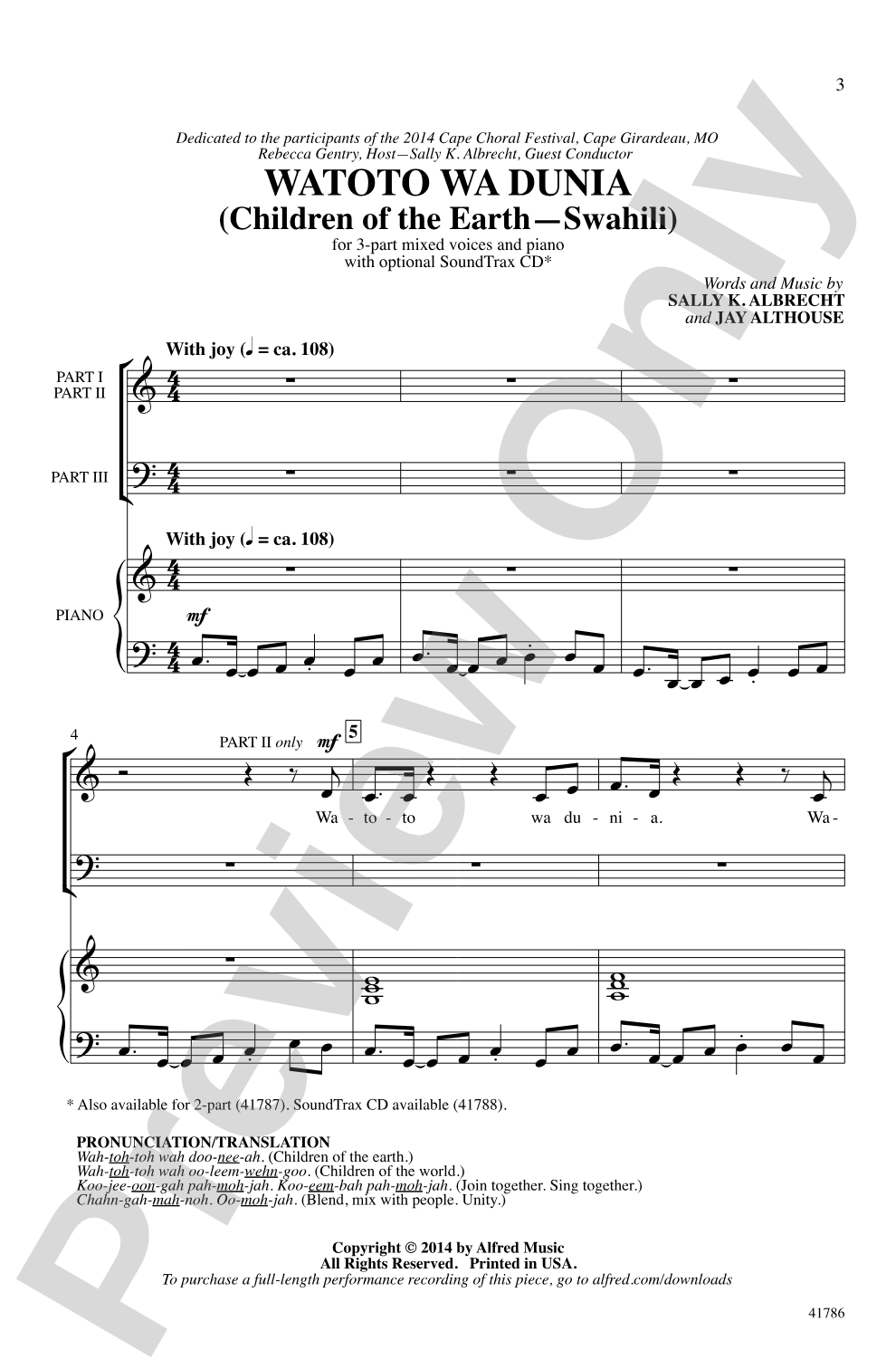
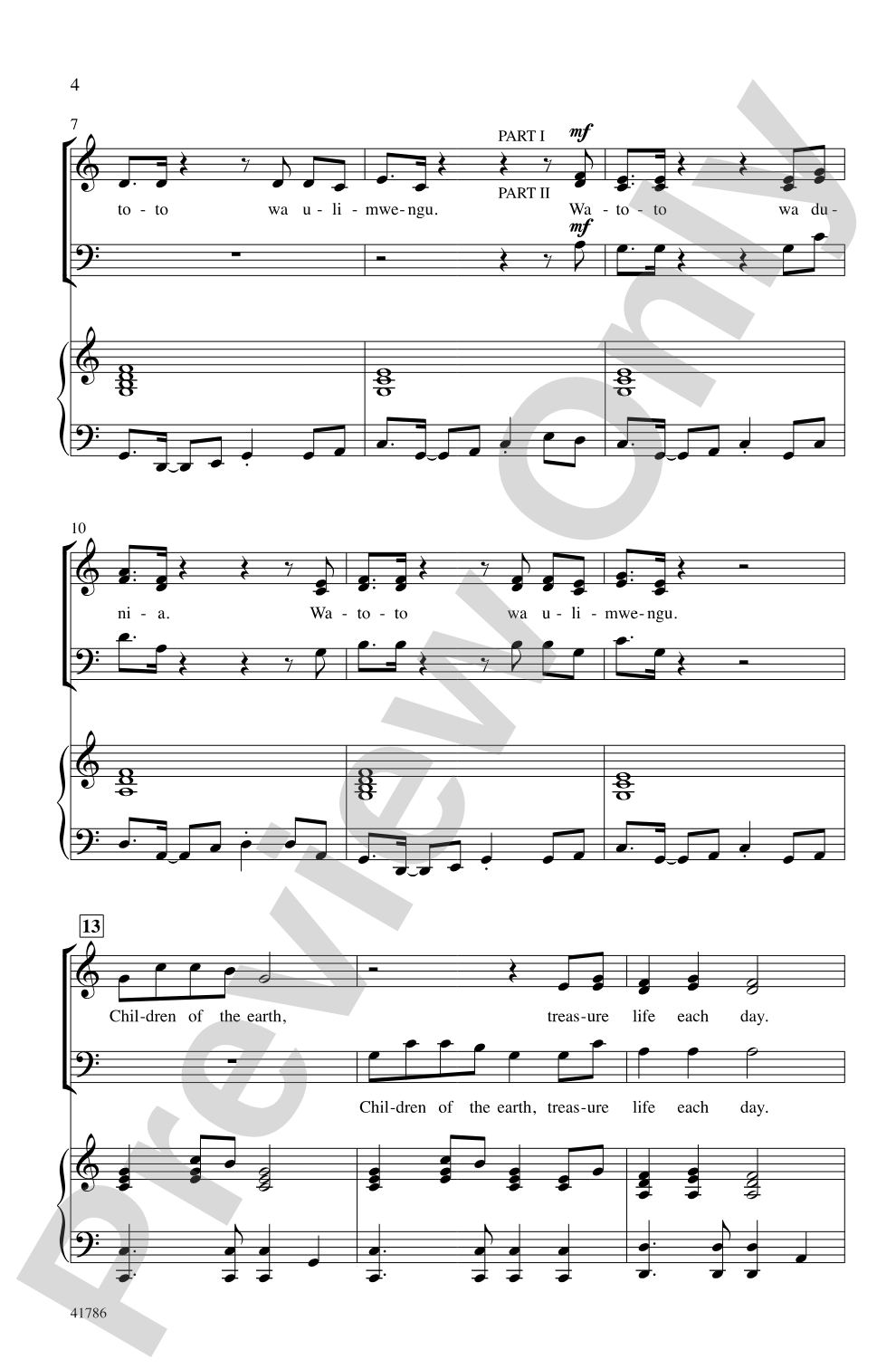

Watoto Wa Dunia (Children of the Earth -- Swahili): 3-Part Mixed Choral Octavo
(Children of the Earth -- Swahili)
Words and music by Sally K. Albrecht and Jay Althouse
Item: 00-PO-0001906
$1.85
Minimum order quantity: 20 copies
Pickup currently not available
Related Items
Watoto Wa Dunia: SoundTrax Digital Audio Download |
$27.99
|
View | |
Watoto Wa Dunia (Children of the Earth -- Swahili): 2-Part Choral Octavo |
$1.85
|
View | |
Watoto Wa Dunia: 3-Part Mixed Choral Octavo |
$1.85
|
View | |
Watoto Wa Dunia: 2-Part Choral Octavo |
$1.85
|
View | |
Watoto Wa Dunia: Choral Octavo SoundTrax CD |
$27.99
|
View |
Description
This fun feature for 2- and 3-part choirs includes Swahili and English lyrics, rhythmic chanting, accented body percussion, and many call and response phrases. Layered African instruments energize the SoundTrax CD and Sally's easy-to-teach choreography (available on Lights!) is spot on.


Watoto Wa Dunia (Children of the Earth -- Swahili): 3-Part Mixed Choral Octavo isn't in MakeMusic Cloud just yet...but it could be. Let us know you'd like to see it, and you'll help shape what comes next. In the meantime, start a free trial and dive into thousands of interactive titles your students can play along with today.
Request This Title
Tell us you want it.
Start Your Free Trial
Explore everything that's ready to play right now.
Sample Audio
1
Audio File
--:--
0:00
0:00
Sample Video
No sample videos found.
Additional Details
Series:
Alfred Choral Designs
Publisher:
Alfred Music
Page Count:
12
SKU:
00-PO-0001906
More about this title
About the Composer: Sally K. Albrecht
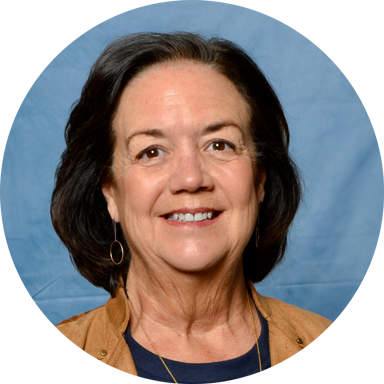
Sally K. Albrecht has shaped American choral music for over three decades, first as Director of School Choral, Vocal, and Elementary Publications at Alfred Music, and continues to do so as a prolific composer with more than 600 published choral works and 75 songbooks and musicals in circulation. An ASCAP award recipient annually since 1987, she has conducted honor choirs at prestigious venues including Lincoln Center, Carnegie Hall, and The Kennedy Center, establishing herself as a leading voice in choral pedagogy and performance.
Her academic training spans music and the performing arts. She earned a B.A. in Music and Theater from Rollins College in 1976, then pursued graduate studies at the University of Miami, completing an M.A. in Drama and an M.M. in Accompanying. She has taught at Oakland University, Jersey City State College, and Meredith College. In recent years, she received the Distinguished Alumna Award from both the University of Miami Frost School of Music and Rollins College, where she serves on the Board of Trustees.
Why we love this
Albrecht and Althouse deliver the multicultural authenticity and teaching savvy that separates a genuine learning experience from a tokenized one. The integration of Swahili and English text, rhythmic body percussion, and call-and-response structure creates natural engagement without requiring students to memorize unfamiliar material in isolation. The choreography cue and recorded accompaniment with layered African instruments means you can teach this successfully even without specialized world music training.
What to expect
Joyful and kinetic. The piece pulses with African rhythmic energy while remaining accessible to young voices; the call-and-response structure and body percussion create a sense of ensemble cohesion and celebration that students feel immediately.
Who it's for
Directors leading 2- and 3-part mixed choirs who want to build cultural awareness and physical engagement without overwhelming their singers. This works equally well in concert hall settings, assembly performances, or cross-curricular units on world cultures.
How to get the most out of it
- Teach the rhythmic chanting patterns separately before layering them into the vocal lines; body percussion becomes much tighter when students master the rhythm independently first.
- Use the call-and-response phrases to establish clear sectional identity. Assign one voice part to lead each call so singers understand their role and can anchor their entrances.
- Balance the body percussion with the vocal line in early rehearsals; students will naturally want to play louder than they sing, so establish dynamics expectations from the start.
- Consult the choreography materials before your first full run-through so you can block movement alongside your musical rehearsal rather than adding it as an afterthought.
How to use it
Program this as a spring concert highlight or finale, where its movement and visual elements will energize your audience. It also serves as a bridge piece in a thematic concert exploring world music or cultural connections, and pairs well with other secular multicultural selections.
Skills your students will build
- Rhythmic precision in layered patterns combining vocal line and body percussion
- Call-and-response phrasing and sectional independence
- Basic Swahili pronunciation and text clarity in a non-English language
- Physical coordination linking movement to musical pulse
- Awareness of African musical traditions and compositional approaches