
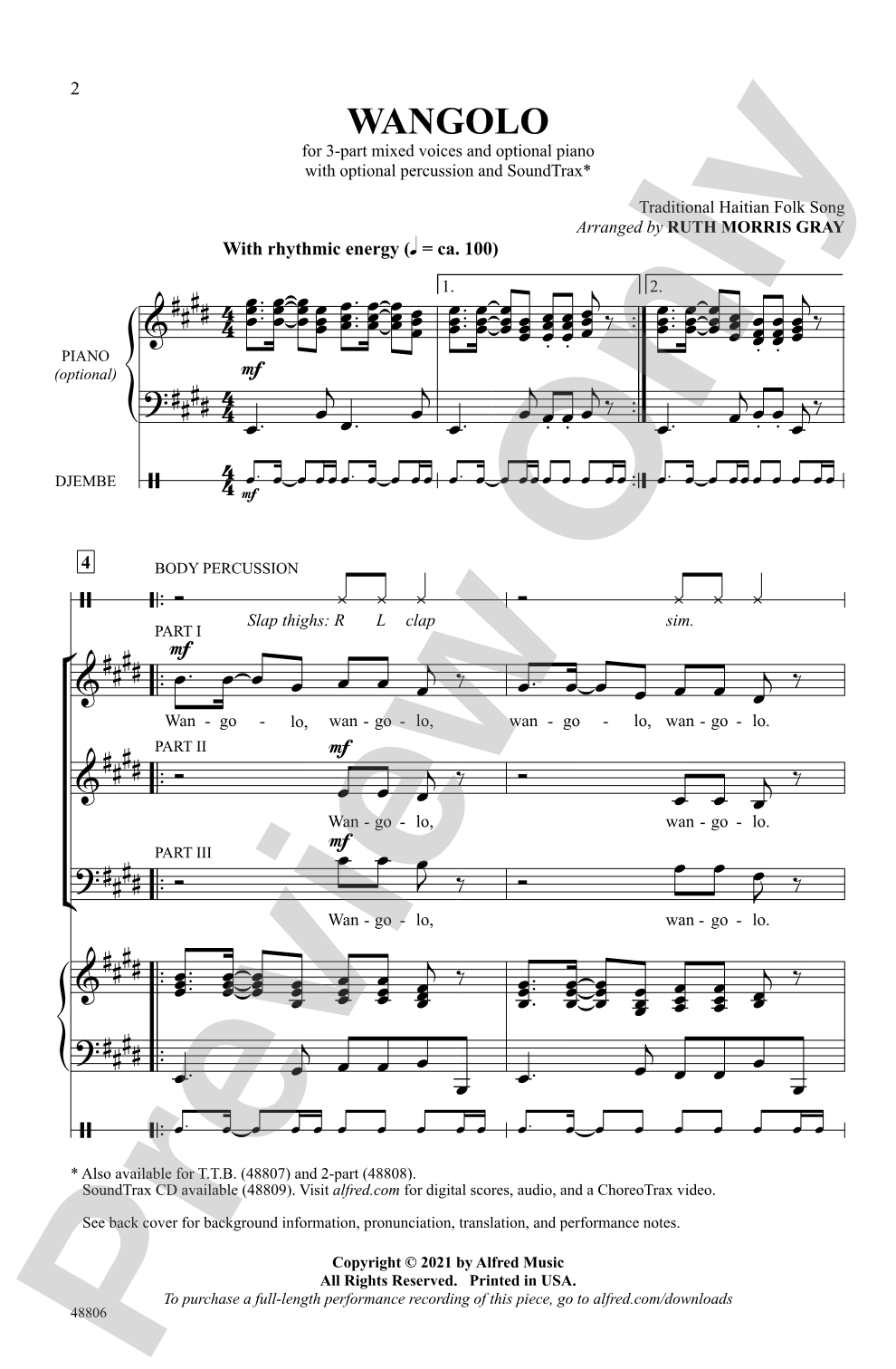

Wangolo: 3-Part Mixed, opt. a cappella Choral Octavo
Traditional Haitian Folk Song / arr. Ruth Morris Gray
Item: 00-PO-0006616
$2.05
Minimum order quantity: 10 copies
Please note: Under U.S. copyright law, you must purchase the exact number of copies needed for your ensemble. Printing, duplicating or sharing additional copies is strictly prohibited.
Pickup currently not available
Related Items
Wangolo: TTB, opt. a cappella Choral Octavo |
$2.05
|
View | |
Wangolo: 2-Part, opt. a cappella Choral Octavo |
$2.05
|
View | |
Wangolo: 3-Part Mixed, opt. a cappella Choral Octavo |
$2.05
|
View | |
Wangolo: TTB, opt. a cappella Choral Octavo |
$2.05
|
View | |
Wangolo: 2-Part, opt. a cappella Choral Octavo |
$2.05
|
View | |
Wangolo: Choral SoundTrax CD |
$29.99
|
View |
Description
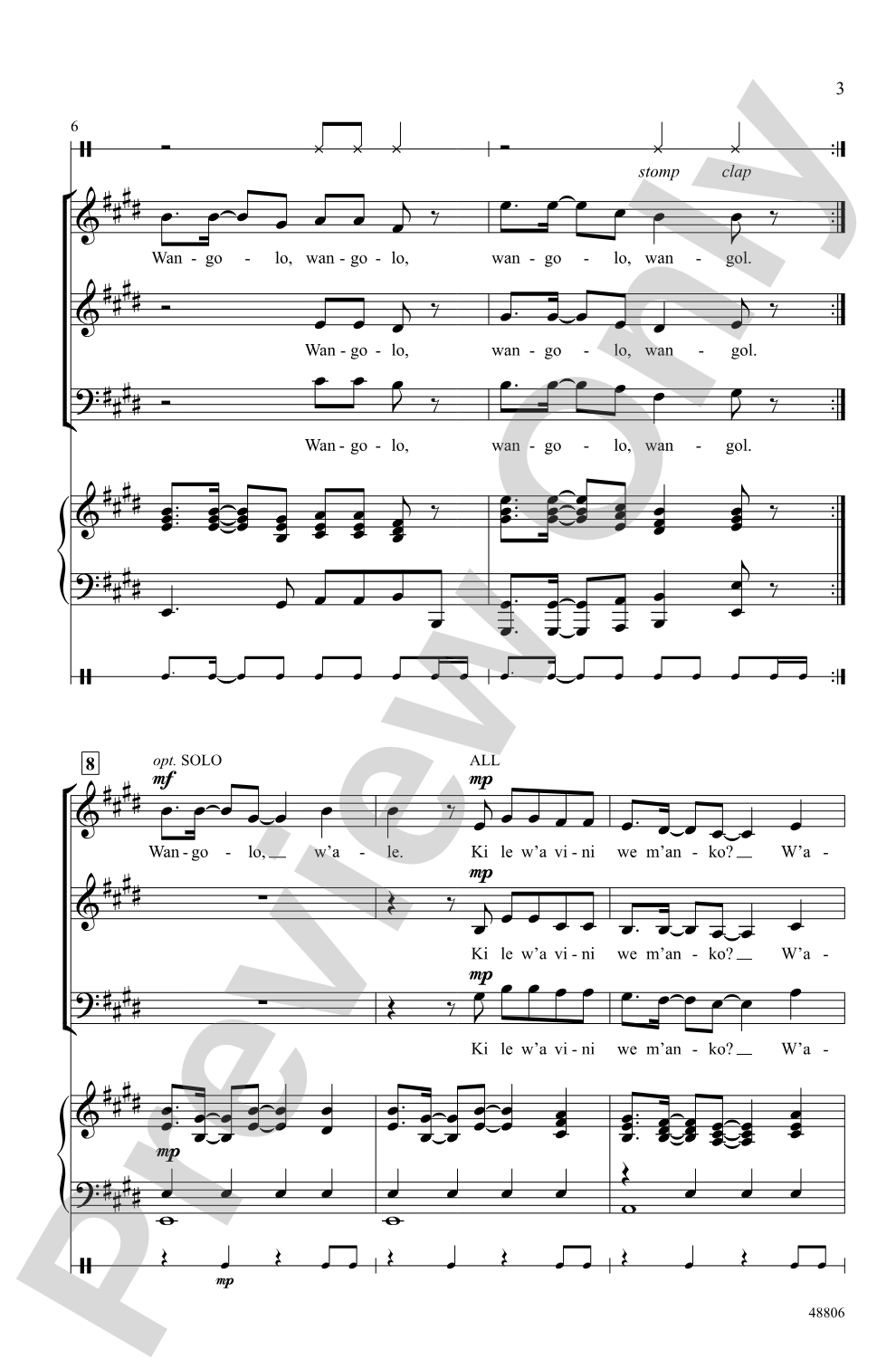
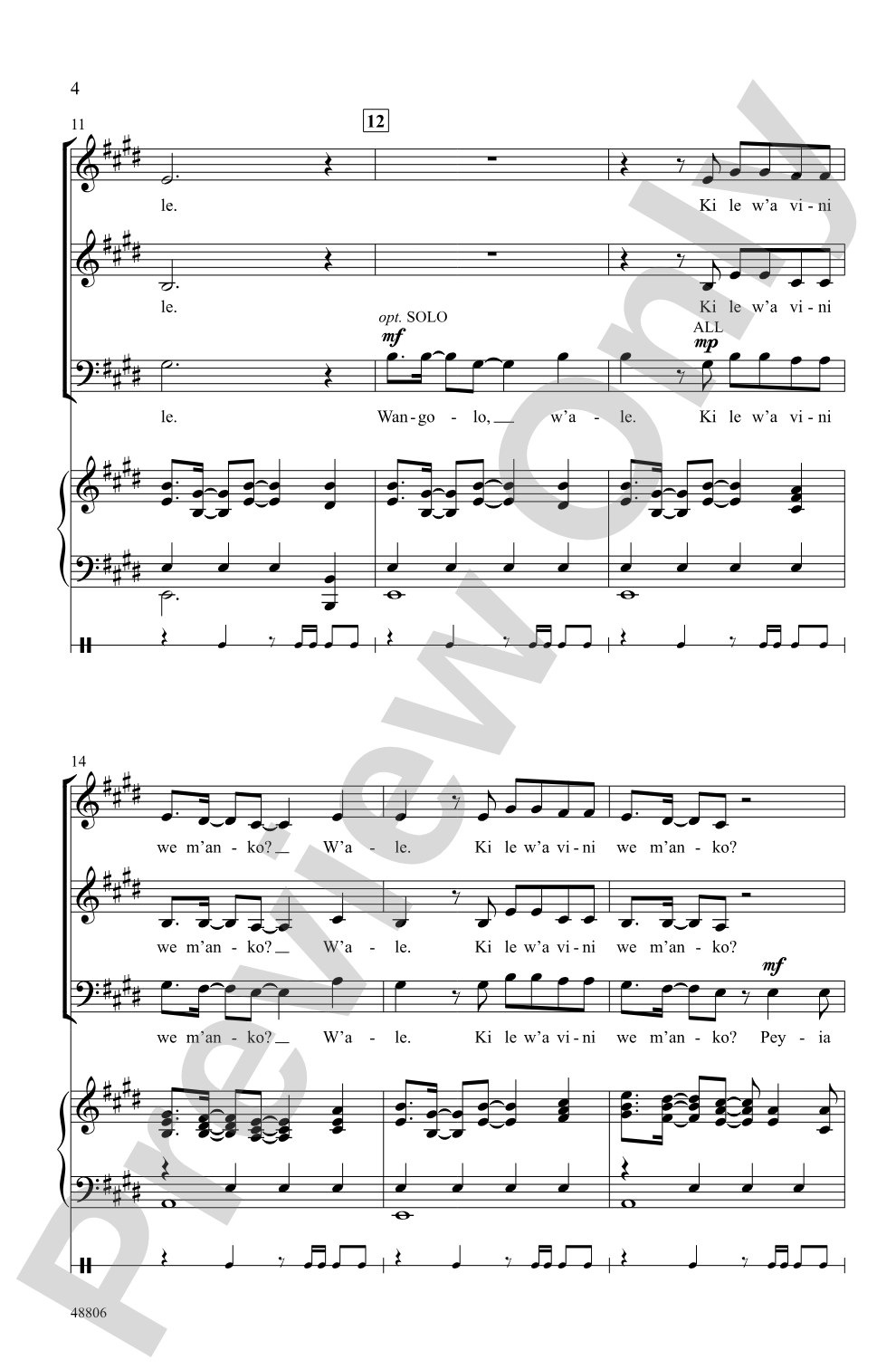
Some history: this song comes from Haiti, but actually refers to the first King of Angola, Ngolo Kiluanje, who was revered as a great king. The Creole word for "king" ("wa") plus the king's name ("Ngolo") became "Wangolo." It's an authentic folk song recalling the peace and prosperity the Angolan people enjoyed before colonization. This rhythmic rendition, which may be performed without piano if desired, includes optional body percussion, suggested parts for djembe and other instruments, optional solos in the call and response section, plus a final descant that tops off the triadic parallel harmonies. Check out the free online ChoreoTrax video for some creative riser choreography.


Discover MakeMusic Cloud: thousands of interactive titles your students can play along with today.
Sample Audio
1
Audio File
--:--
0:00
0:00
Sample Video
1 / 3
Additional Details
Series:
Alfred Choral Designs
Publisher:
Alfred Music
Page Count:
12
SKU:
00-PO-0006616
More about this title
About the Arranger: Ruth Morris Gray

Ruth Morris Gray directs choirs at Rosemead High School in California, where she has shaped the choral program since 2004. She holds degrees in Piano Performance and Composition from Biola University and a Master of Arts in Music Composition from UC Santa Barbara, along with her California Single Subject Music Credential. With over 100 published choral compositions to her name, Gray has established herself as a prolific voice in contemporary choral writing.
Beyond the rehearsal room, Gray remains active as a performer and continues to compose across multiple genres. Her work reflects both rigorous musical training and genuine enthusiasm for making music accessible and engaging for singers at all levels.
Why we love this
Gray transforms a historically resonant Haitian folk song into an arrangement that honors its roots while offering directors multiple pathways for performance. The optional a cappella treatment, suggested body percussion, and built-in call-and-response flexibility make this work immediately adaptable to your ensemble's strengths and your concert vision. The descant finale over parallel triadic harmony delivers the kind of satisfying vocal moment that audiences remember.
What to expect
Wangolo pulses with quiet joy and grounded dignity. The rhythmic propulsion, whether driven by body percussion or optional djembe, creates forward momentum that feels celebratory without being frenetic, while the harmonic movement honors the peace and stability the text recalls. The final ascent into the descant provides a moment of vocal brightness that lifts the piece into something transcendent.
Who it's for
This arrangement works for mixed voice choirs with singers at the middle school through early high school level who are ready for thoughtful repertoire with cultural substance. Ensembles seeking programming that celebrates world music traditions and offers flexible instrumentation options will find this piece both musically rewarding and accessible.
How to get the most out of it
- Establish the rhythmic foundation early in rehearsal by isolating the body percussion parts and djembe patterns separately before layering in the vocal lines; this creates a strong groove that holds the ensemble together in the call-and-response sections.
- Consider assigning soloists to the call-and-response passages during early rehearsals, then gradually invite additional singers to join those sections as confidence builds; this technique allows the piece to grow dynamically from performance to performance.
- If performing a cappella, lock the opening unison passage with clear vowel shapes and consistent breath placement to anchor the harmonic content before the three-part writing begins.
- Watch the free ChoreoTrax video as a teaching tool during rehearsal to spark ideas about staging; your singers don't need to reproduce the choreography exactly, but the video often reveals the musical character and energy the arranger envisioned.
How to use it
Program this as part of a world music concert set or as a standalone cultural spotlight that enriches your audience's understanding of diaspora and historical memory. It also serves well in festivals and contests where multicultural repertoire is valued, and the optional choreography makes it a natural fit for concerts emphasizing movement and staging.
Skills your students will build
- Call-and-response phrasing and ensemble listening
- Rhythmic independence with optional body percussion and auxiliary percussion parts
- SAB three-part harmony with parallel voice leading
- A cappella intonation and blend in unison and mixed voicings
- Stylistic awareness of Haitian Creole language and Caribbean musical traditions