
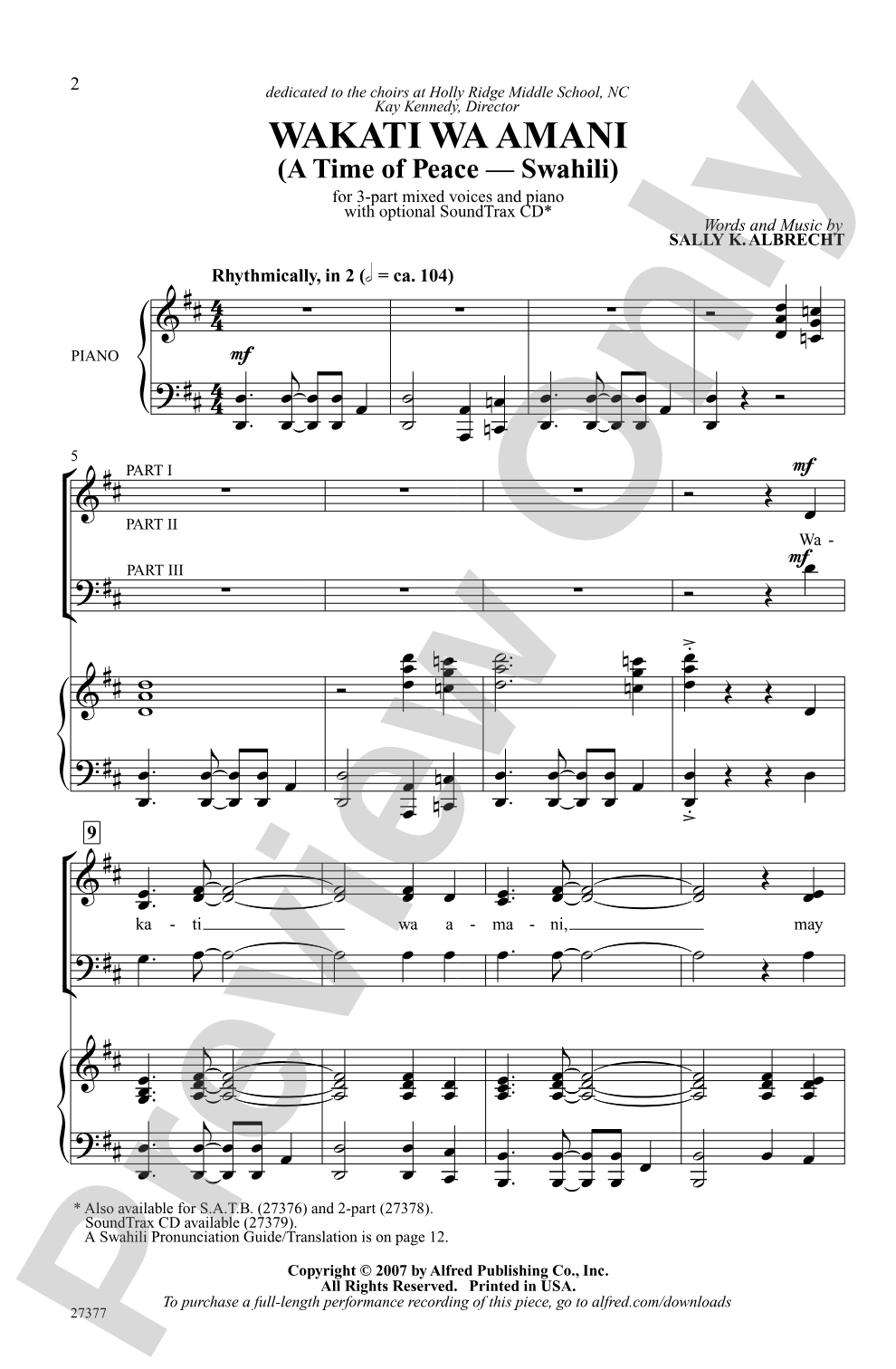
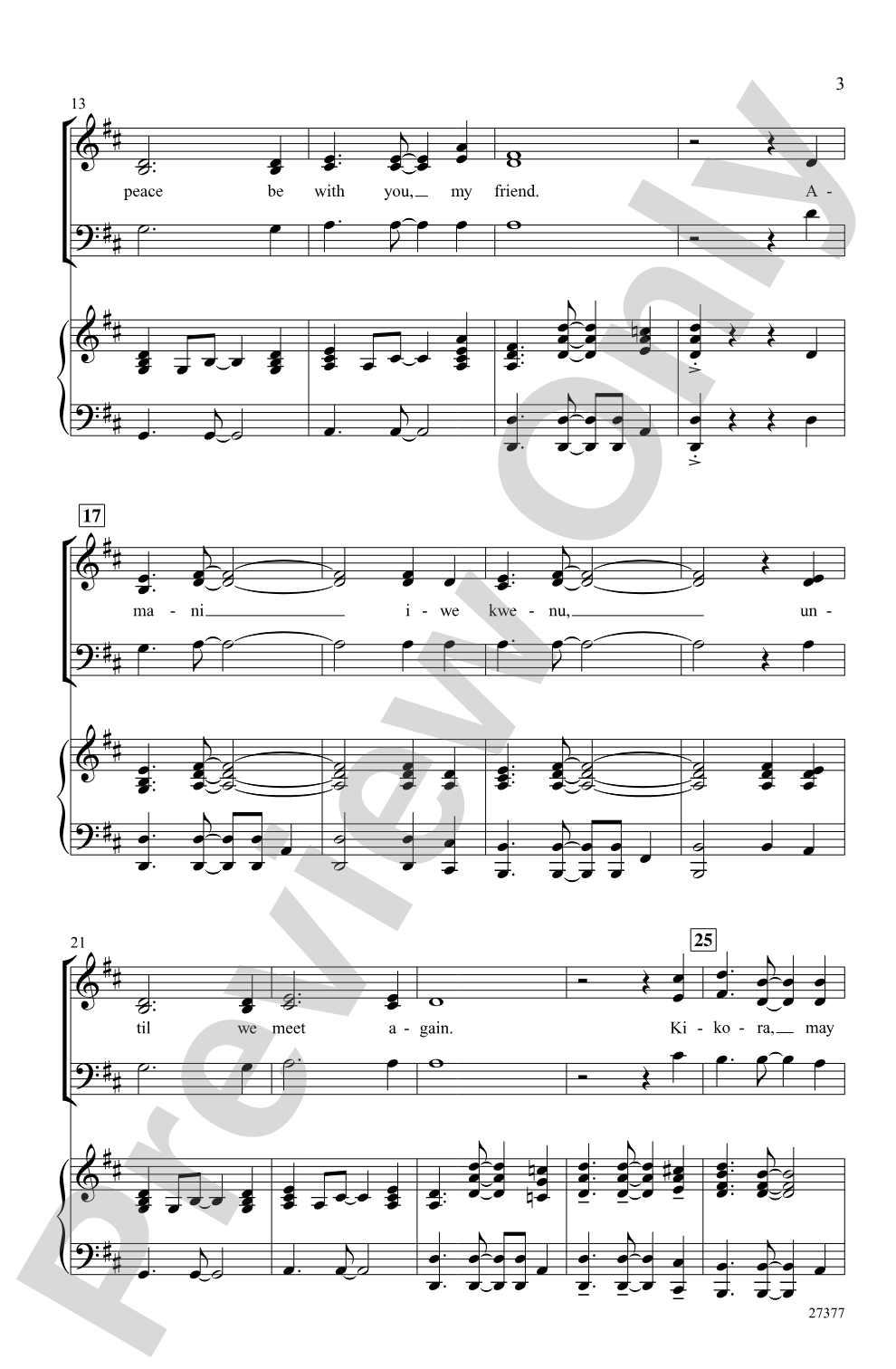
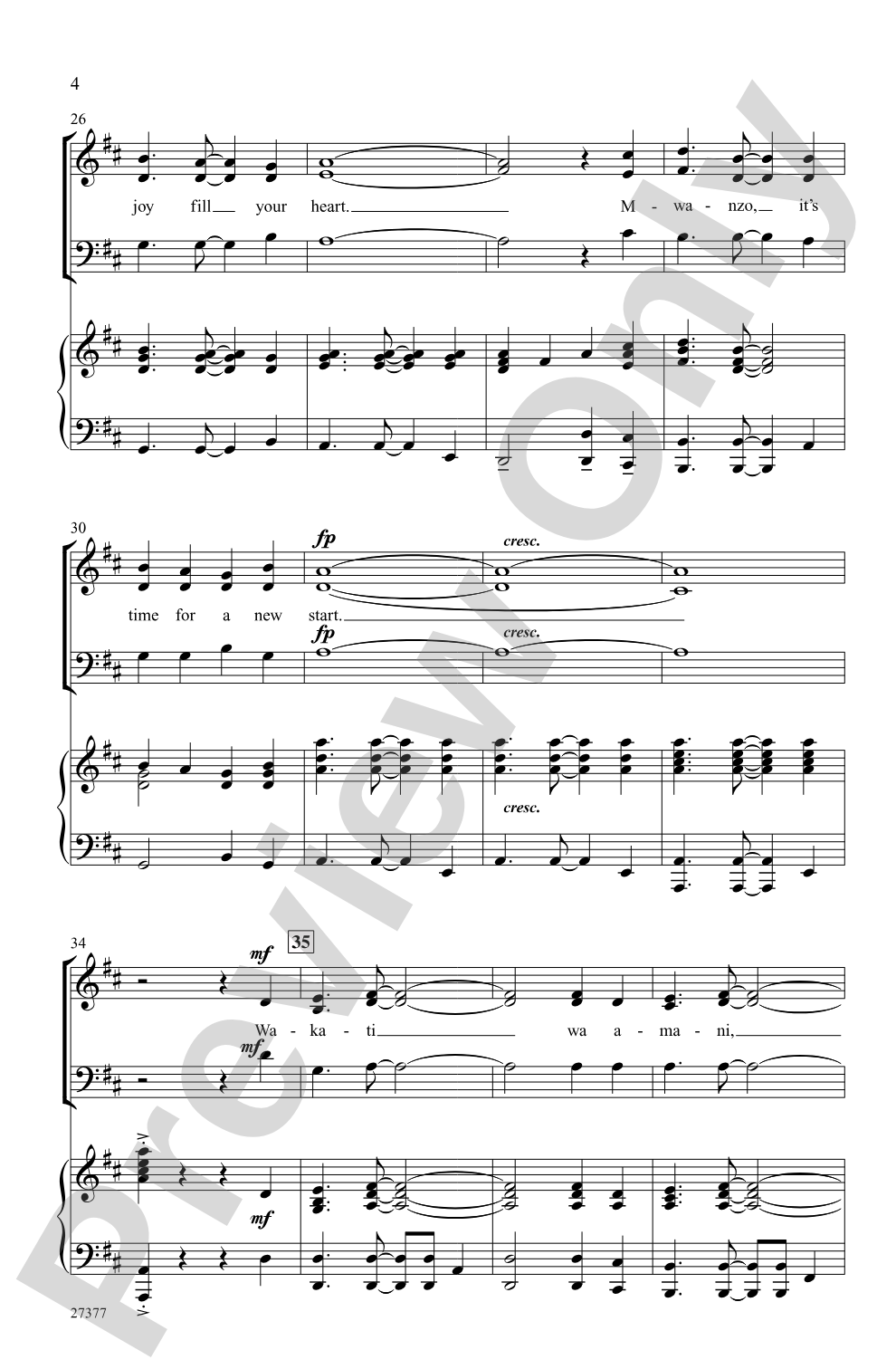

Wakati wa Amani (A Time of Peace - Swahili): 3-Part Mixed Choral Octavo
(A Time of Peace -- Swahili)
Words and music by Sally K. Albrecht
Item: 00-PO-0000393
$1.75
Minimum order quantity: 20 copies
Pickup currently not available
Related Items
Wakati wa Amani: SoundTrax Digital Audio Download |
$22.95
|
View | |
Wakati wa Amani (A Time of Peace - Swahili): SATB Choral Octavo |
$1.75
|
View | |
Wakati wa Amani (A Time of Peace - Swahili): 2-Part Choral Octavo |
$2.25
|
View | |
Wakati wa Amani: SATB Choral Octavo |
$1.75
|
View | |
Wakati wa Amani: 3-Part Mixed Choral Octavo |
$1.75
|
View | |
Wakati wa Amani: 2-Part Choral Octavo |
$2.25
|
View | |
Wakati wa Amani: Choral Octavo SoundTrax CD |
$22.95
|
View |
Description
In any language, peace is a beautiful thing. Perform this African-style rhythmic number for a great cross-cultural addition to any concert or festival. The text alternates between English and Swahili, with a pronunciation guide/translation included in the publication. "Peace be with you, my friend, until we meet again." Choreography featured on "Razzamatazz!" DVD (item 00-27430).


Wakati wa Amani (A Time of Peace - Swahili): 3-Part Mixed Choral Octavo isn't in MakeMusic Cloud just yet...but it could be. Let us know you'd like to see it, and you'll help shape what comes next. In the meantime, start a free trial and dive into thousands of interactive titles your students can play along with today.
Request This Title
Tell us you want it.
Start Your Free Trial
Explore everything that's ready to play right now.
Sample Audio
1
Audio File
--:--
0:00
0:00
Sample Video
No sample videos found.
Additional Details
Series:
Alfred Choral Designs
Publisher:
Alfred Music
Page Count:
12
SKU:
00-PO-0000393
More about this title
About the Composer: Sally K. Albrecht

Sally K. Albrecht has built a prolific career as a choral composer, conductor, and clinician with a distinctive focus on integrating movement into choral performance. Since 1987, she has received annual ASCAP Special Music Awards, and her catalog now includes over 600 published choral works alongside 75 songbooks and musicals. She has led honor choirs at major venues including Lincoln Center, Carnegie Hall, and The Kennedy Center, and spent more than three decades as Director of School Choral, Vocal, and Elementary Publications at leading educational music publishers, most recently Alfred Music.
Albrecht holds degrees from Rollins College (B.A. in Music and Theater, 1976), the University of Miami (M.A. in Drama, 1977; M.M. in Accompanying, 1979), and has taught at Oakland University in Michigan, Jersey City State College in New Jersey, and Meredith College in North Carolina. A Cleveland native, she received the Distinguished Alumna Award from both the University of Miami Frost School of Music and Rollins College in 2021, and previously served as Chair of the Board of Trustees for the Omicron Delta Kappa National Leadership Honor Society. She lives in Wake Forest, North Carolina, with her husband, composer and arranger Jay Althouse.
Why we love this
Albrecht crafts this piece as both a musical and physical experience, pairing authentic African-style rhythmic writing with accessible three-part voicing that lets every singer feel the groove. The bilingual text grounds students in a meaningful message while the included choreography (detailed on the accompanying DVD) transforms the piece from a concert number into a memorable cultural celebration.
What to expect
Joyful and celebratory, with an undercurrent of gentle reflection. The African-style rhythmic foundation creates infectious momentum while the alternating English and Swahili text carries a message of friendship and hope that resonates across language barriers.
Who it's for
Middle school, high school, and community choirs seeking repertoire that combines cultural authenticity with accessible three-part writing and built-in movement opportunity. Directors programming multicultural concerts or festivals will find this piece particularly effective for engaging audiences through both musicality and physicality.
How to get the most out of it
- Emphasize the rhythmic drive that powers this work. Lock the ensemble into a steady pulse from the first rehearsal, and resist the urge to rush the African-inspired rhythmic patterns.
- Integrate the choreography gradually. Begin with vocal preparation alone, then layer in movement once the singers are confident with their parts and the text.
- Encourage clear articulation of both English and Swahili text. The pronunciation guide ensures authenticity; coach singers to shape consonants crisply so the bilingual nature of the piece lands clearly with the audience.
- Use the recorded accompaniment to establish tempo and rhythmic clarity, especially when teaching the percussion-influenced feel that drives the arrangement.
How to use it
Program this as a centerpiece in a multicultural or world music concert, where its rhythmic vitality and choreography provide visual and aural contrast to concert staples. It also works effectively as a finale or closing number, leaving audiences energized by its uplifting sentiment about peace and connection.
Skills your students will build
- Reading and performing African-inspired rhythmic patterns within a three-part texture
- Pronunciation and expressive delivery of text in a non-English language
- Coordinating vocal singing with choreographed movement
- Building ensemble rhythm and pulse through movement-integrated rehearsal