

Vox: SAB, a cappellaChoral Octavo
Words and music by Greg Gilpin
Item: 00-PO-0006923
$2.05
Minimum order quantity: 20 copies
Pickup currently not available
Description
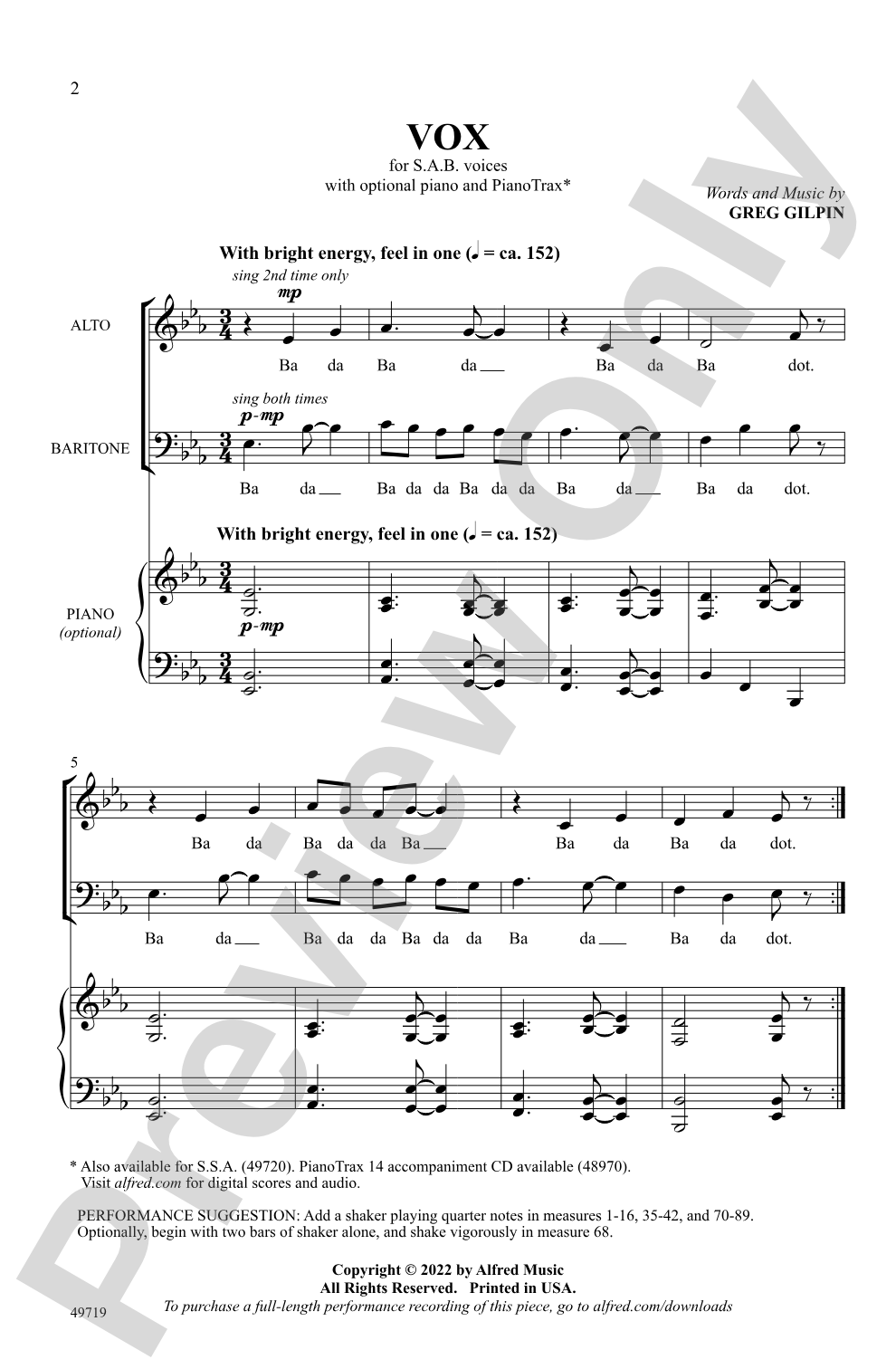
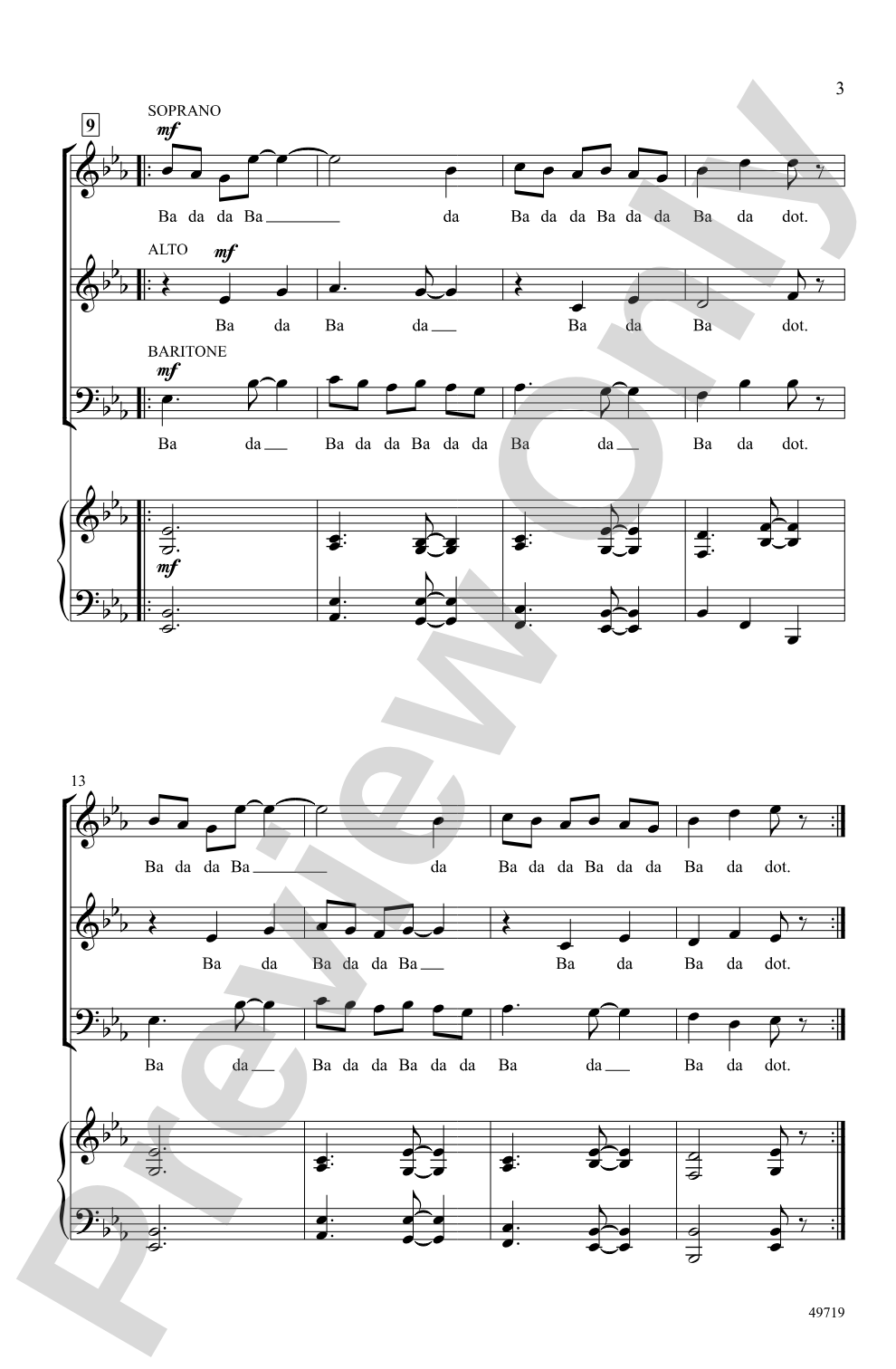
Enjoy the bright energy of ¾ felt in one. This rhythmic Greg Gilpin original may be accompanied by shaker alone or the optional keyboard part. Vibrant vocables have no literal meaning, but virtually bubble with joy---there's a smile built in. A complete form with contrasting sections, varied choral articulations, ostinatos, pedal tones, drones, the works. It's an action-packed musical journey, a colorful collage for the ears.


Vox: SAB, a cappellaChoral Octavo isn't in MakeMusic Cloud just yet...but it could be. Let us know you'd like to see it, and you'll help shape what comes next. In the meantime, start a free trial and dive into thousands of interactive titles your students can play along with today.
Request This Title
Tell us you want it.
Start Your Free Trial
Explore everything that's ready to play right now.
Sample Audio
1
Audio File
--:--
2
1 Vox (A Cappella)
--:--
3
2 Vox (Accompanied)
--:--
Audio File
0:00
0:00
Sample Video
1 / 3
Additional Details
Series:
Alfred Choral Designs
Publisher:
Alfred Music
Page Count:
12
SKU:
00-PO-0006923
More about this title
About the Composer: Greg Gilpin

Greg Gilpin stands at the forefront of contemporary choral music, with a catalog that spans from concert hall premieres to educational publications. An ASCAP award-winning composer and arranger, he has conducted performances at Carnegie Hall, Lincoln Center, Ryman Auditorium, Sydney Opera House, Royal Festival Hall, and Harpa Concert Hall, establishing himself as a major voice in American choral music. His role as Director of Educational Choral Publications for Shawnee Press places him in direct service to the choral education community.
Beyond the concert stage, Gilpin's creative reach extends across multiple disciplines. He scored the award-winning short film "Rosie's Rescue" in 2021 and collaborated with opera singer Angela Brown on a new arrangement of "What Child is This?" for the Indianapolis Symphonic Choir. Active in professional organizations including ACDA, NAfME, and SAG-AFTRA, Gilpin continues to balance his work as teacher, conductor, and composer while maintaining deep investment in the advancement of choral music education.
Why we love this
Gilpin captures something genuinely rare here: a piece with serious compositional architecture that never loses its infectious joy. The interplay of ostinatos, pedal tones, and rhythmic vocables creates sophisticated harmonic texture without asking singers to decode complex language, making it equally satisfying for musicians who want to dig in and choirs looking for a confidence-building crowd-pleaser.
What to expect
A kaleidoscope of sound where joy isn't whispered but bubbles up naturally from the music itself. The bright 3/4 meter propels the piece forward with an almost dance-like quality, while layers of vocables and sustained tones create a colorful soundscape that shifts and surprises without ever losing its fundamental warmth.
Who it's for
SAB choirs with moderate vocal maturity who thrive on rhythmic precision and contemporary energy. This works equally well for middle school advanced groups and high school choirs seeking accessible yet sophisticated a cappella repertoire.
How to get the most out of it
- Keep the rhythmic energy tight and consistent; the shaker part (or optional keyboard) acts as a metronome that anchors the vocables and prevents them from becoming shapeless.
- Differentiate the choral articulations throughout. Where the score marks them, lean into staccato and sustained sections distinctly so the contrast between sections lands.
- Balance the SAB voicing so the soprano and alto lines stay clear above the alto and tenor drones. The pedal tones need to sit underneath, not compete for presence.
How to use it
This works beautifully as a concert opener or closer; its rhythmic drive and uplifting character lift the energy in a room immediately. You might also program it alongside spirituals or world music pieces where rhythm and vocalization take center stage, creating a thematic conversation about how meaning lives in sound and movement, not necessarily in words.
Skills your students will build
- Maintaining rhythmic independence while singing a cappella in compound meter (3/4 felt in one)
- Layering ostinatos and pedal tones while keeping lines transparent and distinct
- Vocal articulation control (staccato, legato, and marcato) across sections
- Singing nonsense syllables with full musicality and intentionality
- Ensemble balance and blend in SAB voicing
- Rhythmic precision in contemporary a cappella writing