
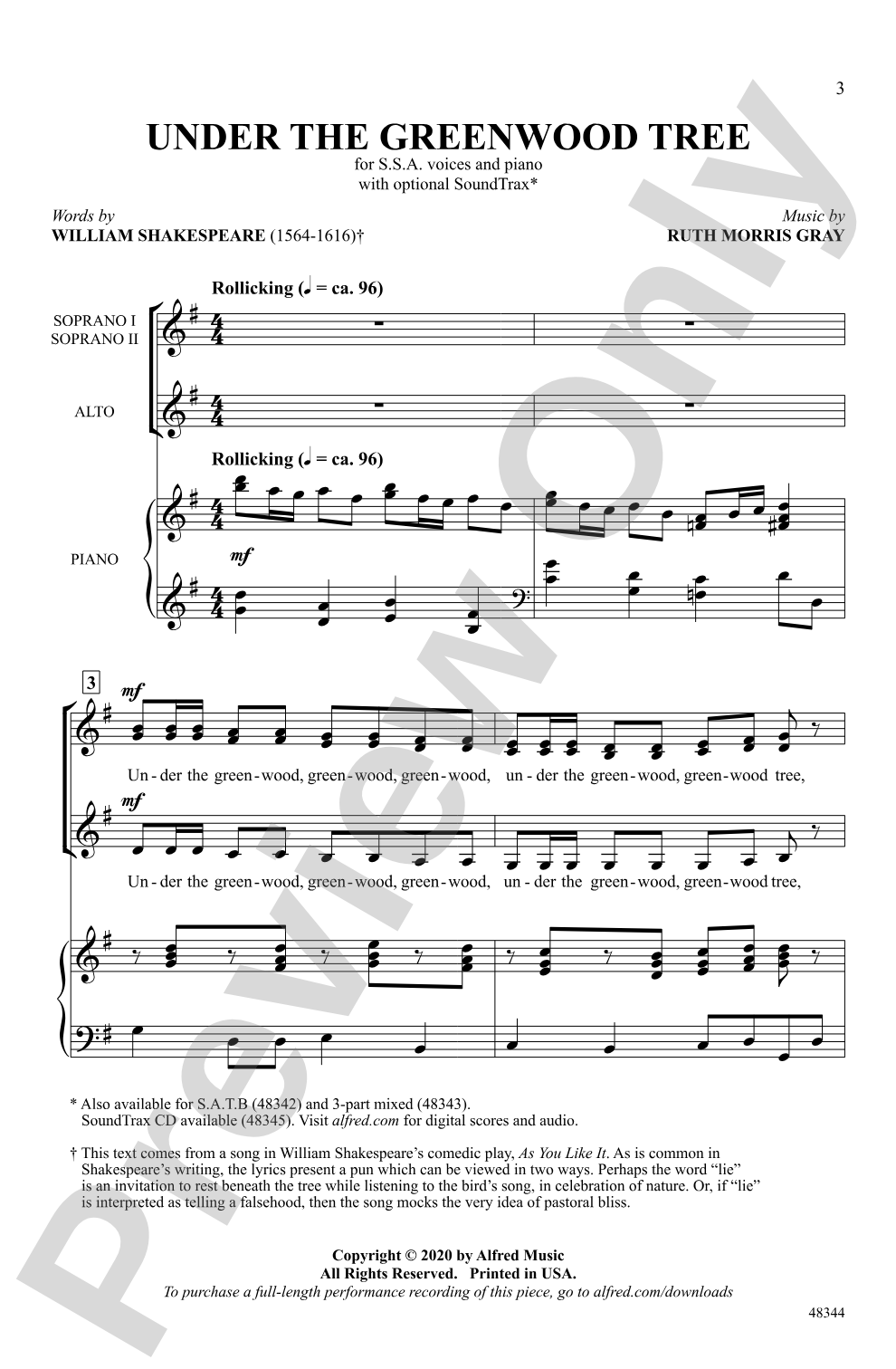

Under the Greenwood Tree: SSA Choral Octavo
Words by William Shakespeare, music by Ruth Morris Gray
Item: 00-PO-0006331
$2.05
Minimum order quantity: 20 copies
Pickup currently not available
Related Items
Under the Greenwood Tree: SoundTrax Digital Audio Download |
$29.99
|
View | |
Under the Greenwood Tree: SATB Choral Octavo |
$2.05
|
View | |
Under the Greenwood Tree: 3-Part Mixed Choral Octavo |
$2.05
|
View | |
Under the Greenwood Tree: SATB Choral Octavo |
$2.05
|
View | |
Under the Greenwood Tree: 3-Part Mixed Choral Octavo |
$2.05
|
View | |
Under the Greenwood Tree: SSA Choral Octavo |
$2.05
|
View | |
Under the Greenwood Tree: Choral SoundTrax CD |
$29.99
|
View |
Description
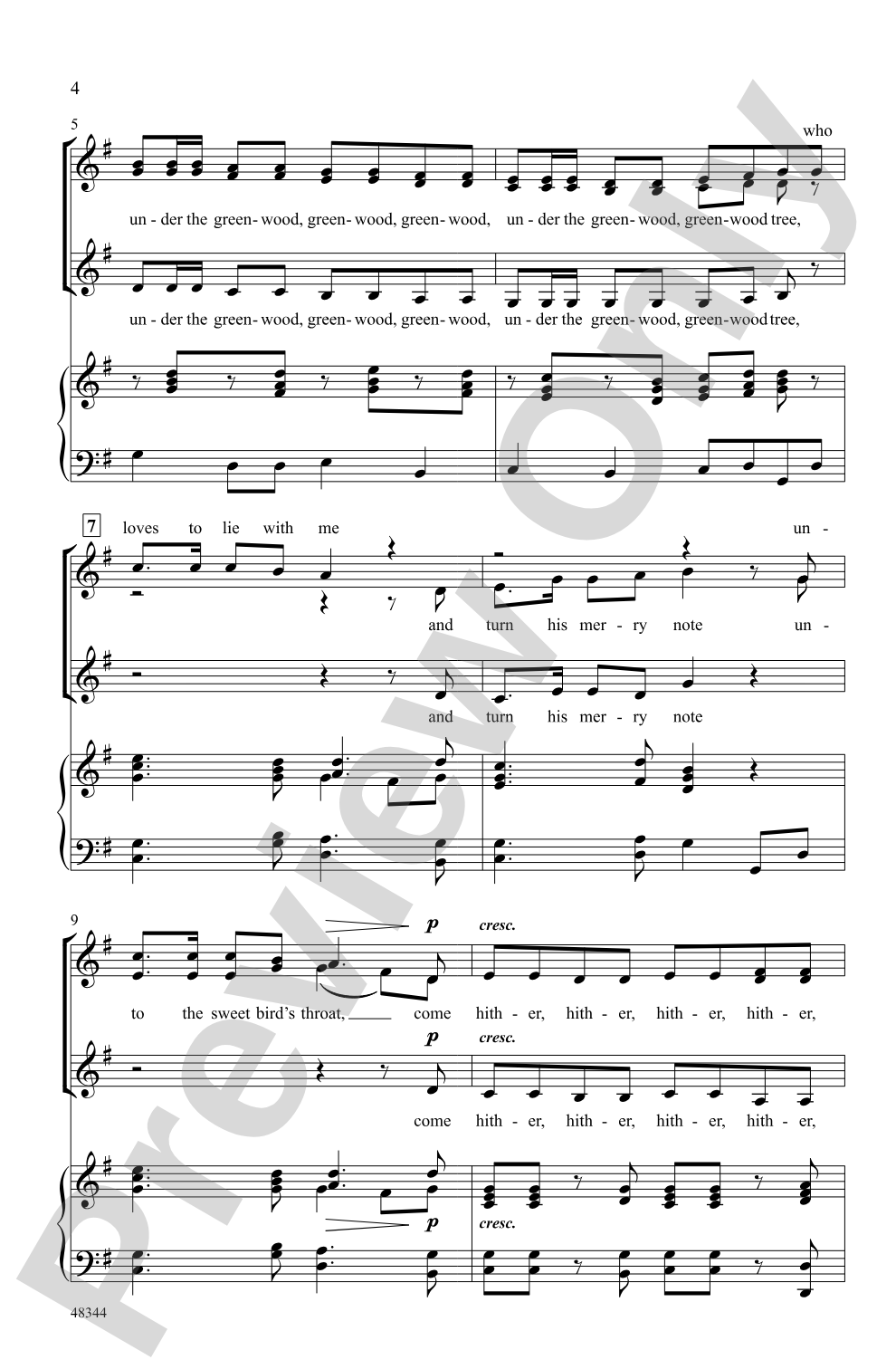
Here's an accompanied contemporary madrigal with a lighthearted lilt, guaranteed to bring a smile. This sprightly setting capitalizes on the energy of Shakespeare's witty words from As You Like It. Repeated phrases and rhythmic motives are fun from start to finish. Optional cue notes add an upper harmony on the final refrain.


Under the Greenwood Tree: SSA Choral Octavo isn't in MakeMusic Cloud just yet...but it could be. Let us know you'd like to see it, and you'll help shape what comes next. In the meantime, start a free trial and dive into thousands of interactive titles your students can play along with today.
Request This Title
Tell us you want it.
Start Your Free Trial
Explore everything that's ready to play right now.
Sample Audio
1
Audio File
--:--
0:00
0:00
Sample Video
No sample videos found.
Additional Details
Series:
Alfred Choral Designs
Publisher:
Alfred Music
Page Count:
12
SKU:
00-PO-0006331
More about this title
About the Composer: Ruth Morris Gray

Ruth Morris Gray brings decades of classroom experience to her compositional work. Since 2004, she has directed choirs and taught piano at Rosemead High School in California, where she has developed a keen instinct for what energizes singers and audiences alike. She holds degrees in piano performance and composition from Biola University and a master's degree in music composition from UC Santa Barbara, training that informs both her technical sophistication and her gift for accessibility.
With over 100 published choral works to her name, Gray has established herself as a trusted voice in contemporary choral music. Her background in performance and pedagogy shapes every piece she writes, ensuring that her compositions challenge singers musically while remaining genuinely enjoyable to prepare and perform.
Why we love this
Ruth Morris Gray understands what makes rehearsals feel alive. This setting sparkles with rhythmic energy and melodic wit, drawing directly from the playfulness of Shakespeare's text. Your singers will move through the piece quickly, building confidence on repeated phrases while nailing genuine musicality by performance time.
What to expect
Picture a madrigal that skips along with genuine joy. The rhythmic motives create a conversational spring in the music, and the Shakespearean text gives singers witty words that feel natural in the mouth. This is the kind of piece that builds genuine smiles during performance.
Who it's for
This piece suits SSA or SSAA choirs of all levels seeking contemporary repertoire with immediate appeal. It works equally well for high school treble ensembles, community choirs, and college women's choruses looking to brighten a concert program.
How to get the most out of it
- Lean into the text's humor by clarifying articulation and consonants; the witty language deserves to land clearly with your audience.
- Shape the repeated phrases as building blocks rather than rote repetitions. Each iteration can gain slight dynamic lift or textual emphasis to maintain forward momentum.
- Balance the three voice parts independently during sectional rehearsals, then blend them together so the lilt remains buoyant rather than heavy.
- For the optional cue notes on the final refrain, decide early whether you'll use them with all singers, a select few, or as an ad-lib choice for confident singers who want extra texture.
How to use it
Program this as a palate-cleansing moment between weightier selections, or open a concert with its infectious energy to immediately connect with your audience. It pairs beautifully alongside other secular madrigals or contemporary choral works, and its literary foundation makes it a natural fit for humanities-integrated performances.
Skills your students will build
- Shaping repeated rhythmic motives for musical interest
- SSA voice balance and blend
- Clarity and diction in English text
- Reading accompanied choral parts
- Building narrative energy through phrasing rather than dynamics alone