
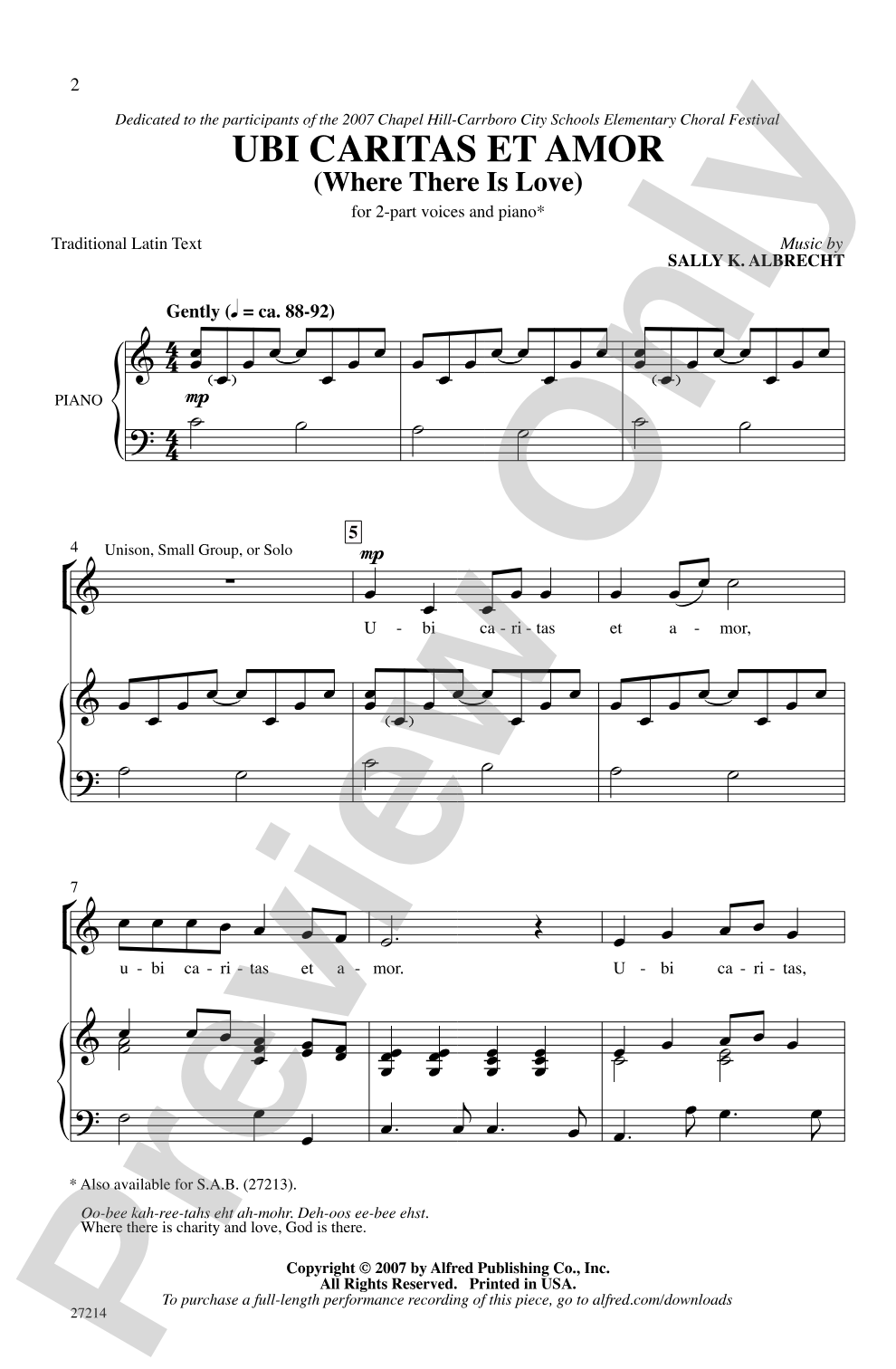
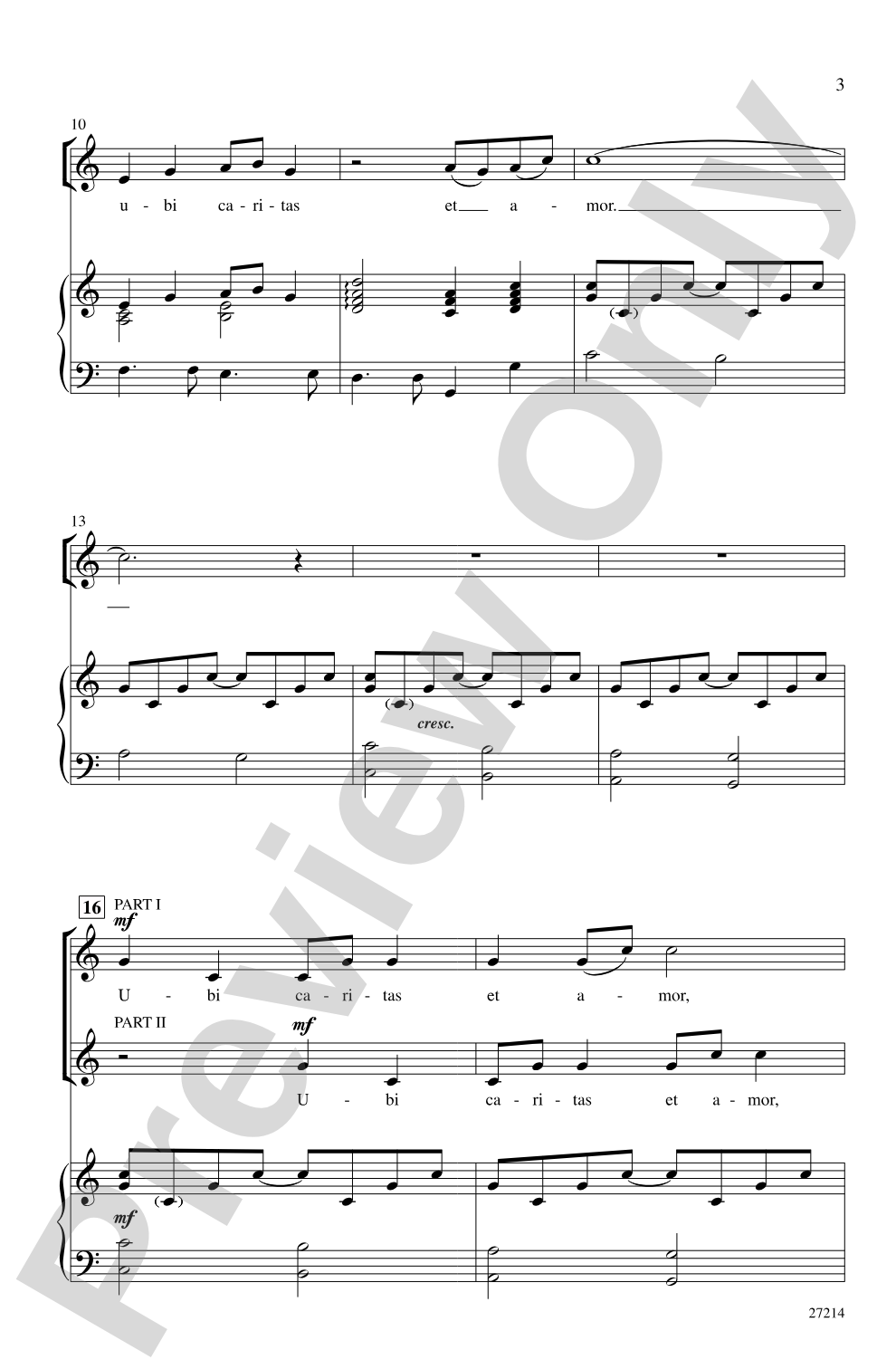

Ubi Caritas et Amor (Where There Is Love): 2-Part Choral Octavo
Traditional Latin Text, music by Sally K. Albrecht
Item: 00-PO-0000327
$2.25
Minimum order quantity: 20 copies
Pickup currently not available
Description
A poignant setting of the Latin text which translates to "Where there is charity and love, God is there." The piece opens quietly, with a unison statement of the melody. Teaching suggestion: teach the melody to all parts, and they've learned most of the piece. It's beautiful in its simplicity and clarity. Choirs of all ages will sound good on this work at contests, festivals, and adjudications.


Ubi Caritas et Amor (Where There Is Love): 2-Part Choral Octavo isn't in MakeMusic Cloud just yet...but it could be. Let us know you'd like to see it, and you'll help shape what comes next. In the meantime, start a free trial and dive into thousands of interactive titles your students can play along with today.
Request This Title
Tell us you want it.
Start Your Free Trial
Explore everything that's ready to play right now.
Sample Audio
1
Audio File
--:--
0:00
0:00
Sample Video
No sample videos found.
Additional Details
Series:
Alfred Archive Edition: Alfred Choral Designs
Publisher:
Alfred Music
Page Count:
8
SKU:
00-PO-0000327
More about this title
About the Composer: Sally K. Albrecht

Sally K. Albrecht has shaped American choral music through six decades of prolific composition and advocacy for singers of all ages. Since 1987, she has been a consistent recipient of the ASCAP Special Music Award, and her catalog now exceeds 600 published choral works alongside 75 musicals and songbooks. Her influence extends beyond the page: she has conducted honor choirs at Lincoln Center, Carnegie Hall, and The Kennedy Center, and spent over thirty years directing school choral and vocal publications for major educational music publishers, most recently as Director of School Choral Publications for Alfred Music.
Albrecht's work reflects her deep understanding of voice pedagogy and the transformative power of movement in choral singing. She holds degrees from Rollins College (B.A. in Music and Theater, 1976), the University of Miami (M.A. in Drama, 1977; M.M. in Accompanying, 1979), and has taught in music departments across the country. A resident of Wake Forest, North Carolina, she received the Distinguished Alumna Award from both the University of Miami Frost School of Music and Rollins College in 2021, and previously served as Chair of the Board of Trustees for Omicron Delta Kappa National Leadership Honor Society.
Why we love this
Albrecht's setting proves that sacred music for younger or less experienced singers doesn't require compromise. The unison opening gifts singers a clear melodic foundation, and the teaching suggestion embedded in the score reflects decades of classroom wisdom: once singers know the tune, the piece nearly teaches itself. It's the kind of writing that builds confidence and resonates with audiences at adjudications and festivals without ever feeling simplistic.
What to expect
Quiet reverence opens into a gentle affirmation of faith. The melody sits comfortably in the voice and moves with a natural, almost hymn-like quality, while the harmony deepens without complicating the message. It feels intimate and sincere, the kind of piece that reminds singers why they chose to sing together.
Who it's for
This setting serves choirs ranging from middle school through adult levels, particularly those new to Latin sacred music or building confidence with two-part writing. It works equally well for honor choirs, festival performances, and worship settings where authentic beauty matters more than technical display.
How to get the most out of it
- Begin with the unison melody in full voice to establish the text and tune for your singers. This shared entry point makes the subsequent harmony feel earned rather than imposed.
- Shape the dynamics with the arc of the text itself. The opening quietness creates sacred space; let any dynamic rise unfold gradually and return to stillness by the final cadence.
- Attend to Latin vowel purity throughout. The simplicity of the writing makes diction flaws immediately visible, so precise, unified vowels will amplify the piece's clarity.
- Balance the two voice parts by ear rather than by volume. The second part should support without overwhelming; adjust your seating or section strength accordingly during rehearsal.
How to use it
Pair this octavo with stronger unison or three-part pieces to build a section of sacred works, or use it as an opening number to establish a contemplative tone for a concert. Its eight pages and modest performance time make it ideal for festival programs where time slots are tight and impact must remain high.
Skills your students will build
- Singing in two independent voice parts with harmonic awareness
- Interpreting Latin sacred text and applying accurate vowel sounds
- Building confidence in unison before adding harmonic complexity
- Shaping longer melodic lines with appropriate phrasing and breath placement