
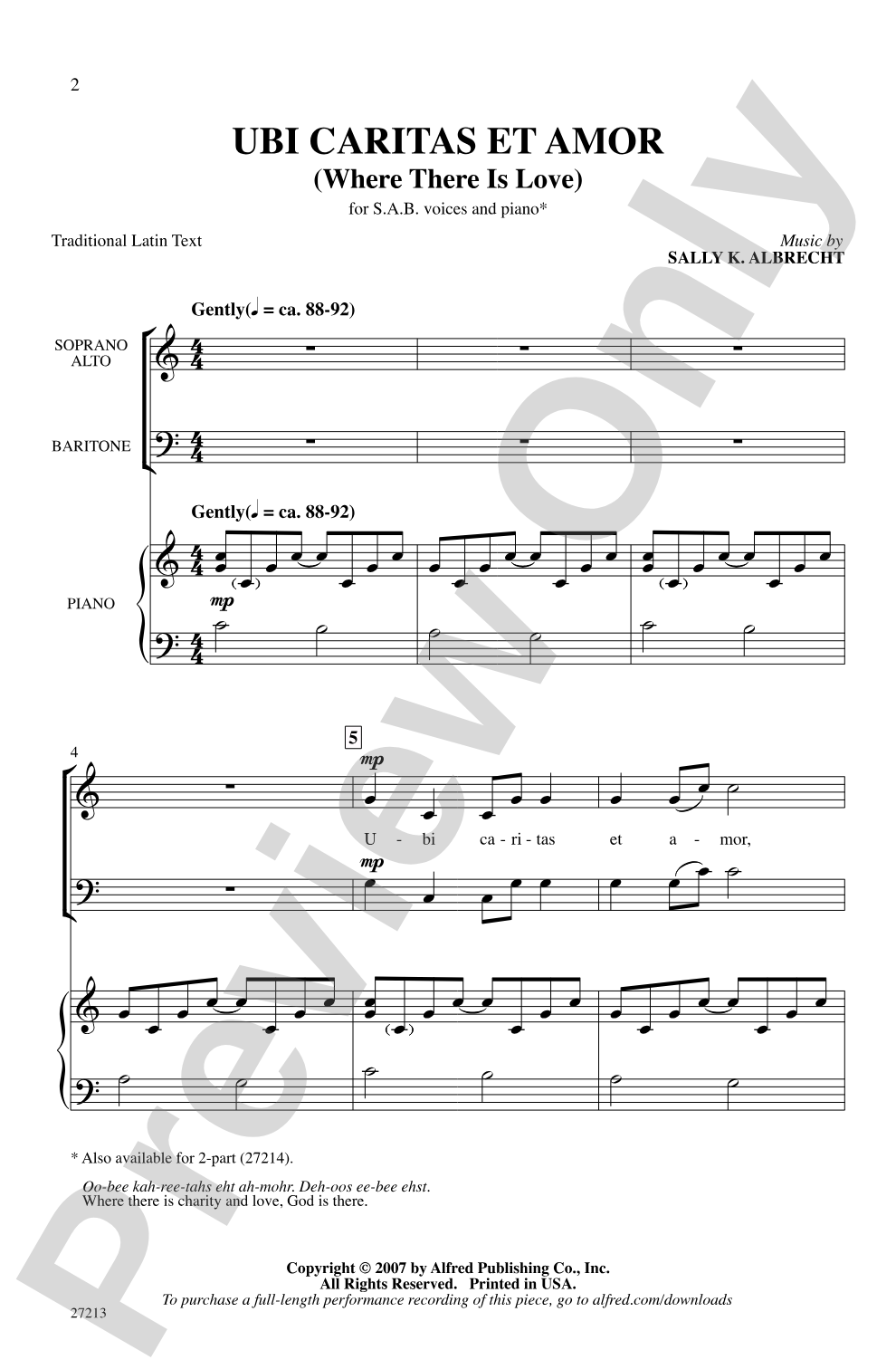
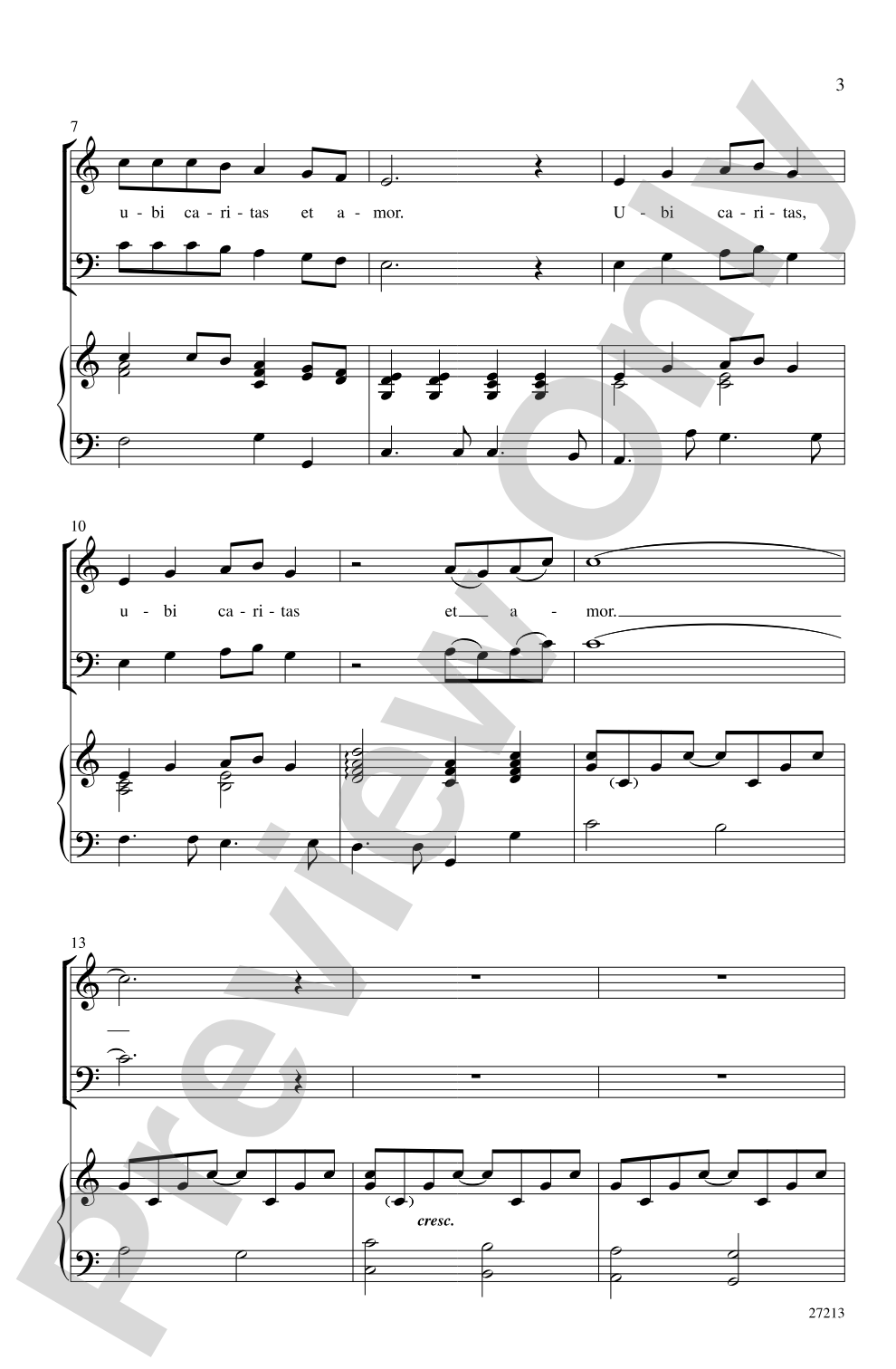

Ubi Caritas et Amor (Where There Is Love): SAB Choral Octavo
Traditional Latin Text, music by Sally K. Albrecht
Item: 00-PO-0000326
$1.75
Minimum order quantity: 20 copies
Pickup currently not available
Description
A poignant setting of the Latin text which translates to "Where there is charity and love, God is there." The piece opens quietly, with a unison statement of the melody. Teaching suggestion: teach the melody to all parts, and they've learned most of the piece. It's beautiful in its simplicity and clarity. Choirs of all ages will sound good on this work at contests, festivals, and adjudications.


Ubi Caritas et Amor (Where There Is Love): SAB Choral Octavo isn't in MakeMusic Cloud just yet...but it could be. Let us know you'd like to see it, and you'll help shape what comes next. In the meantime, start a free trial and dive into thousands of interactive titles your students can play along with today.
Request This Title
Tell us you want it.
Start Your Free Trial
Explore everything that's ready to play right now.
Sample Audio
1
Audio File
--:--
0:00
0:00
Sample Video
No sample videos found.
Additional Details
Series:
Alfred Choral Designs
Publisher:
Alfred Music
Page Count:
12
SKU:
00-PO-0000326
More about this title
About the Composer: Sally K. Albrecht

Sally K. Albrecht has shaped choral music education for over three decades, serving as Director of School Choral, Vocal, and Elementary Publications at major educational publishers, most notably Alfred Music. A prolific composer with more than 600 choral works and 75 musicals and songbooks in print, she has earned the ASCAP Special Music Award annually since 1987 and conducted honor choirs at prestigious venues including Lincoln Center, Carnegie Hall, and The Kennedy Center.
Albrecht holds degrees from Rollins College (B.A. in Music and Theater, 1976), the University of Miami (M.A. in Drama, 1977; M.M. in Accompanying, 1979), and has taught at Oakland University, Jersey City State College, and Meredith College. Her distinctive approach to choral music, particularly her integration of movement with singing, has influenced generations of directors and students. She resides in Wake Forest, North Carolina, and serves on the Board of Trustees at Rollins College.
Why we love this
Albrecht's setting demonstrates the pedagogical wisdom that defines her work. Rather than complicating a timeless text with elaborate counterpoint, she lets the melody breathe in unison, then gradually layers the voices in ways that emerge naturally from the music itself. Your singers will feel the dignity of the Latin text while gaining confidence from an arrangement that trusts simplicity.
What to expect
The music opens with an intimate quality, as if a single voice is offering a prayer. When the harmonies enter, they deepen the moment rather than interrupt it, creating a sense of community gathering around a shared truth. The piece maintains a hushed, contemplative character throughout, inviting singers and listeners into genuine musical stillness.
Who it's for
This octavo works for intermediate to advanced choirs across middle school, high school, and adult levels. Directors seeking repertoire that earns adjudication recognition without requiring virtuosic vocal technique will find this piece especially valuable for contest and festival programming.
How to get the most out of it
- Begin in a quiet, reverent dynamic. The unison opening establishes the melody with clarity; resist the urge to overdrive the sound even when additional parts enter.
- Since all three parts share the main melodic material at some point, use sectional rehearsal strategically. Teach melody first across the entire choir, then separate voices to learn their specific lines in context.
- Shape the piece through text underlay rather than dramatic tempo shifts. Let the natural cadences and Latin phrasing guide your releases and breathing.
- Balance the middle voices carefully in SAB voicing. The alto line often carries harmonic color that can be lost if not given space equal to the sopranos.
How to use it
Program this as an anchor for a sacred or liturgical concert set, where it can stand alone or frame other choral works. Its accessibility makes it an excellent choice for mid-concert placement, offering your audience a moment of reflection before moving to more energetic repertoire. The piece also serves well in multidenominational school or community choral concerts where sacred music transcends sectarian boundaries.
Skills your students will build
- singing sustained tones with consistent tone quality and breath support
- maintaining pitch accuracy in unison before adding harmonic complexity
- balancing three-part SAB voicing with attention to blend and inner-part clarity
- interpreting Latin text with appropriate diction and phrasing
- responding to subtle dynamic and expressive changes without relying on extreme contrasts