
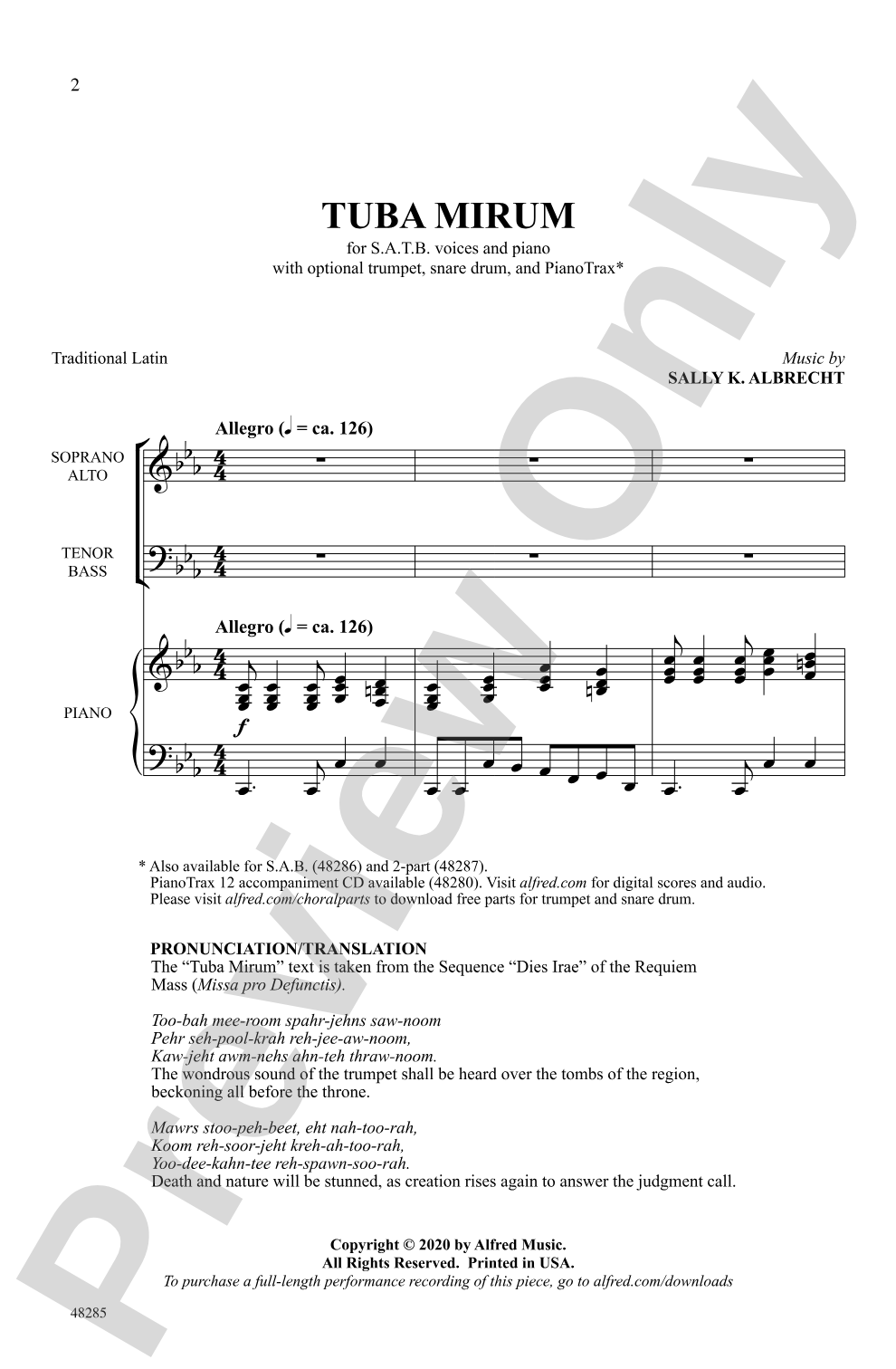

Tuba Mirum: SATB Choral Octavo
By Sally K. Albrecht
Item: 00-PO-0006290
$2.05
Minimum order quantity: 20 copies
Pickup currently not available
Description
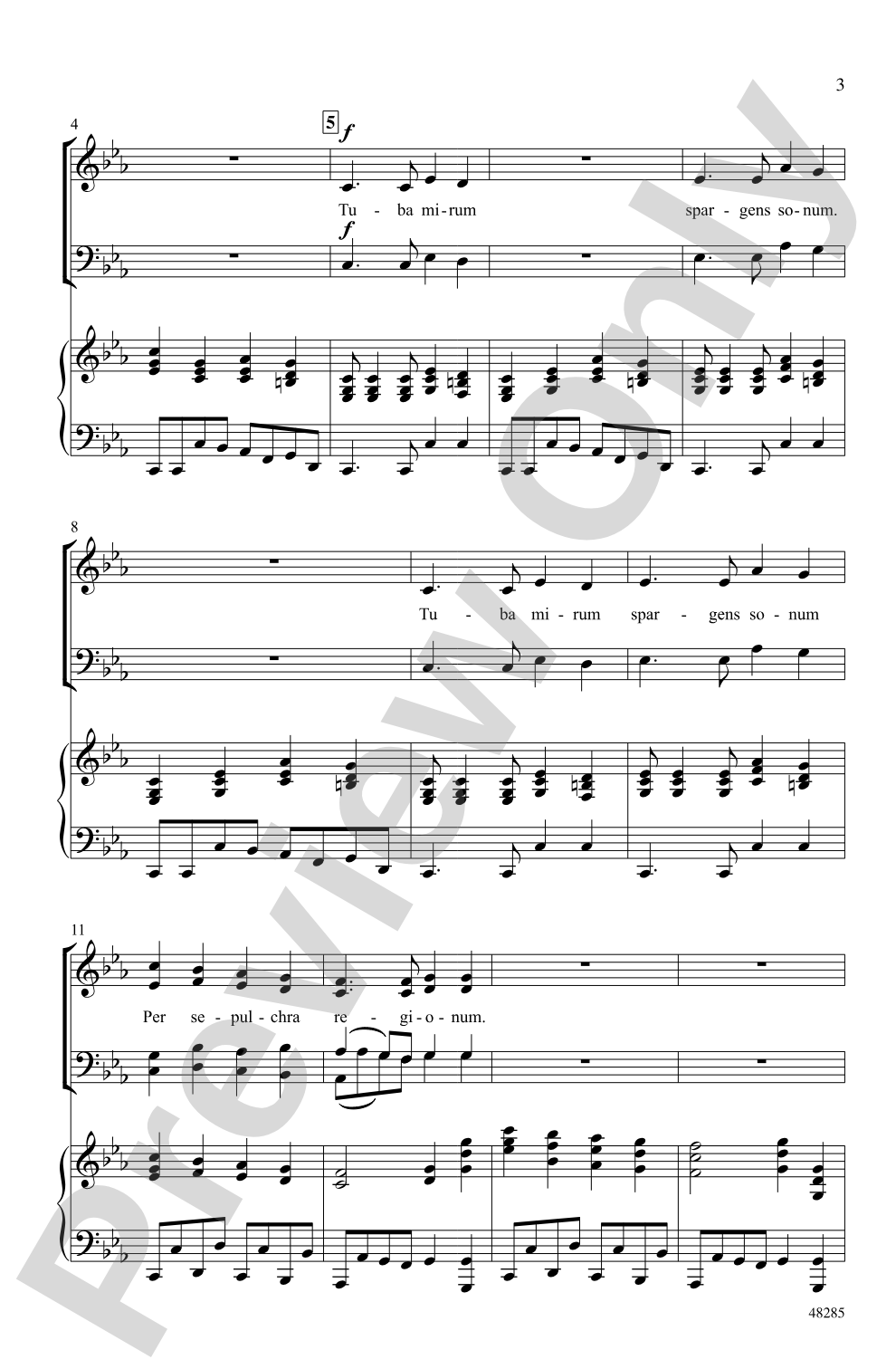
One of the most dramatic Latin texts from the Requiem Mass, powerfully rendered! The minor melody gradually unfolds before being traded antiphonally between voices. Optional trumpet and snare drum parts heighten the mood. Riveting in any voicing.


Tuba Mirum: SATB Choral Octavo isn't in MakeMusic Cloud just yet...but it could be. Let us know you'd like to see it, and you'll help shape what comes next. In the meantime, start a free trial and dive into thousands of interactive titles your students can play along with today.
Request This Title
Tell us you want it.
Start Your Free Trial
Explore everything that's ready to play right now.
Sample Audio
1
Audio File
--:--
0:00
0:00
Sample Video
1 / 2
Additional Details
Series:
Alfred Choral Designs
Publisher:
Alfred Music
Page Count:
8
SKU:
00-PO-0006290
More about this title
About the Composer: Sally K. Albrecht

Sally K. Albrecht has shaped American choral music for over three decades as a composer, conductor, and clinician with a particular gift for integrating movement into choral performance. Her catalog spans more than 600 published works, from octavos to full-length musicals, and she has been recognized annually by ASCAP since 1987 for her contributions to music. She has conducted honor choirs at prestigious venues including Lincoln Center, Carnegie Hall, and The Kennedy Center, while serving for many years as Director of School Choral, Vocal, and Elementary Publications at Alfred Music.
Albrecht holds degrees from Rollins College (B.A. in Music and Theater, 1976), the University of Miami (M.A. in Drama, 1977; M.M. in Accompanying, 1979), and has taught at Oakland University, Jersey City State College, and Meredith College. She received the Distinguished Alumna Award from both the University of Miami Frost School of Music and Rollins College in 2021, and served as Chair of the Board of Trustees for the Omicron Delta Kappa National Leadership Honor Society.
Why we love this
Albrecht takes one of the liturgy's most potent moments and builds it around a melody that unfolds with theatrical restraint before erupting into antiphonal exchanges. The optional trumpet and snare drum parts elevate the drama without demanding an expanded ensemble, making this accessible yet genuinely powerful for choirs looking to program something with real gravitas.
What to expect
The piece inhabits a space of solemn contemplation that gradually intensifies. As the melody passes between voices in alternating phrases, the texture builds toward something urgent and declarative, heightened by the optional percussion. The Latin text carries weight, and Albrecht's harmonic choices ensure the gravity of "Tuba Mirum" (the trumpet's terrible call) resonates throughout.
Who it's for
This octavo serves choirs preparing concert or festival programs who want to include sacred repertoire with dramatic impact and manageable forces. SATB ensembles at the intermediate to advanced level will find the harmonic language and text understandable, while the optional instrumental parts allow groups with brass and percussion to enhance the performance.
How to get the most out of it
- Shape the opening minor melody with careful dynamic control; let each phrase breathe before passing it between voice sections, resisting the urge to rush the gradual unfolding.
- Balance the antiphonal exchanges so that each voice group claims its moment with authority while remaining rhythmically locked to the other sections.
- If using the optional trumpet and snare drum parts, rehearse them separately first to ensure the percussion sits as a rhythmic anchor rather than pushing the tempo forward.
- Experiment with spatial positioning (dividing SATB groups) to maximize the antiphonal effect during rehearsal, even if your concert staging must remain more traditional.
How to use it
Pair this with other Requiem movements or sacred works to create a thematic evening, or position it as a standalone concert centerpiece that demonstrates your choir's ability to tackle liturgical text with musical maturity. Its 8-page length makes it ideal for a mixed concert where you're balancing multiple genres and styles.
Skills your students will build
- Singing antiphonal exchanges between voice sections with rhythmic precision
- Sustaining dynamic control through gradual textural expansion
- Interpreting Latin sacred text with appropriate phrasing and diction
- Balancing SATB sonority across extended minor-key harmonies
- Coordinating with optional instrumental parts (trumpet and snare drum)