

Tshepa Thapelo: SATB, a cappella Choral Octavo
Sotho Folk Song / arr. Ruth Morris Gray
Item: 00-PO-0003247
$1.90
Minimum order quantity: 20 copies
Pickup currently not available
Related Items
Tshepa Thapelo: 3-Part, a cappella Choral Octavo |
$1.90
|
View | |
Tshepa Thapelo: SSA, a cappella Choral Octavo |
$1.90
|
View | |
Tshepa Thapelo: SATB, a cappella Choral Octavo |
$1.90
|
View | |
Tshepa Thapelo: 3-Part, a cappella Choral Octavo |
$1.90
|
View | |
Tshepa Thapelo: SSA, a cappella Choral Octavo |
$1.90
|
View |
Description
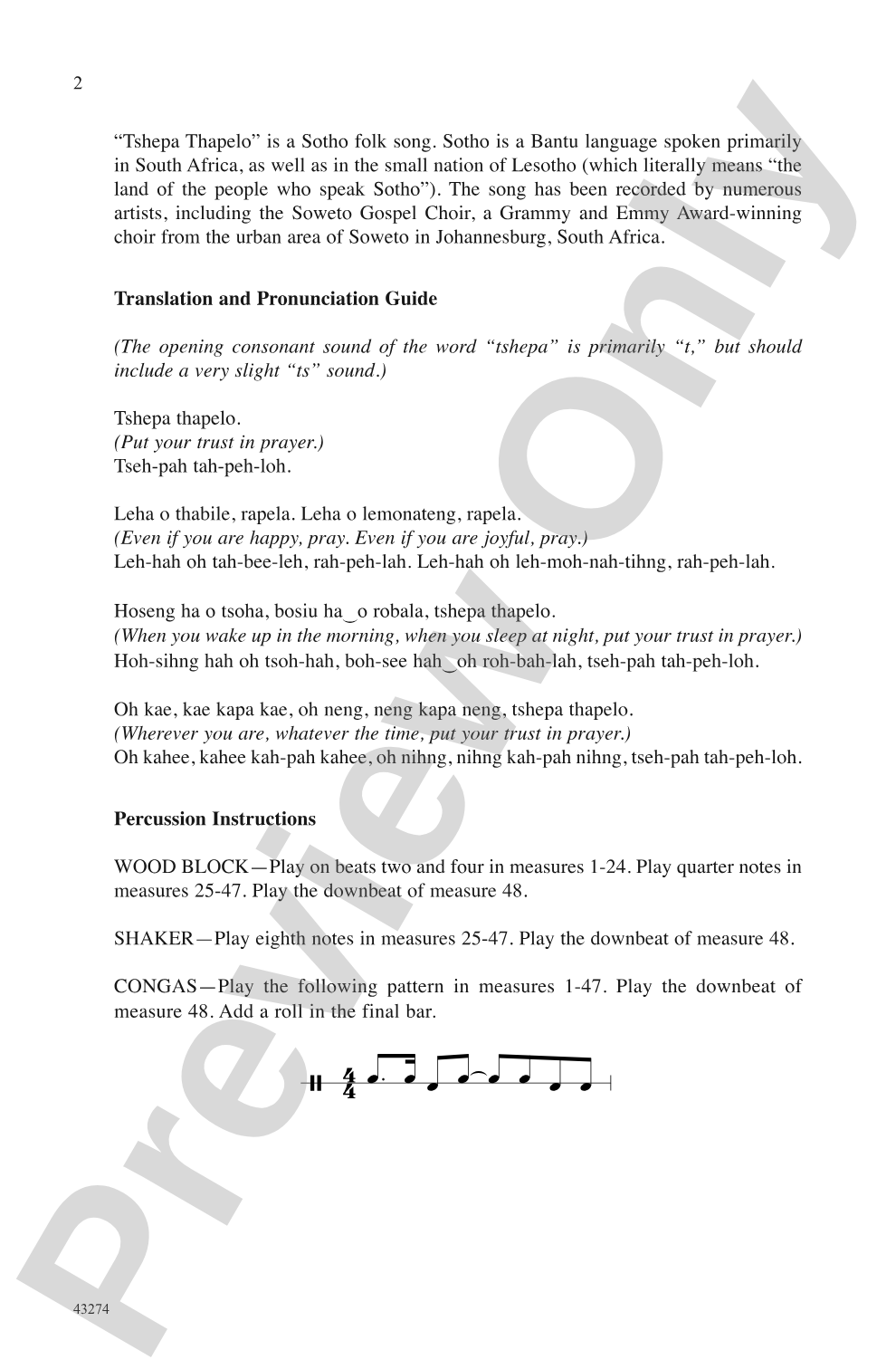
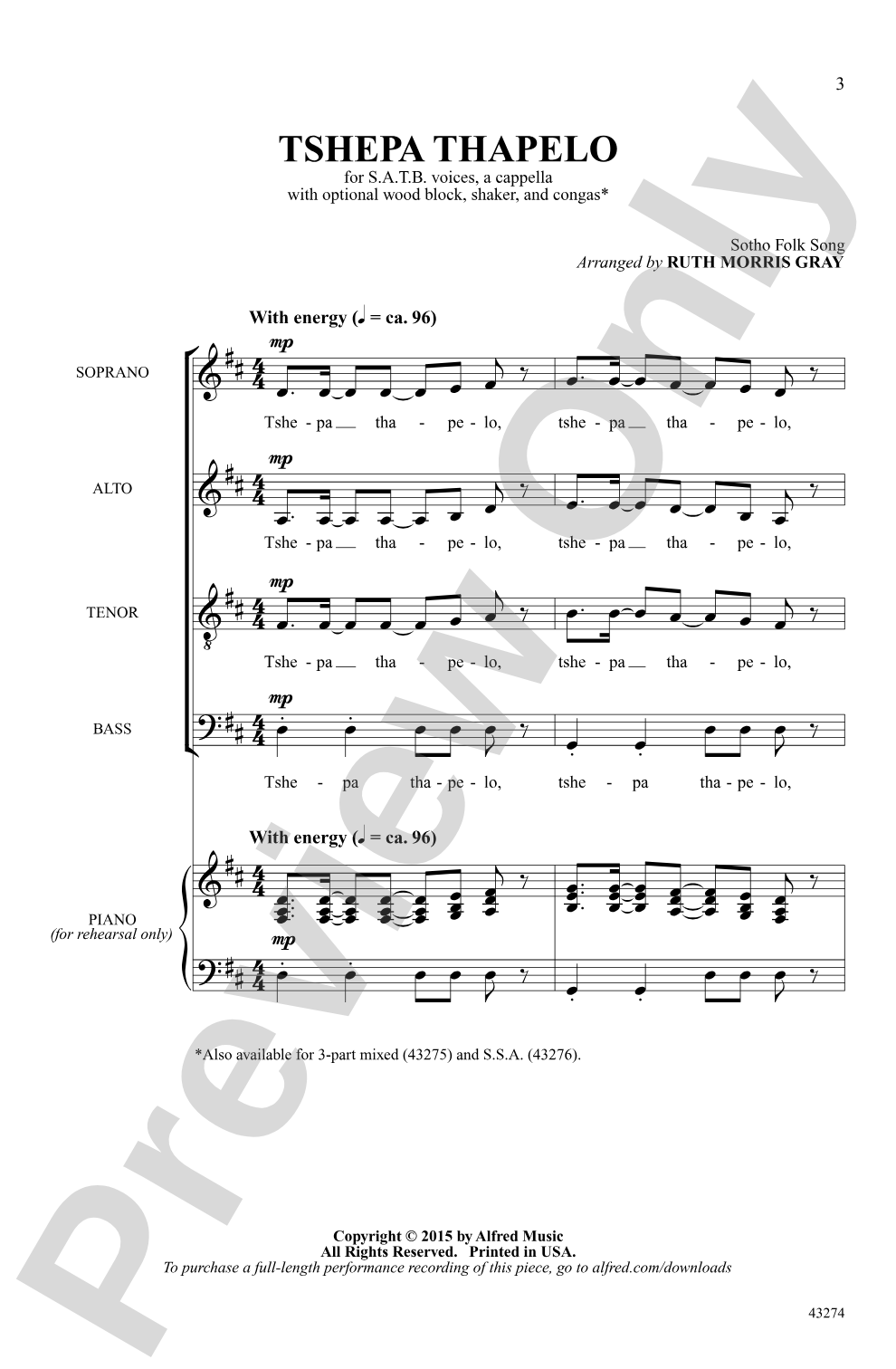
An irresistible a cappella arrangement of the authentic Sotho folk song! Solid choral harmonies and infectious rhythms (supported with optional percussion patterns) create a backdrop for special features by the basses and sopranos. A rarely-heard slow African groove.


Tshepa Thapelo: SATB, a cappella Choral Octavo isn't in MakeMusic Cloud just yet...but it could be. Let us know you'd like to see it, and you'll help shape what comes next. In the meantime, start a free trial and dive into thousands of interactive titles your students can play along with today.
Request This Title
Tell us you want it.
Start Your Free Trial
Explore everything that's ready to play right now.
Sample Audio
1
Audio File
--:--
0:00
0:00
Sample Video
No sample videos found.
Additional Details
Series:
Alfred Choral Designs
Publisher:
Alfred Music
Page Count:
12
SKU:
00-PO-0003247
More about this title
About the Arranger: Ruth Morris Gray

Ruth Morris Gray directs choirs at Rosemead High School in California, where she has built a thriving choral program since 2004. She also teaches piano and has composed over 100 pieces for choral ensembles. Her training spans performance and composition, with degrees from Biola University, UC Santa Barbara, and California State University, Northridge.
Beyond the choir room, Gray remains active as a performer and composer while pursuing her passion for travel, reading, and cycling.
Why we love this
Ruth Morris Gray brings an arranger's ear for authentic cultural material combined with the practical wisdom of a high school choral director. The arrangement honors the Sotho folk tradition while giving every section (especially basses and sopranos) a chance to shine, making it engaging for singers at multiple levels. The optional percussion patterns open a door for creative staging and collaboration without requiring your singers to become percussionists.
What to expect
An unhurried but propulsive groove that settles into your body the way traditional music does. The Sotho melody carries genuine warmth and accessibility, while the four-part harmony creates sophistication beneath an apparently simple surface. There is joy here, grounded in something real and unfamiliar.
Who it's for
High school and advanced middle school choirs seeking a multicultural piece that energizes singers and audiences without relying on a piano or instruments. This works especially well for groups with rhythmic confidence and interest in folk traditions beyond the Western European canon.
How to get the most out of it
- Lock the rhythm between sections early in rehearsal. The infectious groove depends on precision, so isolate the harmonic backbone (SATB parts without text) and drill it to a metronome before adding choreography or percussion.
- Shape the bass line with particular care. These singers carry the groove; have them sing through their entrance and feel where the pulse sits relative to the harmonic motion above.
- Explore the optional percussion patterns as an ensemble choice, not a requirement. Even light hand percussion or body percussion can anchor the groove if your singers need support, but the piece stands beautifully on its own with voices alone.
- Highlight soprano and bass solos in separate rehearsals so they own their moments. Knowing their featured passages are solid will free the rest of the ensemble to listen and respond rather than cover for weak spots.
How to use it
Program this alongside other world music selections to create a focused set on authentic folk traditions, or use it as a concert centerpiece that feels both fresh and rooted. Its infectious energy makes it an ideal piece for a spring or multicultural concert, and it could anchor a program exploring rhythm across cultures.
Skills your students will build
- Reading and performing rhythmic independence in ensemble texture
- Sustaining and shaping a cappella tone with four moving parts
- Responding to and communicating with a groove-based pulse
- Interpreting cultural context and style in unfamiliar folk material
- Balancing part security with expressive soloistic singing