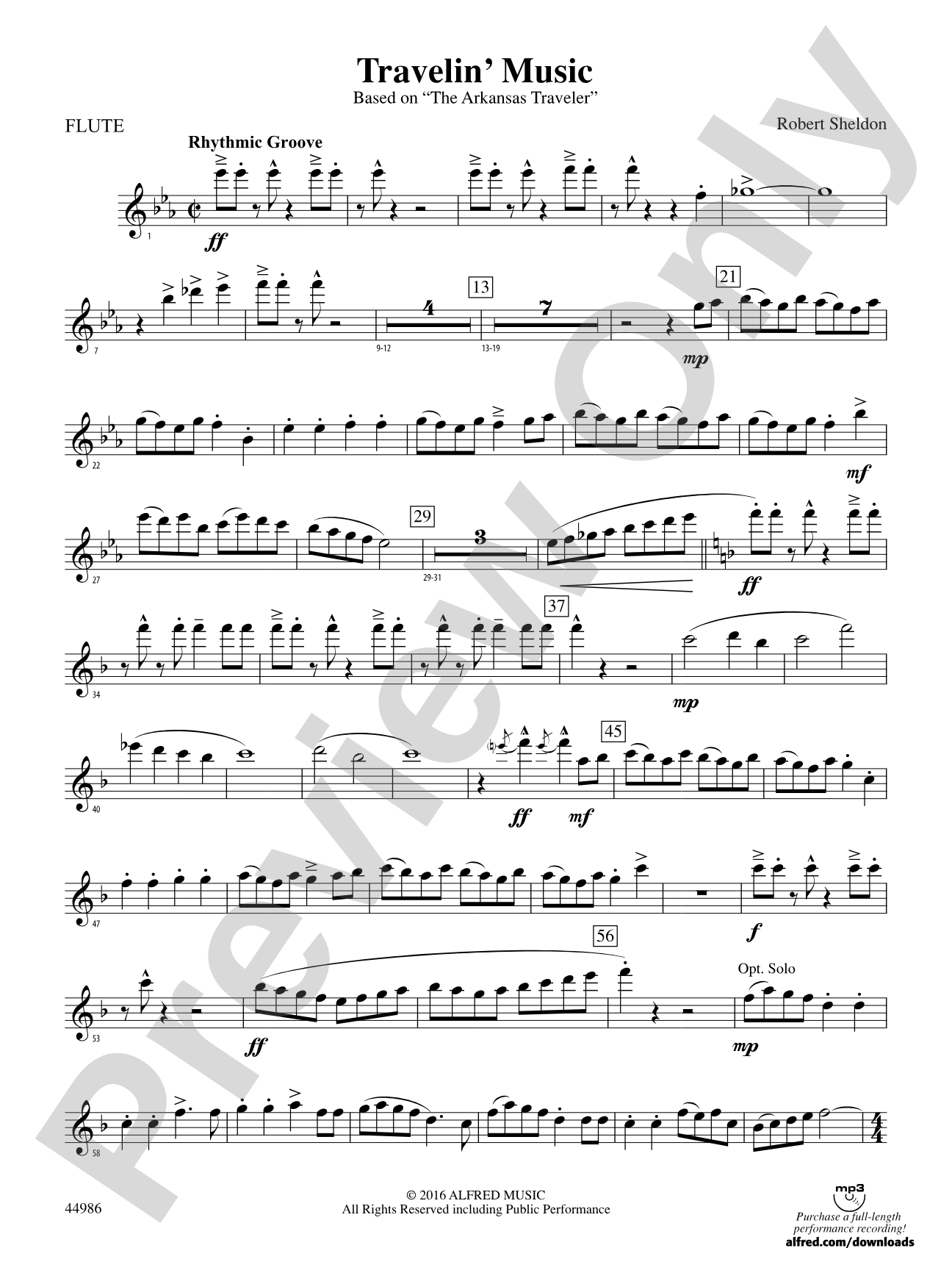
Travelin' Music: Flute Sheet Music Preview

Travelin' Music: Flute

Based on "The Arkansas Traveler"

Arr. Robert Sheldon

Grade: 3 (Medium)

Item: 00-PC-0017451_F1

Digital Download
$3.00
Description
"The Arkansas Traveler" is one of the most popular and well known of all Arkansas folk songs. Originally a fiddle tune, this rendition is set in a cajun groove, and uses a number of compositional techniques to explore and develop the tune in many unexpected ways. Great fun to play, and certain to delight audiences! (2:50)

Don't just read it, hear it, play along with it, and watch your students grow with it. In MakeMusic Cloud, Travelin' Music: Flute comes alive with professional accompaniment, adjustable tempo, and built-in practice tools that turn solo practice into real progress.

Sample Audio
0:00
0:00
Sample Video
Additional Details
Series: Young Symphonic
Publisher: Alfred Music
Page Count: 258
SKU: 00-PC-0017451_F1

More about this title

About the Composer: Robert Sheldon

Robert Sheldon

Robert Sheldon stands among the most frequently performed composers in wind band repertoire today. His works appear regularly on contest lists and concert programs worldwide, and his commissions continue to shape the landscape of band music. Beyond composing, Sheldon has shaped music education directly as lead author of Sound Innovations for Concert Band, a resource used in countless classrooms.

His contributions have earned recognition from the American School Band Director's Association, Phi Beta Mu, and ASCAP. Sheldon maintains an active schedule as guest conductor for All-State and Regional Honor Bands, and his clinician work has taken him across the United States and to Japan, Canada, Italy, Germany, Australia, and China. His compositions have been performed at Carnegie Hall, Orchestra Hall in Chicago, Boston Symphony Hall, the Sydney Opera House, and the Kennedy Center. VanderCook College of Music awarded him an honorary doctorate in 2020.

Why we love this

Sheldon takes a folk melody that students recognize and respect, then rebuilds it through smart compositional choices that keep the band engaged. The cajun groove sets a contemporary energy while maintaining the tune's character, and the developmental writing keeps everyone playing something interesting rather than doubling the melody for two and a half minutes.

What to expect

A folk melody gets a modern makeover and a sense of humor. The cajun groove gives it groove and energy, while unexpected harmonic and melodic turns keep listeners guessing. By the end, the familiar tune has traveled somewhere surprising and fun.

Who it's for

Grade 3 bands ready to move beyond straightforward melodies into arrangement and development. Students benefit from playing a tune they may recognize, which builds confidence while they navigate Sheldon's more sophisticated treatment of harmony and form.

How to get the most out of it

  • Establish the cajun groove early in rehearsals by locking the percussion into a tight rhythm section; this foundation makes the melodic sections land with clarity.
  • Balance the tutti sections carefully so the development passages don't overwhelm the original tune when it returns; mark your cut-to-balance points in the score.
  • Let the ensemble feel the relaxed pulse of the groove rather than fighting it with a rigid tempo; this tune breathes.
  • Highlight the unexpected compositional moments and harmonic turns for your band so they understand why audiences will react with delight rather than predictability.

How to use it

Program this as a concert opener or mid-concert palette cleanser; its accessibility and audience recognition make it excellent for building momentum early. The tune's folk origins and contemporary groove also work well in programs exploring American musical traditions or cultural diversity.

Skills your students will build

  • Maintaining steady rhythm within a groove-based accompaniment
  • Recognizing compositional development and variation techniques
  • Balancing melody against active harmonic and rhythmic accompaniment
  • Interpreting stylistic markings and articulation in a contemporary folk setting

You May Also Like