
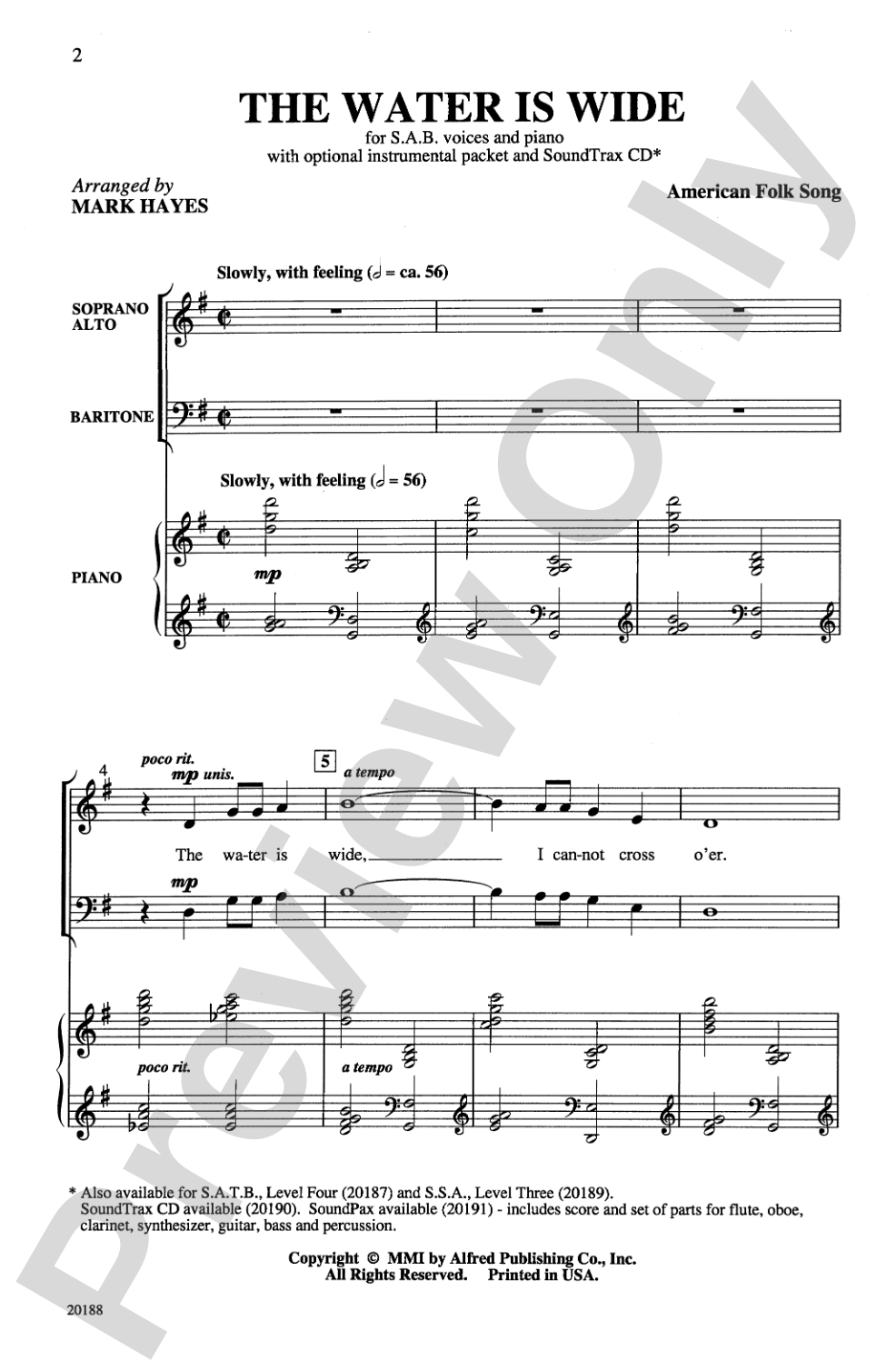
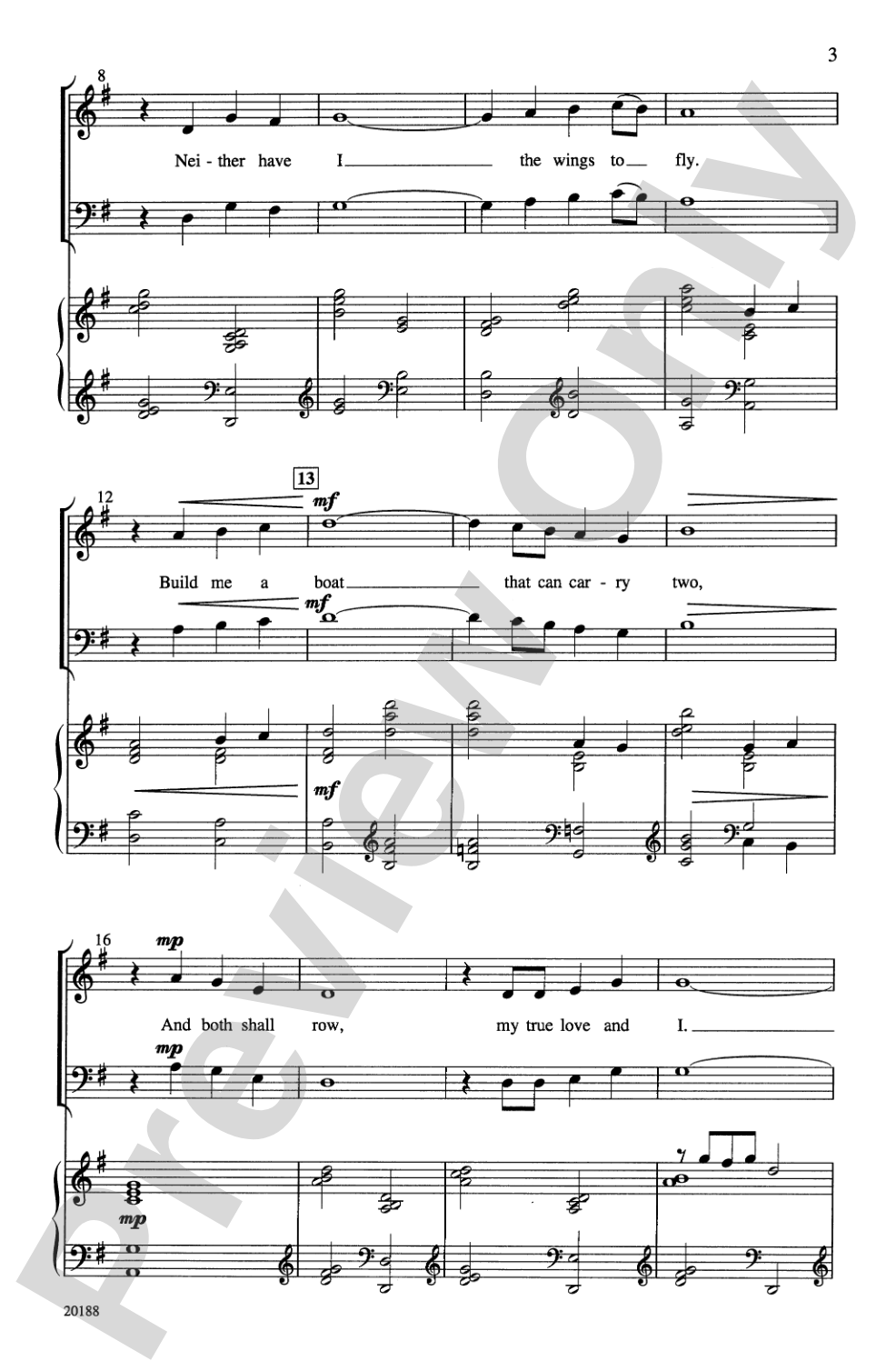

The Water Is Wide: SAB Choral Octavo
Arr. Mark Hayes
Item: 00-PO-0002886
$2.25
Minimum order quantity: 20 copies
Pickup currently not available
Related Items
The Water Is Wide: SATB Choral Octavo |
$2.25
|
View | |
The Water Is Wide: SSA Choral Octavo |
$2.25
|
View | |
The Water Is Wide: SATB Choral Octavo |
$2.25
|
View | |
The Water Is Wide: SAB Choral Octavo |
$2.25
|
View | |
The Water Is Wide: SSA Choral Octavo |
$2.25
|
View | |
The Water Is Wide: Choral Octavo SoundTrax CD |
$27.99
|
View | |
The Water Is Wide: Choral SoundPax |
$20.00
|
View |
Description
This new arrangement by Mark Hayes is destined to become a classic and a favorite of choral groups of any age. It's fresh, inventive, yet rich in choral tradition---hallmarks of Mark Hayes' writing. The first verse is strong unison writing, the second features an echo section, the third is voiced with lush, fluid harmonies, and the fourth scores the female voices in counterpoint with the men. The arrangement fades away, "like the morning dew." Outstanding SoundPax and SoundTrax CD.


The Water Is Wide: SAB Choral Octavo isn't in MakeMusic Cloud just yet...but it could be. Let us know you'd like to see it, and you'll help shape what comes next. In the meantime, start a free trial and dive into thousands of interactive titles your students can play along with today.
Request This Title
Tell us you want it.
Start Your Free Trial
Explore everything that's ready to play right now.
Sample Audio
1
Audio File
--:--
0:00
0:00
Sample Video
No sample videos found.
Additional Details
Series:
Alfred Archive Edition: Alfred Choral Designs
Publisher:
Alfred Music
Page Count:
12
SKU:
00-PO-0002886
More about this title
About the Arranger: Mark Hayes

Mark Hayes has composed and arranged over 1,750 published works across sacred and secular genres. A pianist, conductor, and orchestrator of international stature, Hayes holds a Bachelor of Music degree summa cum laude in Piano Performance from Baylor University (1975) and has guest conducted at Lincoln Center, the National Cathedral, and Carnegie Hall. His output spans choral literature, orchestral works, musical theater scores, and an extensive catalog of piano repertoire.
Hayes received the Award for Exemplary Leadership in Christian Music from Baylor University in 2010. He has premiered major works at prestigious venues, including his Requiem at Lincoln Center (2013) and St. Ignatius Basilica in Rome as part of the Vatican-sponsored Festival Pro Musica E Arte Sacra (2014). His compositions and arrangements are performed worldwide, and his work balances technical craftsmanship with accessibility for performers of varying levels.
Why we love this
Hayes crafts this folk melody with genuine structural artistry, moving your singers through four distinct textural zones that keep the performance fresh without sacrificing the song's emotional core. The progression from unison to echo effects to dense harmonies to counterpoint feels inevitable rather than arbitrary, and the fade ending ('like the morning dew') gives singers a poetic moment they'll actually believe in. This is the kind of arrangement that works equally well with high school choirs and adult community ensembles because Hayes respects both the simplicity of the tune and the intelligence of the performers.
What to expect
The Water Is Wide unfolds like a meditation on a familiar melody. Hayes honors the folk tune's inherent tenderness while layering it with structural interest that draws listeners inward, never outward. There's an intimacy in watching the arrangement unfold from bare unison to intricate counterpoint and back to stillness, creating a sense of arrival and rest rather than spectacle.
Who it's for
SAB arrangements work well for choirs with strong treble sections and developing lower voices, making this ideal for high school beginning choirs, community ensembles, and church choirs with mixed experience levels. The straightforward harmonic language and singable ranges accommodate both skilled musicians and those still building confidence. Directors seeking a folk standard that doesn't require octavos in four or five parts will find this particularly useful.
How to get the most out of it
- Build the dynamic trajectory carefully across the four verses. The unison opening should sit quietly; each subsequent section gains textural weight, not just volume. Let the counterpoint in the final verse speak clearly before the fade.
- Attend to the echo sections with precision. These moments require rhythmic lock between the answering voices and the original line. A slight breath between statement and echo clarifies the technique without breaking the song's legato quality.
- Shape the closing fade with intention. This is not a slow decrescendo into nothing; it's a deliberate dissolution, almost as if the sound is being absorbed into silence. Singers should sustain pitch and intonation through the diminishment.
How to use it
This arrangement fits naturally into programs centered on American folk heritage, seasonal concerts, or thematic programming around water, loss, or contemplation. Its modest instrumental requirements (the octavo works with piano accompaniment) make it a strong choice for spring concerts or intimate settings like church services, and the recorded accompaniments give directors flexibility for rehearsal or performance.
Skills your students will build
- Singing in unison with secure pitch and blend
- Executing echo effects with rhythmic clarity
- Balancing four-part SAB harmony with attention to inner voices
- Reading and performing counterpoint between upper and lower voices
- Sustaining pitch during dynamic shifts and textural changes