
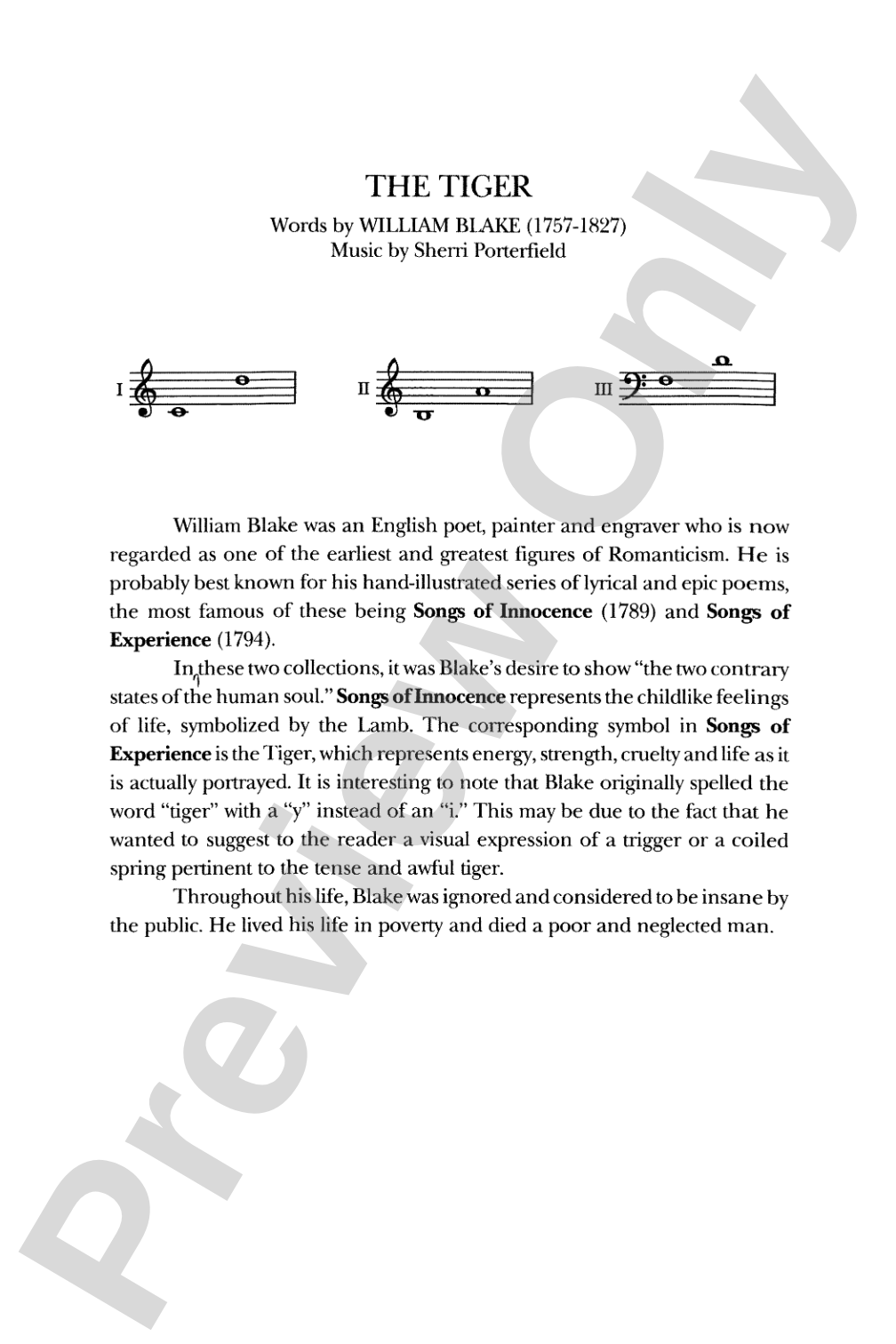
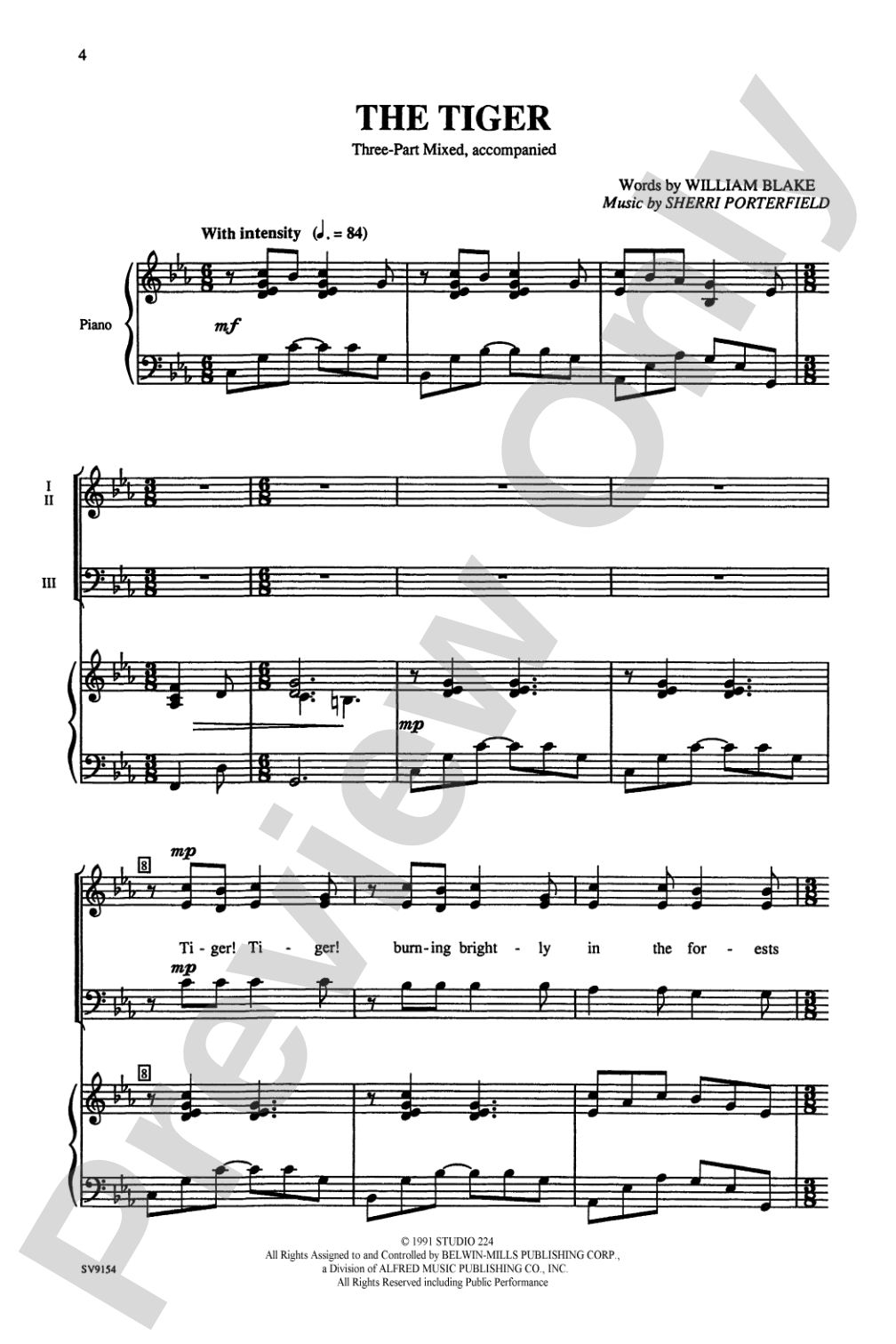

The Tiger: 3-Part Mixed Choral Octavo
By Sherri Porterfield
Level: Moderate
Item: 00-PO-0002743
$2.05
Minimum order quantity: 20 copies
Pickup currently not available
Description
Musical life is breathed into William Blake's stunning text. Intensity builds throughout this well-constructed work. Sherri captures the excitement, the fear, and dread of the tiger. A wonderful new work for concert, contest or festival. Creative yet accessible. This title is available in MakeMusic Cloud and Music Prodigy. This title is available in MakeMusic Cloud.


The Tiger: 3-Part Mixed Choral Octavo isn't in MakeMusic Cloud just yet...but it could be. Let us know you'd like to see it, and you'll help shape what comes next. In the meantime, start a free trial and dive into thousands of interactive titles your students can play along with today.
Request This Title
Tell us you want it.
Start Your Free Trial
Explore everything that's ready to play right now.
Sample Audio
1
Audio File
--:--
0:00
0:00
Sample Video
No sample videos found.
Additional Details
Publisher:
Alfred Music
Page Count:
12
SKU:
00-PO-0002743
More about this title
About the Composer: Sherri Porterfield

Sherri Porterfield leads the choral program at Cedar Park Middle School in Cedar Park, Texas, and has directed award-winning choirs across Missouri, Kansas, and Texas. Her ensembles have earned numerous first-place finishes at competitions and performed at state music educators conventions. She has also served as an adjunct assistant professor of music education at the University of Missouri-Kansas City Conservatory of Music and regularly works as a clinician and guest conductor with honor choirs throughout the country.
With over 175 published choral compositions to her name, Porterfield has maintained an active career as a composer represented by Alfred Music Publishing and other major houses. She has received yearly ASCAP awards since 1997 and holds degrees from the University of Memphis (B.S.E. in music education) and the University of Missouri-Kansas City (Master of Music in choral conducting). Her contributions to music education have earned her recognition in multiple editions of Who's Who publications, and she holds memberships in the Texas Music Educators Association, American Choral Directors Association, and ASCAP.
Why we love this
Blake's text demands musical sophistication, and Porterfield delivers without overcomplicating the voices. The way intensity accumulates from opening to climax makes this engaging for both singers and audiences, rewarding the director's preparation with a piece that builds genuine dramatic impact. At grade 3, the part writing stays manageable while the emotional arc feels substantial.
What to expect
The music captures the paradox of Blake's tiger: menacing yet mesmerizing, powerful yet contained within formal elegance. Energy accumulates steadily, pulling singers and listeners forward through growing tension until the final moment crystallizes the wonder and dread that Blake's poem evokes.
Who it's for
Middle school and early high school choirs seeking a piece that challenges them musically while remaining within their technical reach. Directors looking for a substantial contest or festival selection will find the dramatic arc and carefully crafted harmonies rewarding at this grade level.
How to get the most out of it
- Shape the dynamic rise carefully over the full length of the piece. Resist the urge to start loud; let the tension emerge gradually so the final intensity feels earned rather than exhausted.
- Attend to Blake's vivid imagery by encouraging singers to visualize the tiger's movement and power. The physicality of that commitment will deepen the musicality naturally.
- Balance SAB voicing by ensuring the alto line sits securely in tune; this middle voice anchors the harmonic color and prevents the sonority from thinning during exposed moments.
- Use the recorded accompaniment as a reference during rehearsal, but move toward independent singing as the ensemble gains confidence. Independence strengthens their awareness of how their part functions within the whole texture.
How to use it
Pair this with concert programming that spans mood and energy. A performance arc that opens with lighter material and builds toward this work's intensity creates memorable programming. Its twelve pages allow it to function as a centerpiece in a concert or festival set without overwhelming time constraints.
Skills your students will build
- Building and sustaining dynamic intensity through longer phrases
- Balancing part independence in 3-part mixed voicing
- Interpreting poetic text through musical choices and character
- Reading harmonic language with moderate chromaticism
- Coordinate ensemble sound while maintaining individual vocal integrity