

The Stars and Stripes Forever: Piano
By John Philip Sousa / arr. Kevin Olson
Item: 98-DYA9019
$3.50
Pickup currently not available
Description
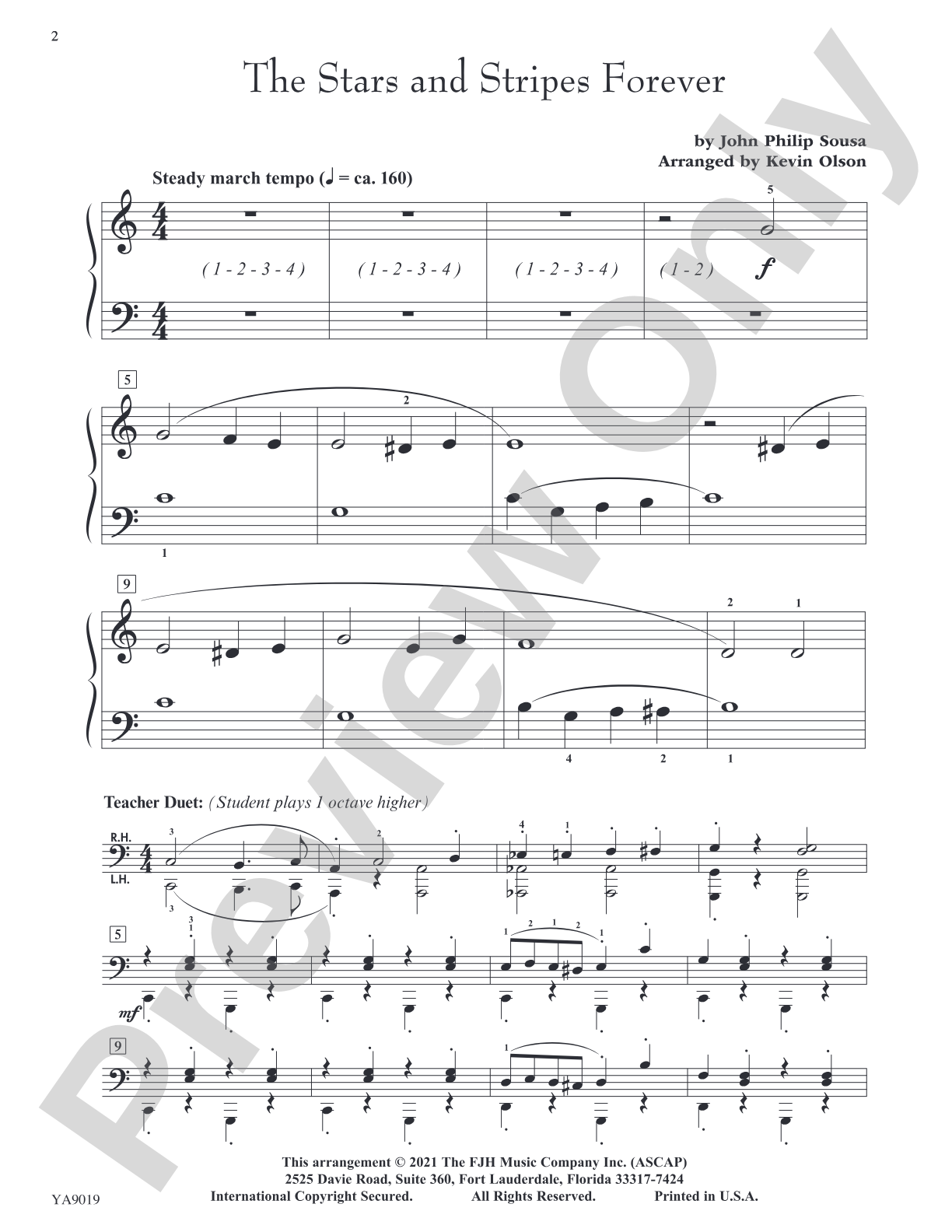
A rousing march in the key of C major is arranged with no eighth notes. Each hand plays a few accidentals, but remains close to the MC position. The interesting teacher duet makes you want to get up and join the parade! This would be a terrific choice for a Patriotic recital.


The Stars and Stripes Forever: Piano isn't in MakeMusic Cloud just yet...but it could be. Let us know you'd like to see it, and you'll help shape what comes next. In the meantime, start a free trial and dive into thousands of interactive titles your students can play along with today.
Request This Title
Tell us you want it.
Start Your Free Trial
Explore everything that's ready to play right now.
Sample Audio
No sample audio found.
Sample Video
No sample videos found.
Additional Details
Series:
Arranged For You
Publisher:
The FJH Music Company, Inc.
SKU:
98-DYA9019
More about this title
About the Composer: John Philip Sousa
John Philip Sousa (1854-1932) was an American composer and conductor whose marches defined a genre and shaped American musical identity. His facility for memorable melody, crisp orchestration, and infectious rhythmic drive made him one of the most performed composers in history. His works remain staples in band and orchestra curricula, introducing students to the march form and the precision required to bring patriotic music to life.
Beyond composition, Sousa was a skilled conductor and advocate for musicians' rights. His prolific output and commitment to accessible, well-crafted music ensured that his works would reach classrooms, concert halls, and civic celebrations across generations. For music educators, his marches offer both technical clarity and genuine musical substance.
Why we love this
Kevin Olson's arrangement captures the unmistakable energy of Sousa's most iconic march while keeping both hands comfortable for early elementary pianists. The teacher duet lifts this beyond a simple solo: it transforms the piece into a genuine collaboration that sparks joy in students and reminds them why they love performing together. This is the kind of arrangement that makes kids smile at the keyboard.
What to expect
Bright, processional, and celebratory. The march rhythm carries you forward with an almost irresistible momentum, and the familiar tune sits comfortably under the fingers, allowing performers to focus on bringing out the character rather than survival. There's genuine joy in playing something this recognizable and spirited.
Who it's for
Early elementary pianists preparing for their first recitals and students building confidence in sight-reading and hand position stability. The straightforward technical demands and familiar melody make this ideal for young performers who want the satisfaction of playing a "big" piece without wrestling with complex fingering or wide intervals.
How to get the most out of it
- Keep the tempo steady and confident; marches thrive on predictable pulse. Use a metronome in practice to lock in the rhythmic character before performing.
- Shape the melody with intentional phrasing rather than note-to-note evenness. Think of singing the tune as you play.
- Listen carefully to the teacher's duet part during rehearsals. The interplay between student and accompanist is what makes this arrangement special, so balance matters.
- Maintain clarity in the hand position work. Since the piece avoids large jumps, focus on clean articulation rather than pedal substitution.
How to use it
Program this as the concluding number in a patriotic or end-of-year recital, where its rousing character provides a satisfying send-off for the audience. The teacher duet also makes it a compelling choice for a student-teacher collaborative performance, bridging the gap between student recital pieces and ensemble experiences.
Skills your students will build
- Steady tempo and pulse maintenance in march style
- Hand position awareness with minimal position shifts
- Reading accidentals within a single tonal center
- Phrasing and shaping of melodic lines
- Listening and balance in duo performance