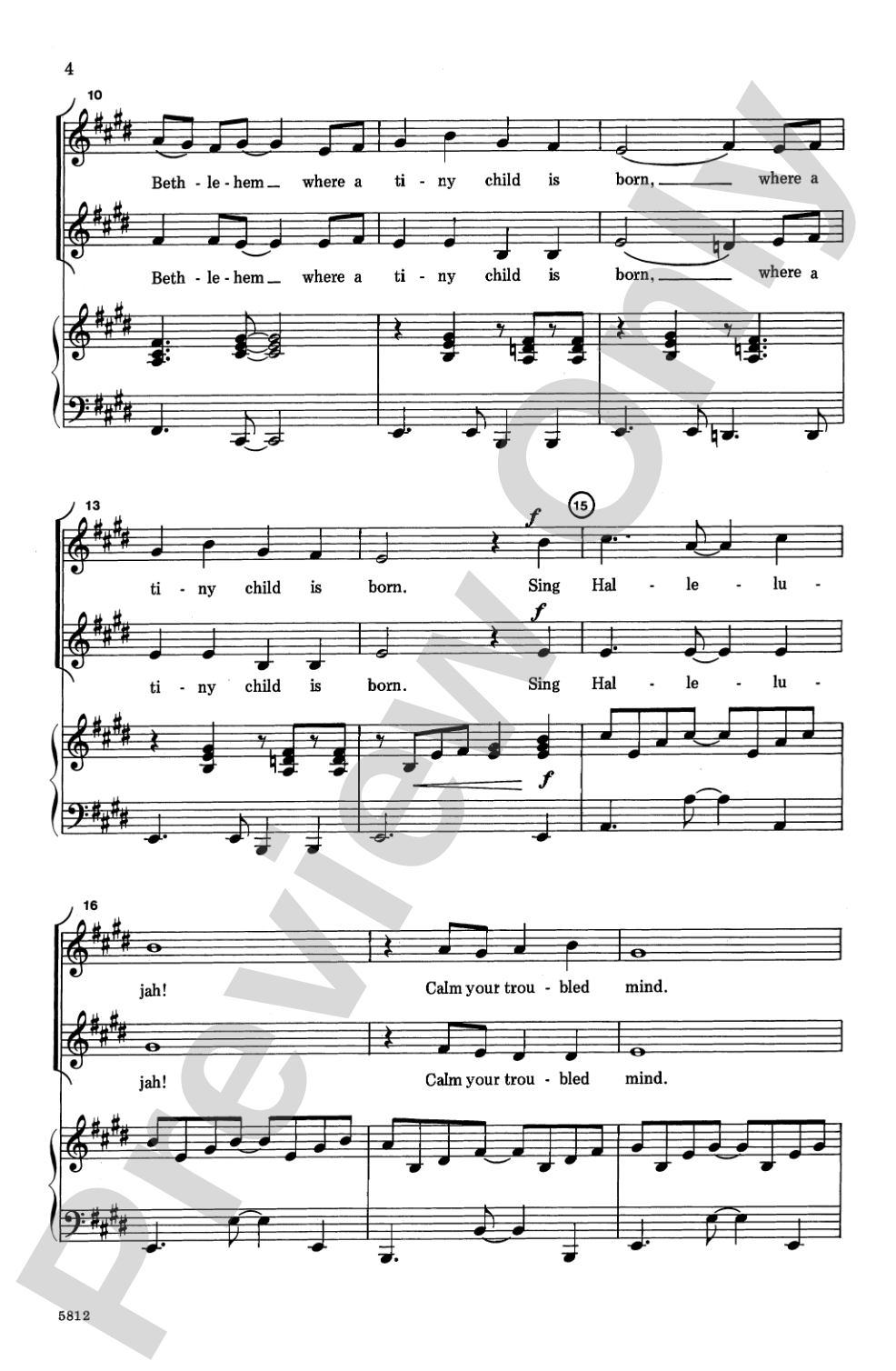
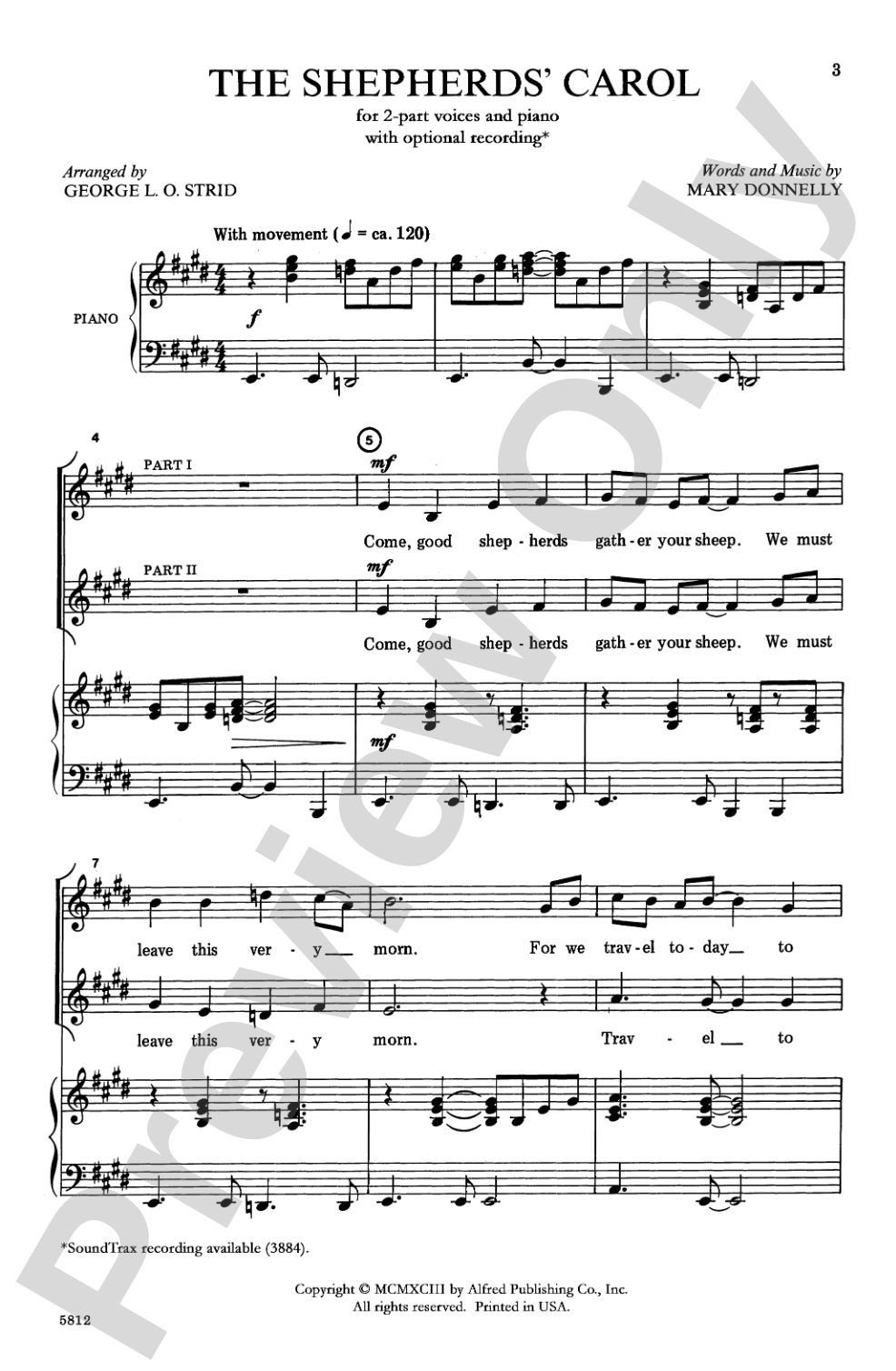
The Shepherd's Carol Sheet Music Preview

The Shepherd's Carol: 2-Part Choral Octavo

Music by Mary Donnelly and George L. O. Strid

Item: 00-PO-0004491

Digital Download
$2.25

Minimum order quantity: 20 copies

Description
Here's another fine 2-part work from Mary Donnelly and George Strid. The melody of this "walking tempo" Christmas piece is based on the Mixolydian mode (flat 7th). There's some vocal independence but the two parts sing together, rhythmically, for much of the piece. The final chorus includes a descant.

The Shepherd's Carol: 2-Part Choral Octavo isn't in MakeMusic Cloud just yet...but it could be. Let us know you'd like to see it, and you'll help shape what comes next. In the meantime, start a free trial and dive into thousands of interactive titles your students can play along with today.

Sample Audio
No sample audio found.
Sample Video
Additional Details
Series: Alfred Archive Edition: Alfred Choral Designs
Publisher: Alfred Music
Page Count: 12
SKU: 00-PO-0004491

More about this title

About the Composer: Mary Donnelly

Mary Donnelly

Mary Donnelly grew up in Reno, Nevada and completed her undergraduate degree at the University of Nevada, Reno with majors in English and French. During her college years, she organized children's choruses and discovered her passion for music education, leading her to pursue formal teacher certification. She earned a Master's Degree in Education from Lesley College in Cambridge, Massachusetts, where she studied arts integration across the curriculum.

Donnelly spent thirty years teaching general music and choir in elementary and middle schools throughout the Washoe County School District in Reno. In 1985, she began collaborating with George Strid when their principal asked them to compose a musical for Reading Week. That first project sparked a prolific partnership that has produced over two hundred songs and twenty-five musicals. She holds memberships in ACDA, NEA, and ASCAP and continues to live in Reno with her husband.

Why we love this

Donnelly and Strid have crafted a carol that balances accessibility with musical sophistication. The Mixolydian mode gives the melody a subtle modal flavor without requiring singers to navigate complex harmonic terrain, while the rhythmic unison sections allow developing singers to build confidence. The descant in the final chorus rewards your ensemble with a moment of genuine vocal independence that feels earned, not tacked on.

What to expect

The steady walking tempo and modal melody create a sense of gentle pilgrimage, evoking the shepherds' journey. There's a reflective, unhurried quality that feels both contemporary and timeless, with enough vocal variety to engage singers without overwhelming them.

Who it's for

This octavo serves middle school choirs and developing high school ensembles seeking substantial Christmas repertoire with modest vocal demands. It works equally well for community and church choirs looking to add a carol with harmonic depth beyond standard major-key fare.

How to get the most out of it

  • Shape the melody with the walking tempo as your anchor. The piece's rhythmic clarity works best when you keep the pulse steady and let the phrasing breathe naturally rather than pushing for legit.
  • Balance the two parts during moments of independence by assigning singers strategically; this prevents the higher part from drowning out the lower line.
  • Introduce the descant only after the choir is secure with the main melody and lower part. This staged approach keeps the final chorus feeling like a genuine musical climax.
  • Highlight the modal character of the melody through vowel consistency and clear diction. The flat 7th works best when your singers tune thoughtfully rather than defaulting to major key instincts.

How to use it

Slot this piece into a Christmas concert as a bridge between more traditional carols and contemporary holiday works. Its moderate length and modest demands make it ideal for a mid-program placement where you can showcase choir growth without requiring excessive rehearsal time investment.

Skills your students will build

  • Singing in the Mixolydian mode and recognizing modal inflection
  • Balancing independence and unison between two parts
  • Maintaining rhythmic precision at a moderate walking tempo
  • Shaping melodic phrasing over harmonic stability
  • Preparing and executing a descant line with textural awareness

You May Also Like