

The Sailor's Life for Me: 2-Part Choral Octavo
Music by Mary Donnelly and George L. O. Strid
Item: 00-PO-0003807
$2.25
Minimum order quantity: 20 copies
Pickup currently not available
Related Items
The Sailor's Life for Me: 2-Part Choral Octavo |
$2.25
|
View |
Description
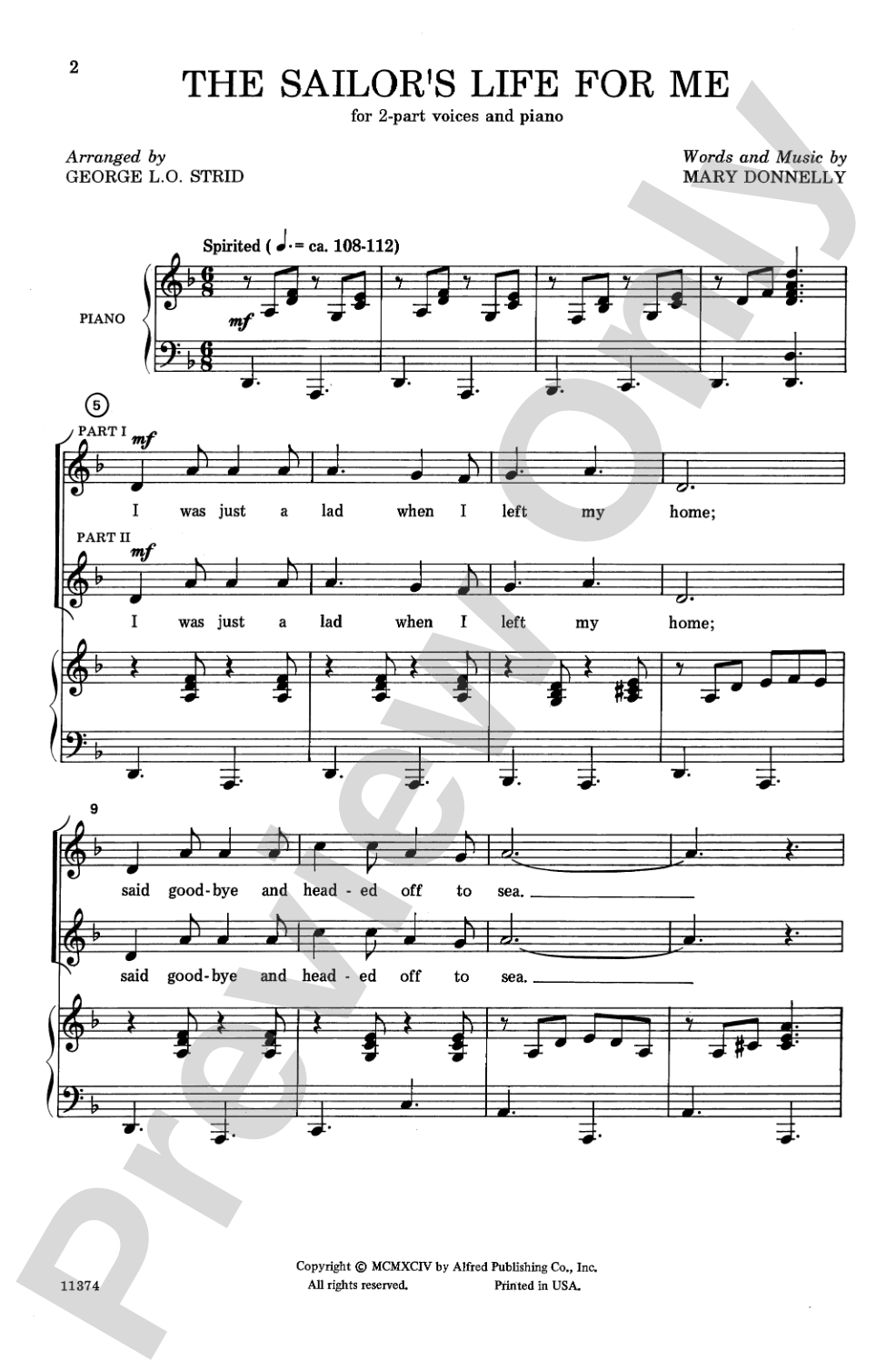
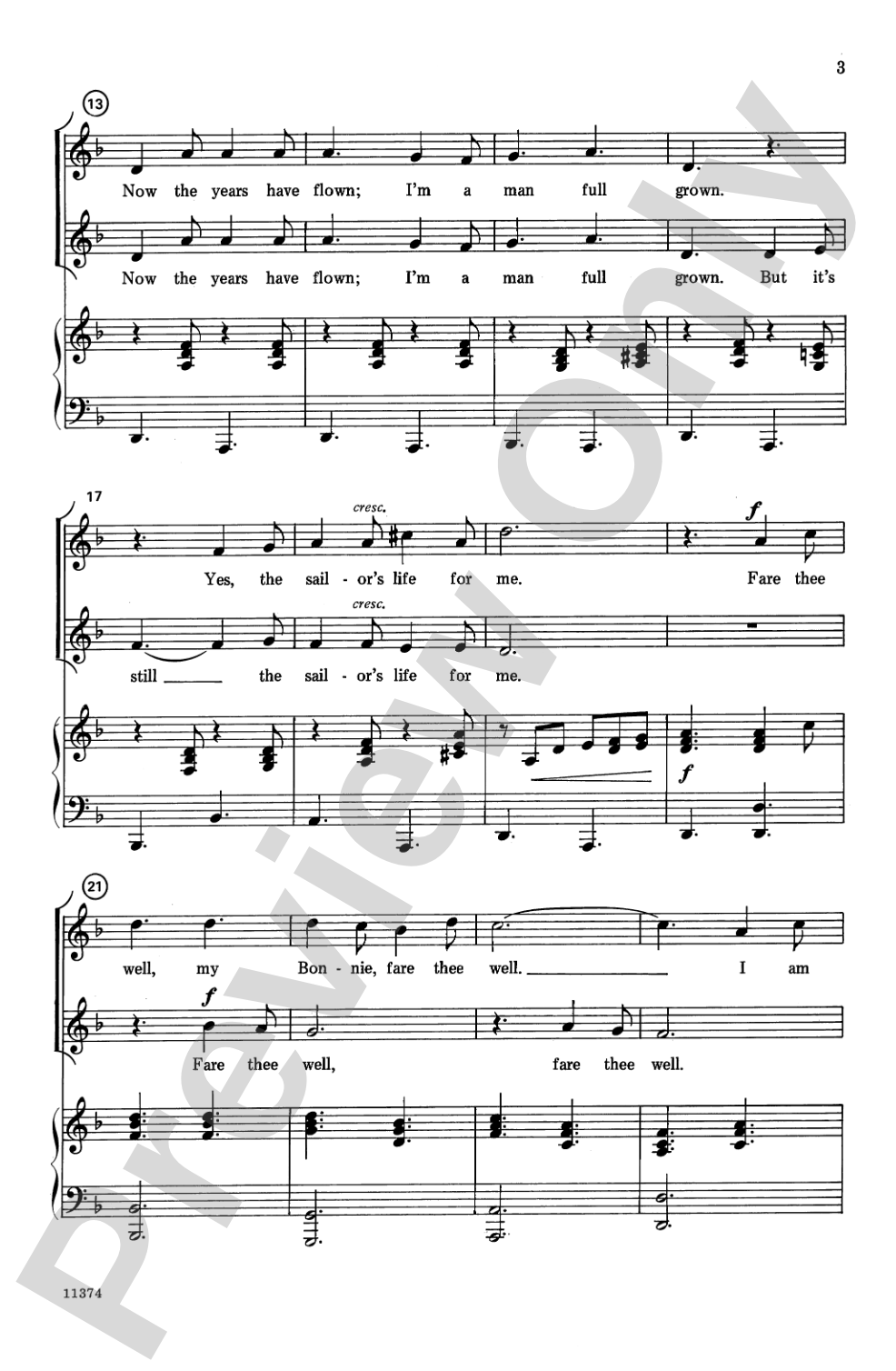
Yo ho! It's a sea chantey for 2-part choirs. "I was just a lad when I left my home; said goodbye and headed off to sea." A slow, mysterious middle section contrasts with the bouncy opening and closing melody. Any young choir will enjoy this one. Consider featuring your guys on this one.


The Sailor's Life for Me: 2-Part Choral Octavo isn't in MakeMusic Cloud just yet...but it could be. Let us know you'd like to see it, and you'll help shape what comes next. In the meantime, start a free trial and dive into thousands of interactive titles your students can play along with today.
Request This Title
Tell us you want it.
Start Your Free Trial
Explore everything that's ready to play right now.
Sample Audio
No sample audio found.
Sample Video
No sample videos found.
Additional Details
Series:
Alfred Archive Edition: Alfred Choral Designs
Publisher:
Alfred Music
Page Count:
12
SKU:
00-PO-0003807
More about this title
About the Composer: Mary Donnelly
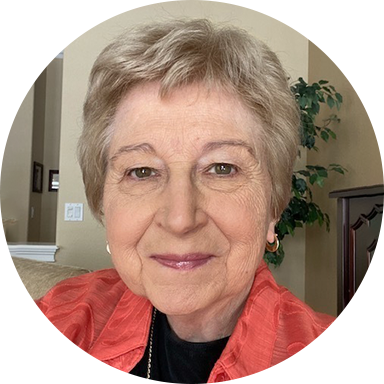
Mary Donnelly grew up in Reno, Nevada, and studied English and French at the University of Nevada before discovering her passion for music education. During her undergraduate years, she organized two children's choruses, an experience that redirected her entire career path. She pursued formal music certification and earned a Master's Degree in Education from Lesley College in Cambridge, Massachusetts, where she focused on integrating the arts across the curriculum.
For three decades, Donnelly taught general music and choir in elementary and middle schools throughout Washoe County, Nevada. In 1985, she began a prolific songwriting partnership with George Strid when their principal asked them to compose a musical for Reading Week. The collaboration proved so fruitful that they have since created over two hundred songs and twenty-five musicals together. Donnelly is an active member of ACDA, NEA, and ASCAP, and continues to live in Reno with her husband.
Why we love this
Donnelly and Strid understand what young singers need: music that's genuinely fun to sing without sacrificing musical substance. The contrast between the energetic, sea-shanty opening and the slower, atmospheric middle section gives your choir real dramatic material to work with, and the return to the bouncy melody provides satisfying closure. The piece lands squarely in that sweet spot where students feel confident performing a recognizable style while building genuine musicianship.
What to expect
The opening bounces with nautical energy and youthful adventure, immediately evoking the feeling of a boy leaving home for the sea. The mysterious middle section deepens the mood, creating a moment of contemplation before the familiar melody returns with renewed warmth and confidence. The overall arc captures both the romance and the reality of a life at sea.
Who it's for
This octavo works beautifully for developing 2-part choirs in grades 4-8 who are ready for something more textually interesting than unison warm-ups but not yet prepared for three or four-part writing. Young singers respond immediately to the chantey style and the straightforward storytelling. Schools programming a maritime or folk-themed concert will find this piece both thematic and genuinely singable.
How to get the most out of it
- Shape the mysterious middle section with gradual dynamic changes and careful attention to vowel consistency; this slower material needs breath support to land its atmospheric quality.
- Anchor the opening and closing bouncy sections with a steady rhythmic pulse from your lower voices, allowing the melody to dance on top without rushing.
- Balance blend in the 2-part texture by ensuring both voice parts sing with equal confidence; weaker singers often disappear in simple voicings, so listen carefully during sectionals.
- Emphasize the narrative quality of the opening line ('I was just a lad when I left my home') by having singers internalize the story before adding musical expression.
How to use it
Consider pairing this with other folk-song arrangements or sea-themed repertoire to create a concert moment with narrative cohesion. It works equally well as a lighter piece bridging more serious choral works, or as the emotional centerpiece of a program exploring traditional American music. The piece's modest technical demands make it ideal for a spring concert where you want to showcase choir development without overloading rehearsal calendars.
Skills your students will build
- Singing in 2-part harmony with independence and balance
- Interpreting musical character through dynamic contrast and phrasing
- Maintaining steady rhythm in bouncy, dance-like sections
- Managing breath phrasing across longer melodic lines in the slower middle section
- Connecting text to musical expression and narrative storytelling