

The Echo Song (Italian Madrigal): SSA (Double Choir), a cappella Choral Octavo
Italian Madrigal
By Orlando di Lasso / arr. Russell Robinson
Item: 00-PO-0000345
$1.75
Minimum order quantity: 20 copies
Pickup currently not available
Description
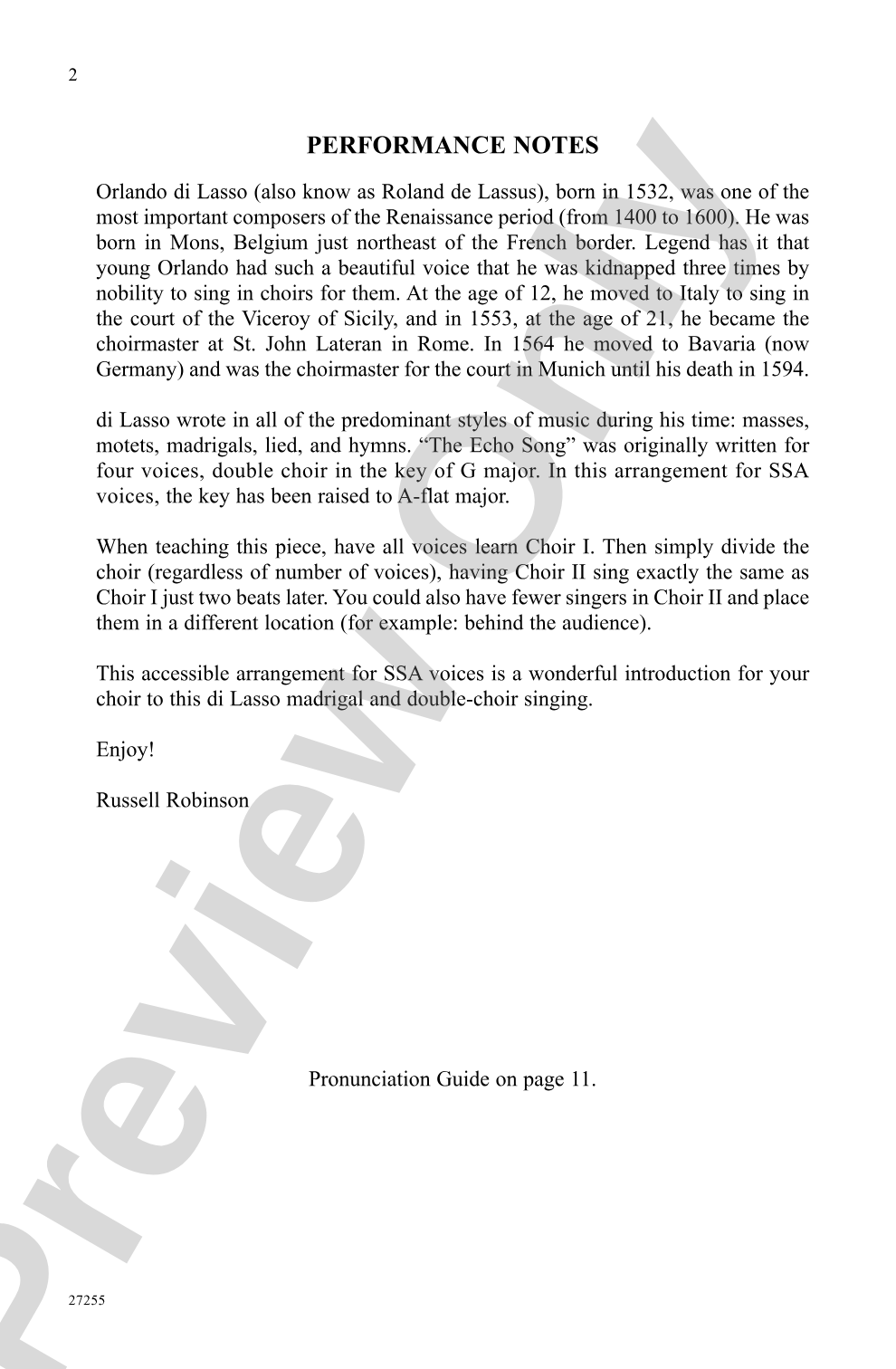
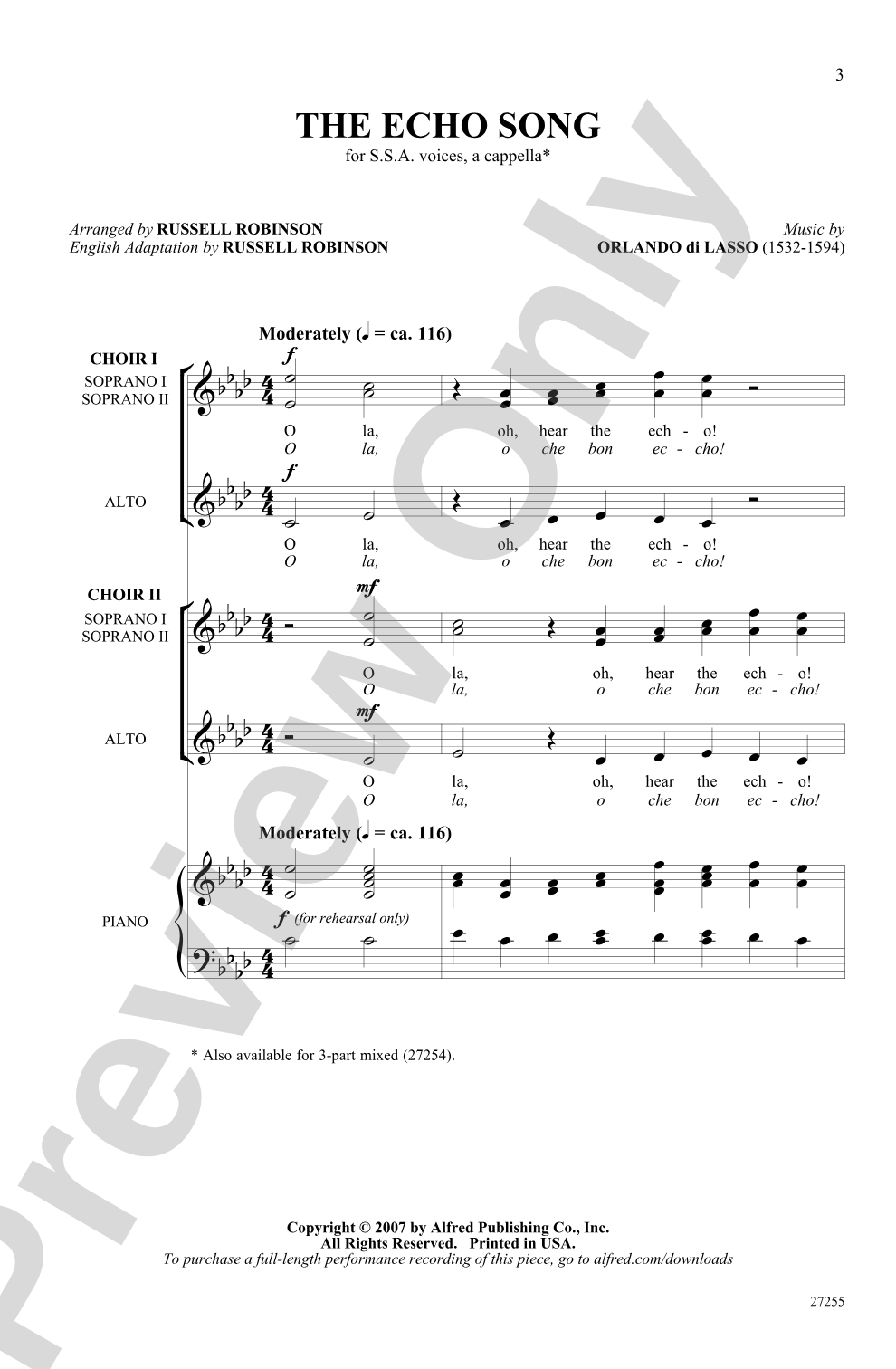
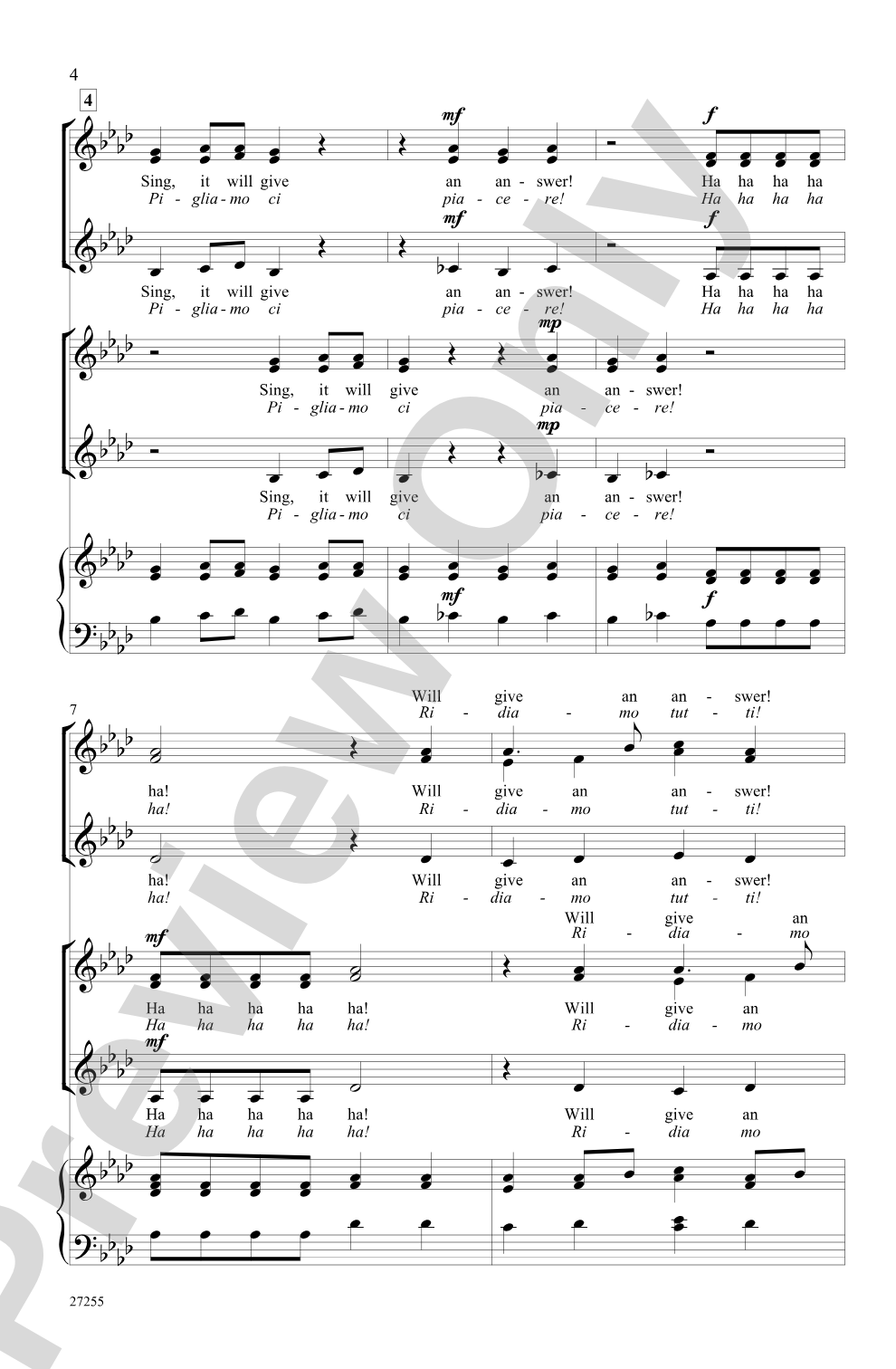
Especially arranged for double 3-part mixed or SSA choirs, each phrase of this famous Italian madrigal is sung by Choir I and repeated precisely by Choir II, many times overlapping to create a textured choral sound. Russell Robinson's masterful adaptation includes an English or Italian text, a useful pronunciation guide, and informative performance notes that will help educate your students.


The Echo Song (Italian Madrigal): SSA (Double Choir), a cappella Choral Octavo isn't in MakeMusic Cloud just yet...but it could be. Let us know you'd like to see it, and you'll help shape what comes next. In the meantime, start a free trial and dive into thousands of interactive titles your students can play along with today.
Request This Title
Tell us you want it.
Start Your Free Trial
Explore everything that's ready to play right now.
Sample Audio
1
Audio File
--:--
0:00
0:00
Sample Video
No sample videos found.
Additional Details
Series:
Alfred Choral Designs
Publisher:
Alfred Music
Page Count:
12
SKU:
00-PO-0000345
More about this title
About the Composer: Orlando di Lasso
Orlando di Lasso (1532-1594) stands among the Renaissance's most prolific and versatile composers, having written over 2,000 works across nearly every genre available to him. His career spanned the courts and churches of Europe, from Rome to Munich, where he served as court kapellmeister and composed everything from masses and motets to secular madrigals that delighted aristocratic audiences.
Di Lasso's gift for text-setting and his ability to capture emotional nuance made him a model for generations of composers. His secular works, particularly the madrigals, showcase a directness and expressive clarity that resonate powerfully in educational settings, making his music an enduring anchor point for understanding Renaissance choral writing.
Why we love this
Russell Robinson's arrangement transforms a Renaissance gem into a remarkably effective teaching tool by leveraging the echo structure to build vocal confidence and part independence without sacrificing authenticity. The double-choir format creates textural richness that keeps singers engaged while the repeating phrases reinforce melodic accuracy and ensemble listening. This is exactly the kind of masterwork arrangement that honors the original while making it genuinely accessible to student singers.
What to expect
The piece captures the playful sophistication of Renaissance secular music, where phrases bounce between two groups like a musical conversation or gentle game. There's elegance and clarity in every phrase, yet the overlapping sections create a warmth and textural depth that surprises listeners expecting something austere or archaic.
Who it's for
This octavo works beautifully for any treble or mixed SSA ensemble with enough singers to form two distinct choirs. It suits choirs seeking substantial Renaissance literature that remains accessible to intermediate singers and rewards careful preparation without demanding virtuosic technique.
How to get the most out of it
- Rehearse each choir's material separately first, drilling the melodic line until it feels natural. Once both choirs own their parts, the echo effect will land with real clarity rather than sounding like a mistake.
- Shape each phrase as a complete musical unit before it echoes. Choir I should breathe with intention and shape toward natural phrase endings; Choir II follows that musical intention, not just the notes.
- Pay close attention to the overlapping moments in the arrangement. These require precise ensemble alignment and demonstrate to students how Renaissance composers layered voices for depth. Mark cue points in rehearsal.
- Use the pronunciation guide to establish consistent vowel placement across both choirs. Homogeneous vowel color makes the echo effect significantly more striking and helps young singers understand why diction matters.
How to use it
Program this as a standalone madrigal in a concert celebrating Renaissance music, or pair it with other di Lasso works or contemporary madrigal settings to build a thematic program. Its moderate length and a cappella requirement make it ideal for concerts where you want to contrast with larger works or modern pieces, letting the piece's musical architecture take center stage.
Skills your students will build
- Renaissance text-setting and phrasing conventions
- Singing in Latin and Italian with accurate pronunciation
- Blending and balancing within a double-choir texture
- Listening for independent melodic lines while maintaining harmonic awareness
- Understanding call-and-response structures and how repetition builds musical form