

The Echo Song (Italian Madrigal): 3-Part (Double Choir), a cappella Choral Octavo
Italian Madrigal
By Orlando di Lasso / arr. Russell Robinson
Item: 00-PO-0000344
$2.25
Minimum order quantity: 20 copies
Pickup currently not available
Description
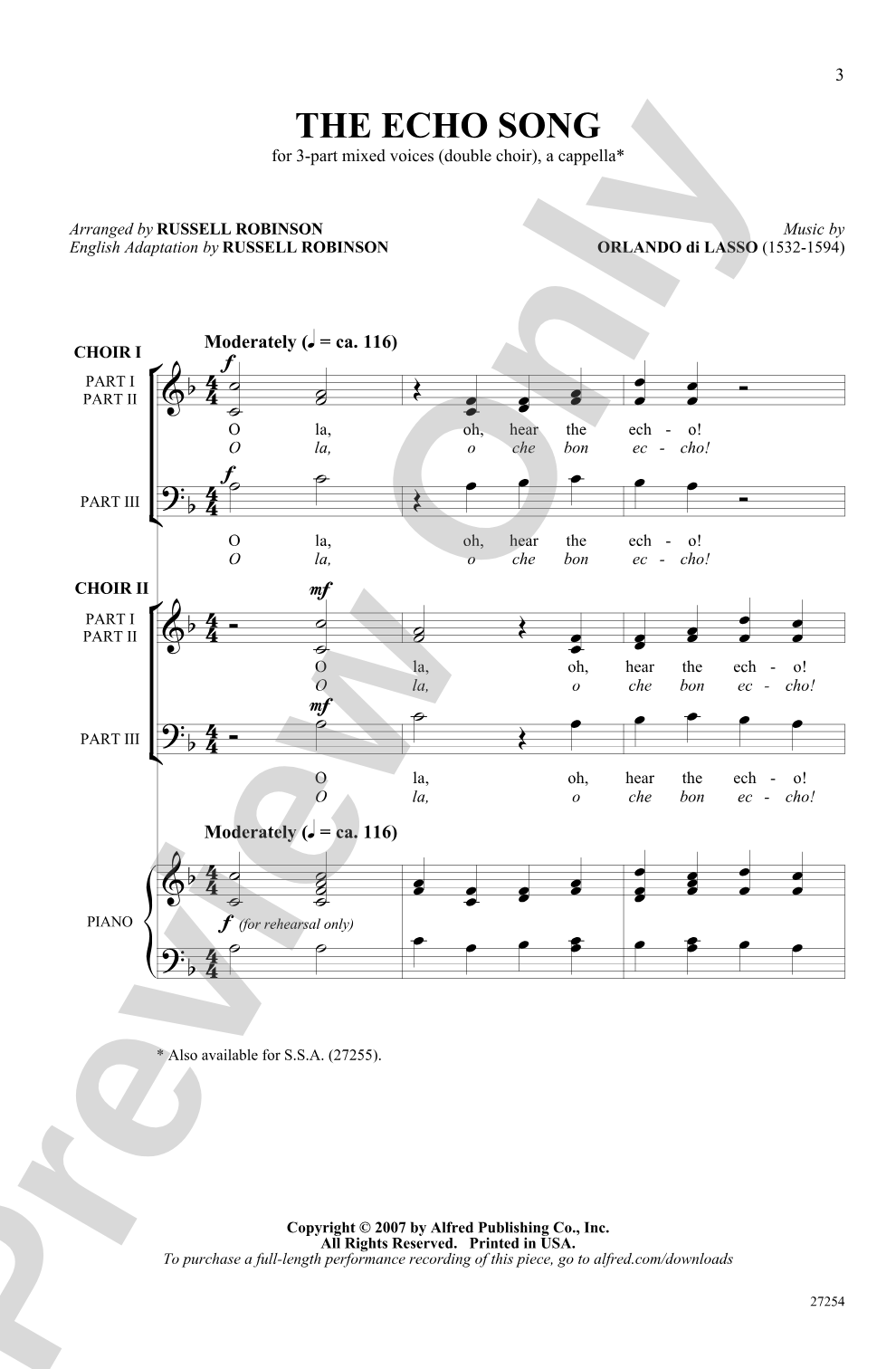
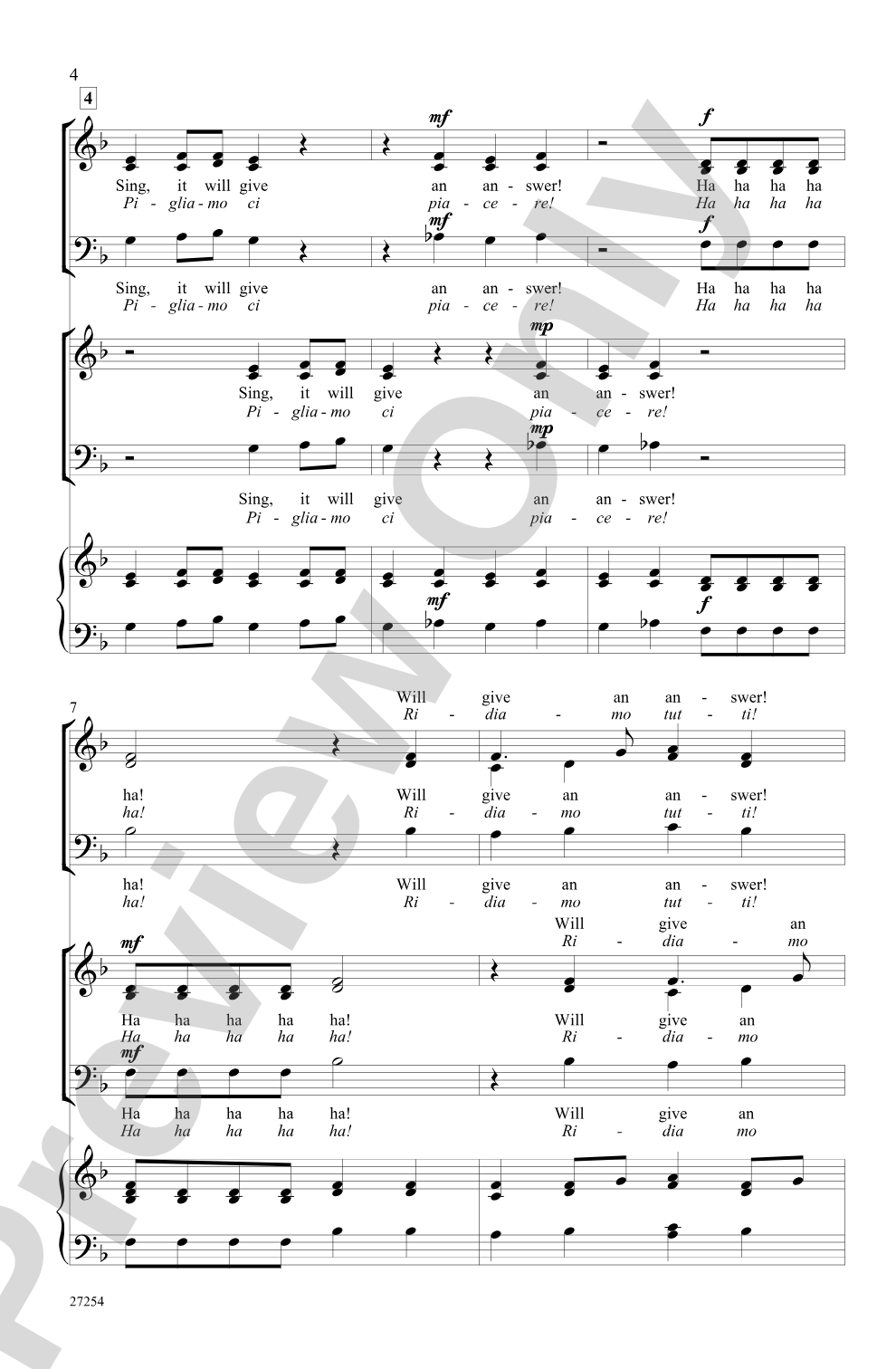
Especially arranged for double 3-part mixed or SSA choirs, each phrase of this famous Italian madrigal is sung by Choir I and repeated precisely by Choir II, many times overlapping to create a textured choral sound. Russell Robinson's masterful adaptation includes an English or Italian text, a useful pronunciation guide, and informative performance notes that will help educate your students.


The Echo Song (Italian Madrigal): 3-Part (Double Choir), a cappella Choral Octavo isn't in MakeMusic Cloud just yet...but it could be. Let us know you'd like to see it, and you'll help shape what comes next. In the meantime, start a free trial and dive into thousands of interactive titles your students can play along with today.
Request This Title
Tell us you want it.
Start Your Free Trial
Explore everything that's ready to play right now.
Sample Audio
1
Audio File
--:--
0:00
0:00
Sample Video
No sample videos found.
Additional Details
Series:
Alfred Archive Edition: Alfred Choral Designs
Publisher:
Alfred Music
Page Count:
12
SKU:
00-PO-0000344
More about this title
About the Composer: Orlando di Lasso
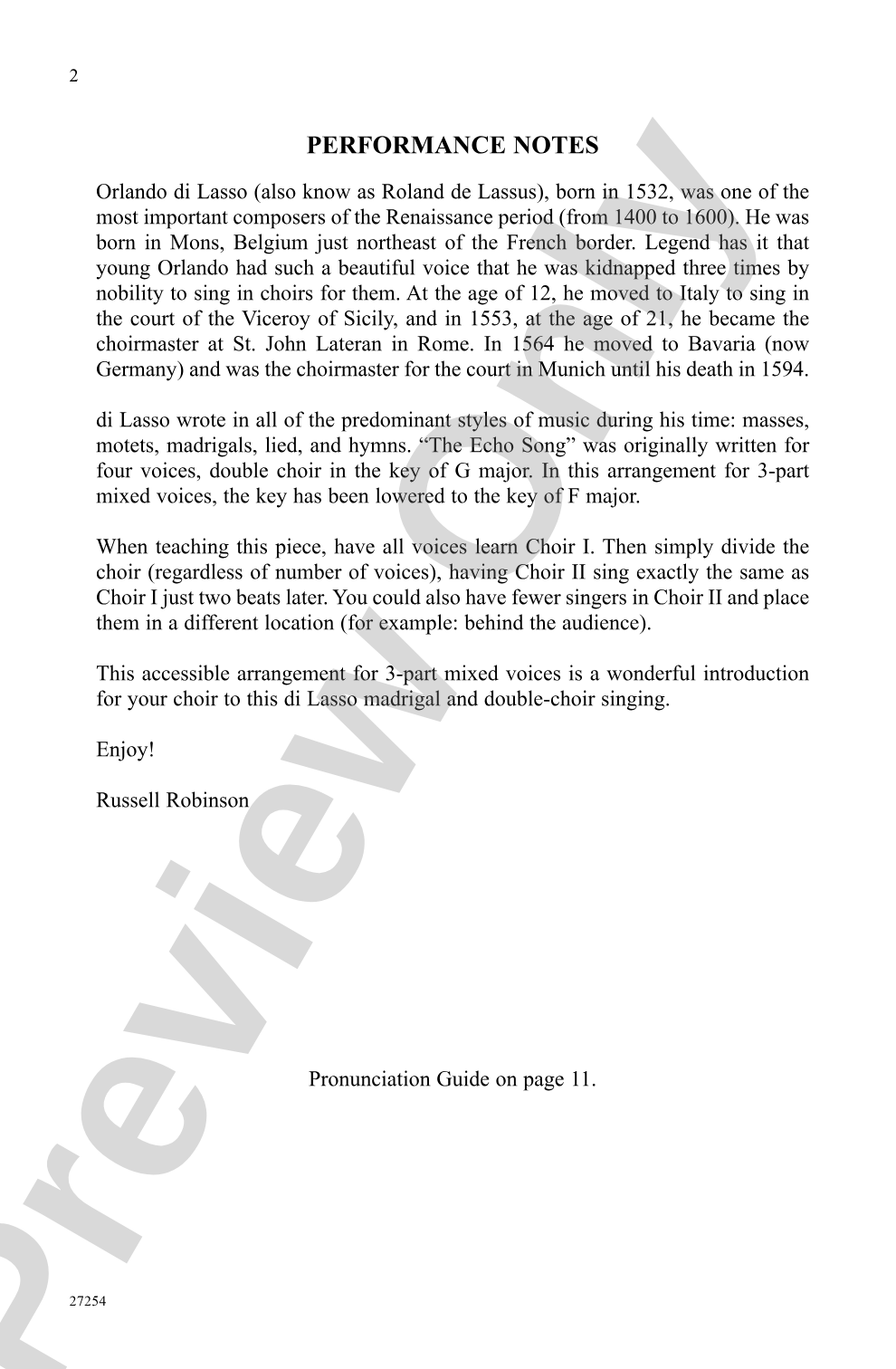
Orlando di Lasso (c. 1532-1594) stands among the Renaissance's most prolific and versatile composers, with a catalog exceeding 2,000 works spanning masses, motets, madrigals, and secular songs. His ability to move seamlessly between sacred and secular genres, combined with his gift for text-painting and emotional directness, made him one of the most sought-after composers of his era. He spent much of his career at the court of Duke Albrecht V in Munich, where he led the chapel and continued composing until his death.
For choral musicians today, Lasso's madrigals offer accessible entry into Renaissance polyphony without sacrificing sophistication. His harmonic language is direct and expressive, his text-setting is natural, and his structural clarity makes his music rewarding to learn and perform.
Why we love this
Russell Robinson's arrangement transforms a single Renaissance madrigal into a spatial and textural experience by splitting it between two choirs, turning the echo principle into an active compositional device rather than a simple repeat. The overlapping phrases create natural acoustic depth without adding complexity to individual voice parts, making it both pedagogically sound and genuinely exciting to perform. This is the kind of Renaissance repertoire that justifies teaching it: students hear and feel the music's architecture, not just the notes.
What to expect
The music unfolds like a musical conversation where one voice speaks and another answers, gradually building layers of sound as phrases overlap and interweave. The Italian text and madrigal style bring a sense of intimacy and forward motion, while the Renaissance harmonies feel both historical and emotionally direct. There's a lightness and clarity here that rewards clean vowels and careful phrase shaping.
Who it's for
This arrangement works well for choirs with at least two strong sections (ideally 6-9 singers per part across both ensembles), intermediate sightreading skills, and familiarity with Renaissance harmonic language. The 3-part voicing makes it accessible to SAB or SSA choirs without compromising the madrigal's character.
How to get the most out of it
- Establish clear spatial separation between Choir I and Choir II before rehearsal, even if they'll stand together in performance. Knowing who sings first shapes how each ensemble internalizes the text and phrasing.
- Pay close attention to Robinson's pronunciation guide when moving between Italian and English texts. Consistency within each choir matters more than perfection; choose one language and commit fully.
- Balance the echo moments carefully so Choir II's repetition feels like an intentional response, not an echo that's too soft to hear or too loud to distinguish from the original phrase.
- Use the overlapping sections to teach ensemble listening. Have singers from one choir listen actively to the other during rehearsal so they understand how their line sits within the total texture.
How to use it
Program this as a bridge between a cappella Renaissance motets and secular madrigal concerts, or pair it with other Lasso works to highlight his range and craftsmanship. The double-choir format also makes it an effective opener or closer for concerts, since it creates immediate impact through spatial design without requiring large forces.
Skills your students will build
- Reading Renaissance harmonic language and text-painting in a cappella context
- Balancing independent voice lines while listening to multiple choirs simultaneously
- Matching vowel shapes and breath placement across separated ensembles
- Performing repeated phrases with rhythmic and tonal consistency
- Interpreting Italian text with proper pronunciation and musical intent