
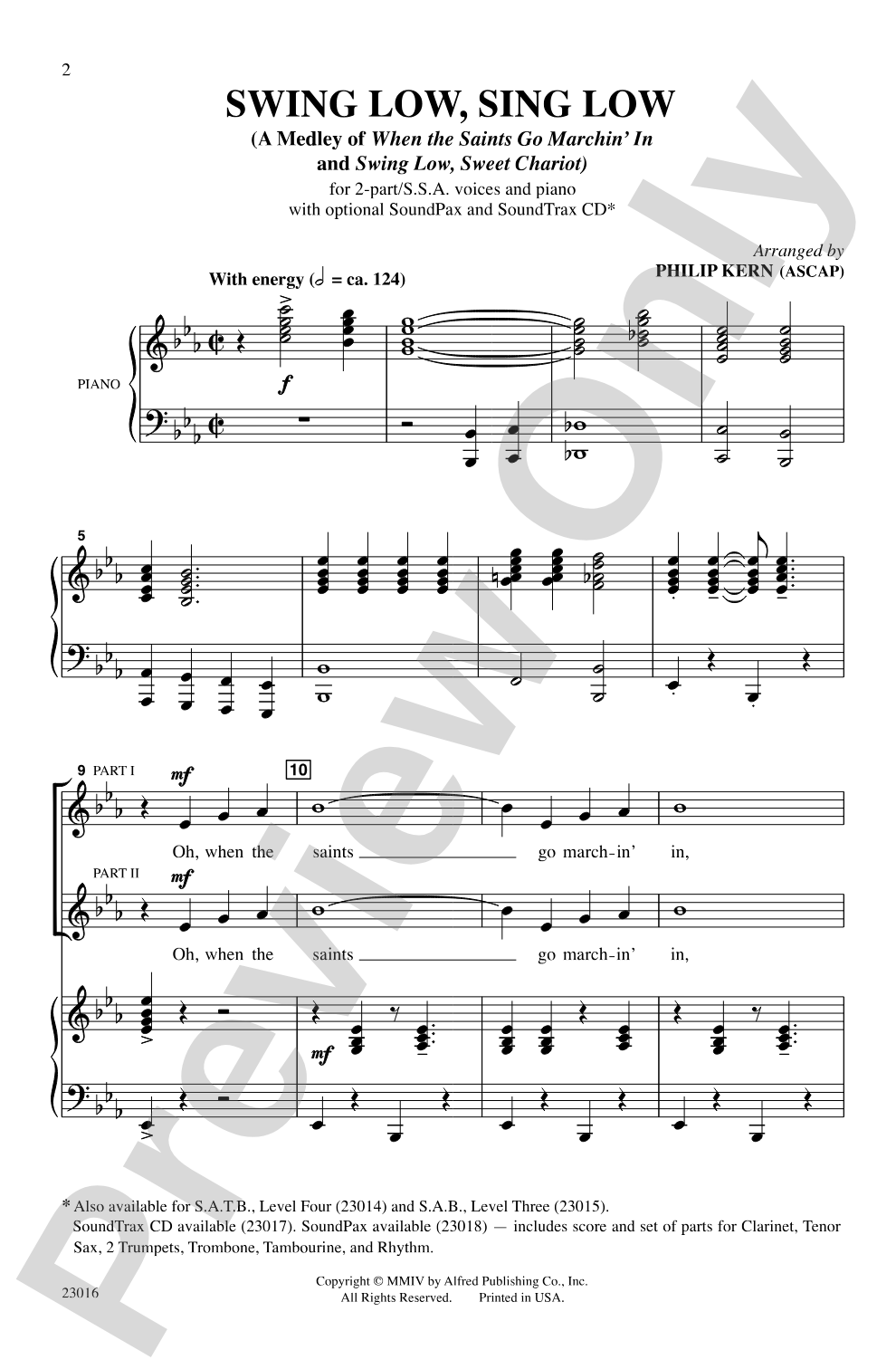

Swing Low, Sing Low: 2-Part/SSA Choral Octavo
Featuring: When the Saints Go Marchin' In / Swing Low Sweet Chariot
Arr. Philip Kern
Item: 00-PO-0007951
$1.85
Minimum order quantity: 20 copies
Pickup currently not available
Description
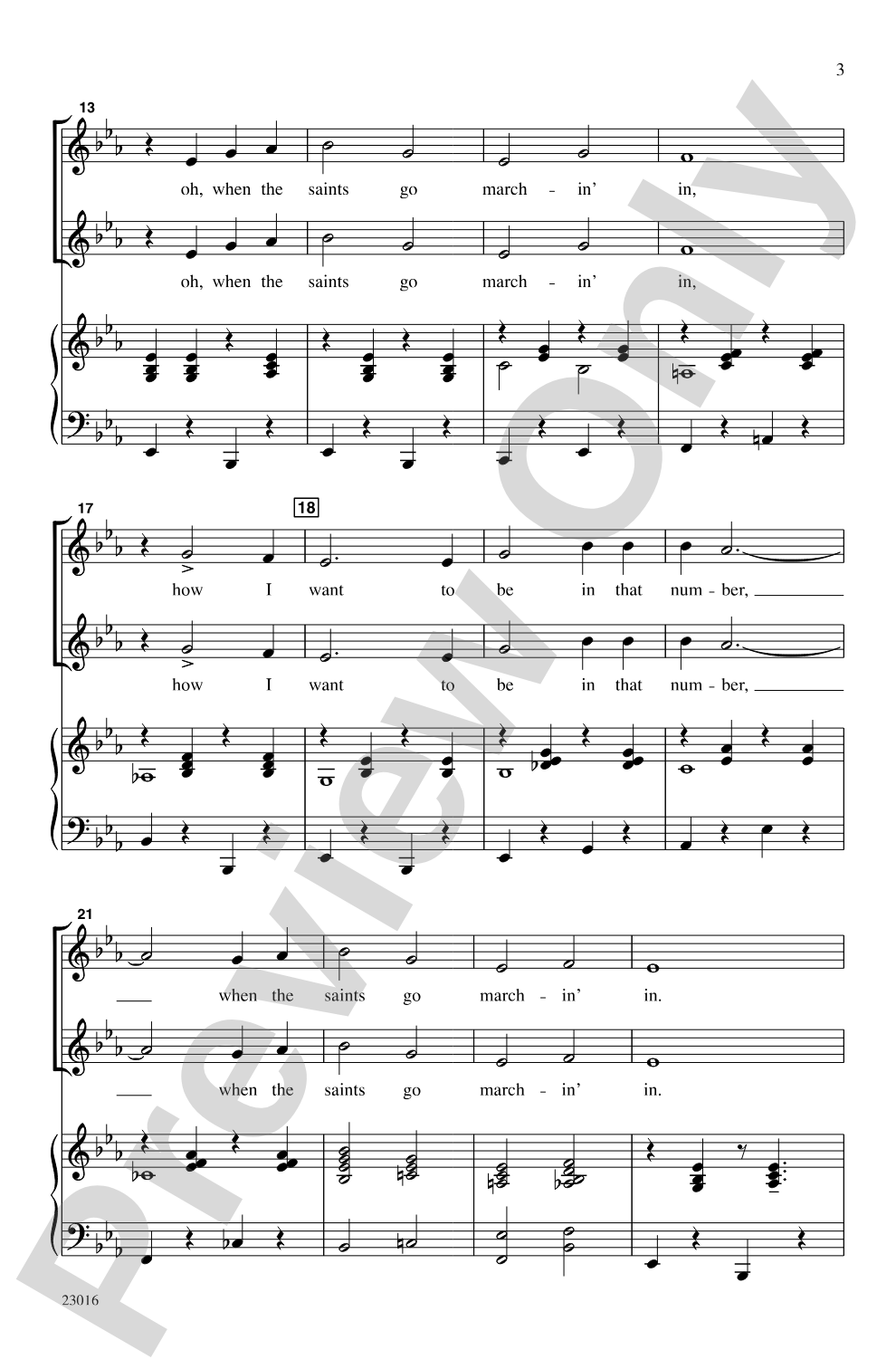
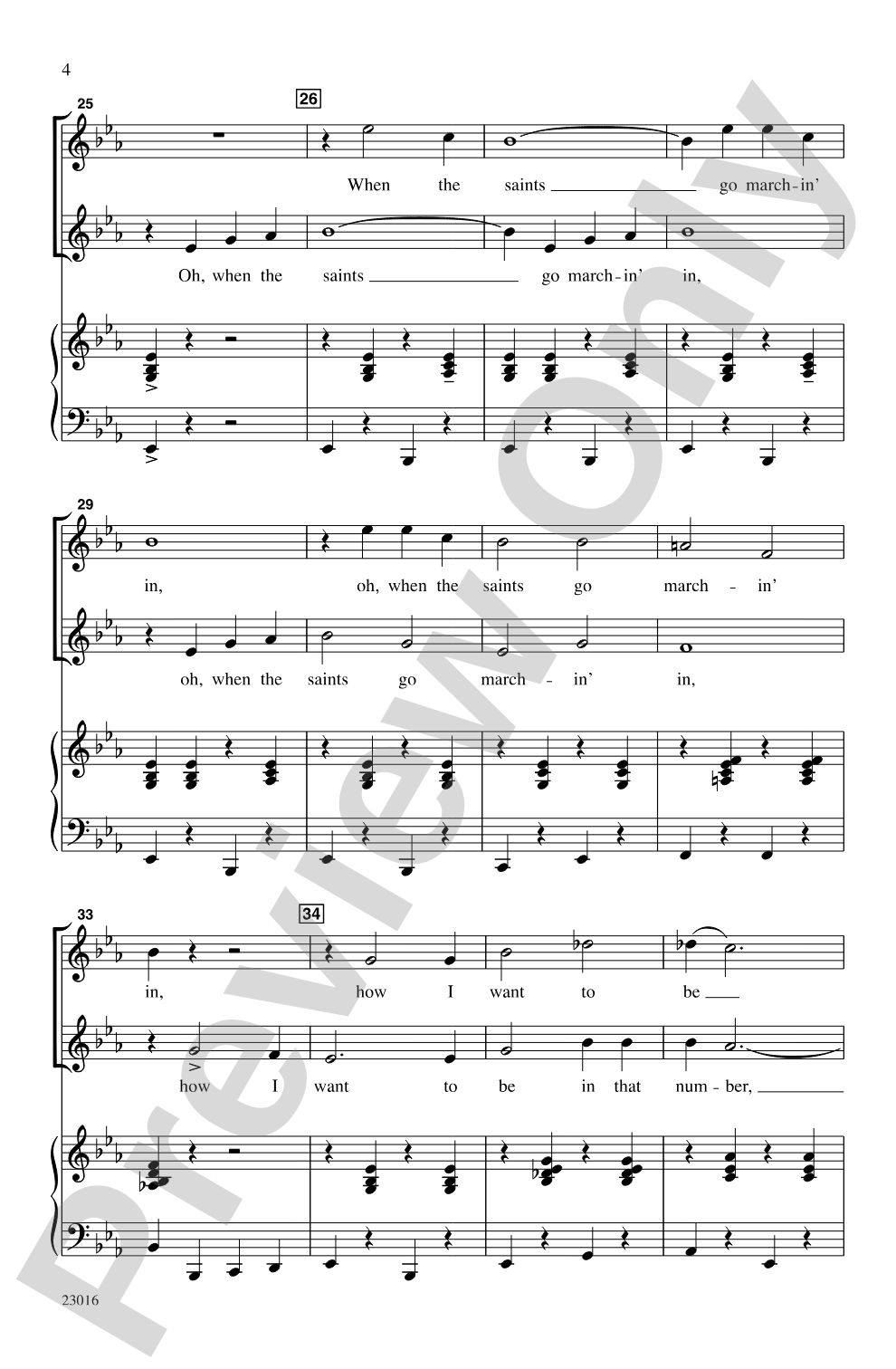
A brilliant pairing of two favorite spirituals by Philip Kern. It's a high energy setting of "When the Saints Go Marchin' In," incorporating two exciting and original counter lines, ultimately combined with the familiar strains of "Swing Low Sweet Chariot." A spirited knockout! Opens with an energized unison, drives through a lively two-part partner song section, features a stunning solo verse accompanied by a finger-snapping a cappella choir, and grows into a full singing, multi-theme, raise-the-roof finish. Surprisingly not difficult to sing with appropriate vocal ranges, tuneful counter lines, and straightforward harmonic writing. Awesome instrumental parts or SoundTrax CD are available. Featured on the new staging DVD/Video "On the Stage!" (DVD #23037, Video #23129).


Swing Low, Sing Low: 2-Part/SSA Choral Octavo isn't in MakeMusic Cloud just yet...but it could be. Let us know you'd like to see it, and you'll help shape what comes next. In the meantime, start a free trial and dive into thousands of interactive titles your students can play along with today.
Request This Title
Tell us you want it.
Start Your Free Trial
Explore everything that's ready to play right now.
Sample Audio
1
Audio File
--:--
0:00
0:00
Sample Video
No sample videos found.
Additional Details
Series:
Alfred Choral Designs
Publisher:
Alfred Music
Page Count:
16
SKU:
00-PO-0007951
More about this title
About the Arranger: Philip Kern
Philip Kern has built a reputation as a choral arranger who understands what works in the rehearsal room and on stage. His arrangements balance accessibility with musical substance, creating pieces that engage singers without oversimplifying the source material.
Why we love this
Kern resists the urge to smooth out these spirituals into something polite. Instead, he layers them with genuine energy: the unison opening hooks singers immediately, the partner song section gives every voice something to do, and that finger-snapping a cappella moment creates a moment of communal joy that audiences feel. The architecture here is intelligent—each section builds logically toward the final payoff where both melodies live together.
What to expect
Spirited and infectious. You move through moments of unison power, intricate two-part weaving, intimate vulnerability in the solo section, and finally a joyful collision of themes that celebrates both melodies at once. There's celebration here without sentimentality.
Who it's for
Middle school through adult choirs seeking a spiritual arrangement with contemporary energy and staging possibilities. The voicing sits well for developing singers while remaining engaging for more experienced ensembles.
How to get the most out of it
- Lock the unison opening with crisp, unified articulation. This section establishes the entire energy level, so nail the rhythmic precision before moving into the two-part texture.
- Shape the counter lines in the partner song section as independent melodic ideas, not accompaniment. These lines deserve breath, phrasing, and dynamic contour so they land as full musical partners rather than support.
- Lean into the finger-snapping section with genuine ownership. This is where the piece shifts from performance to participatory, so commit to the rhythm section work alongside the solo voice.
- Balance the final multi-theme section carefully. Both melodies need to sing through without either drowning the other; rehearse this in layers, then gradually blend them until the blend feels intentional rather than chaotic.
How to use it
Pair this with other spirituals for a thematic concert set, or use it as a high-energy closer that leaves audiences smiling. The movement and staging options make it particularly strong for spring concerts or celebrations where you want something with genuine life and visibility beyond the choir.
Skills your students will build
- Singing independent melodic lines in partner song texture
- Rhythmic precision in unison sections with syncopation
- Balancing multiple concurrent melodies in the final section
- A cappella ensemble listening and blend
- Incorporating movement and physical rhythm into vocal performance