
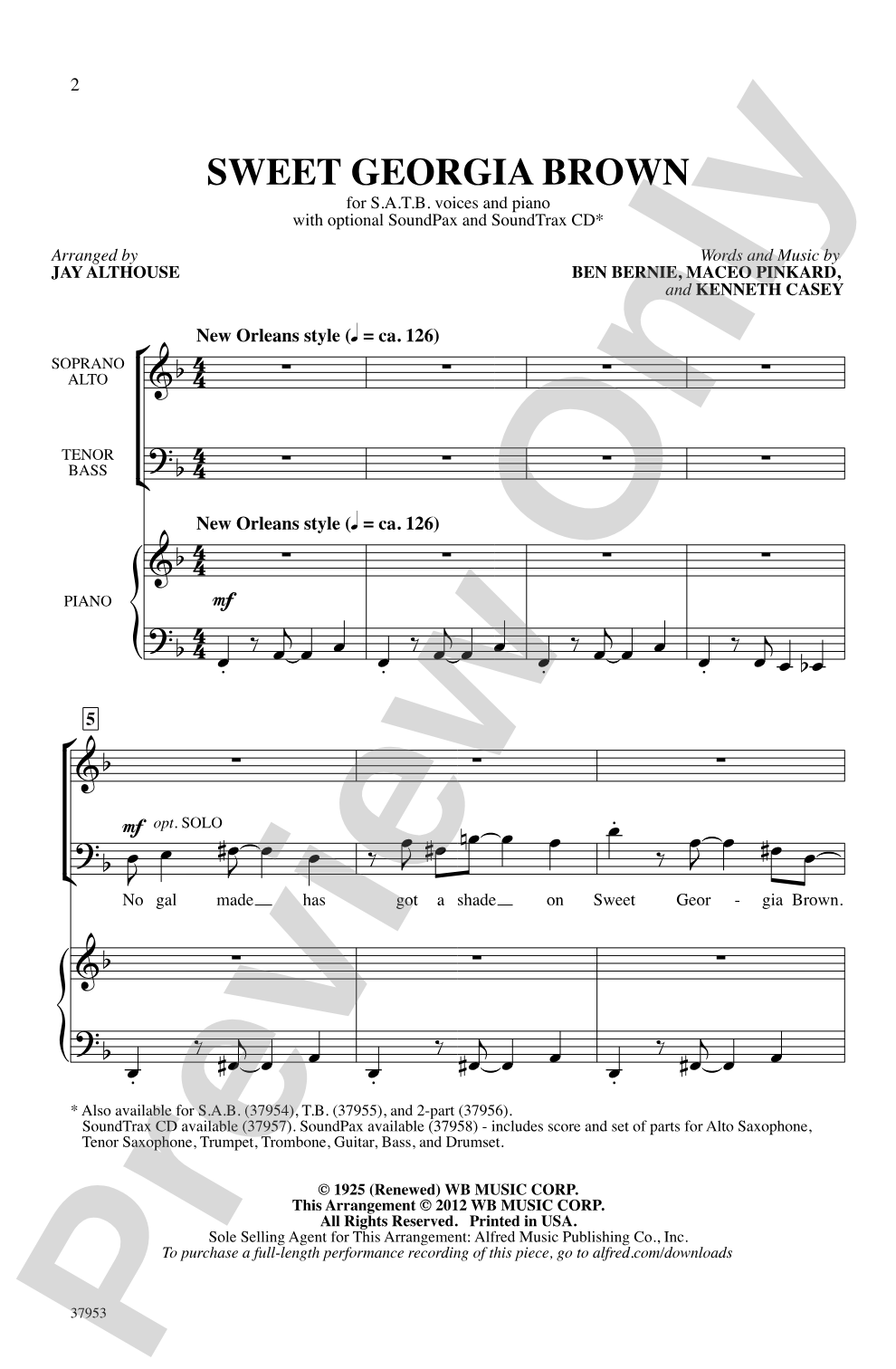
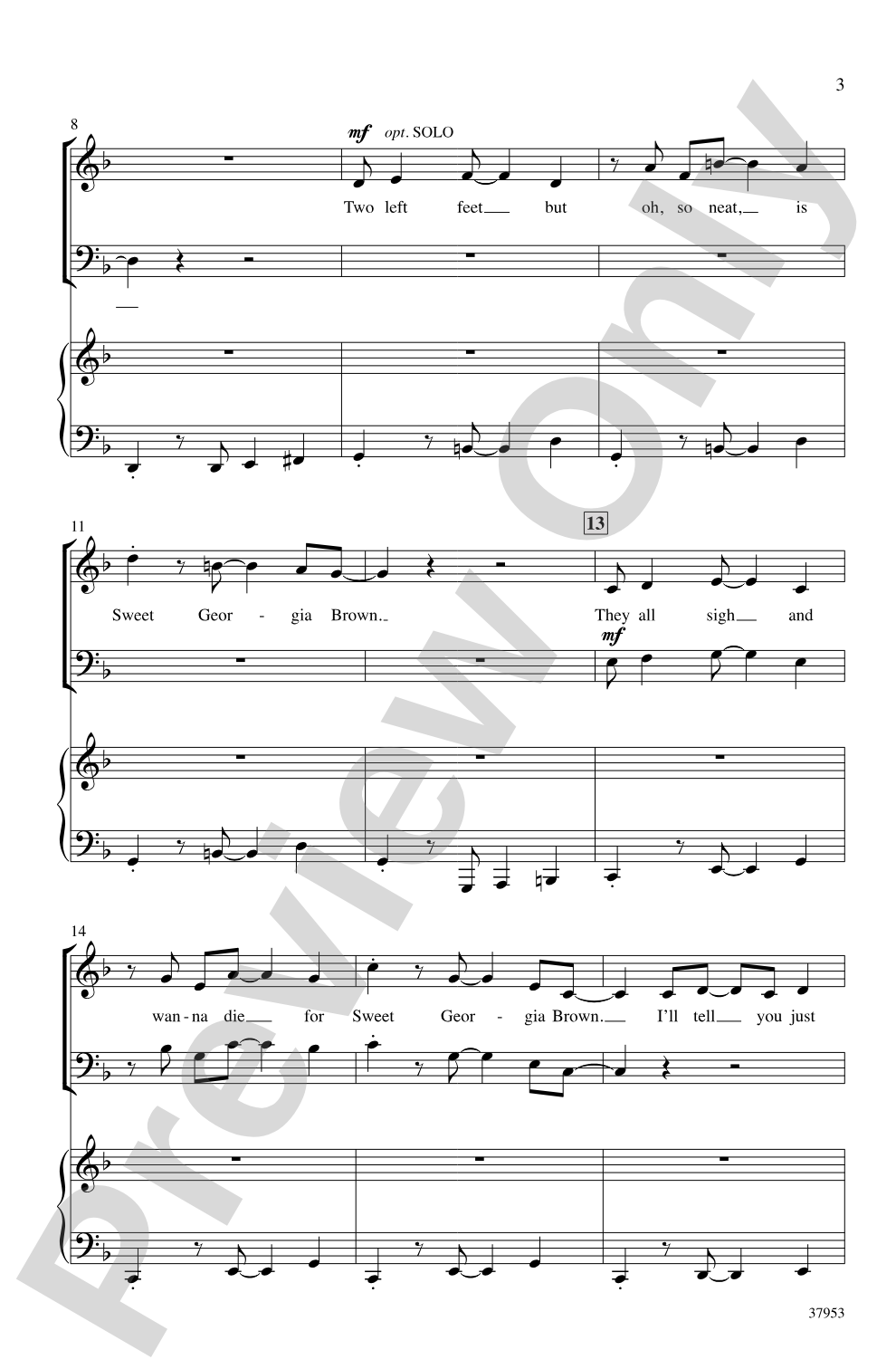
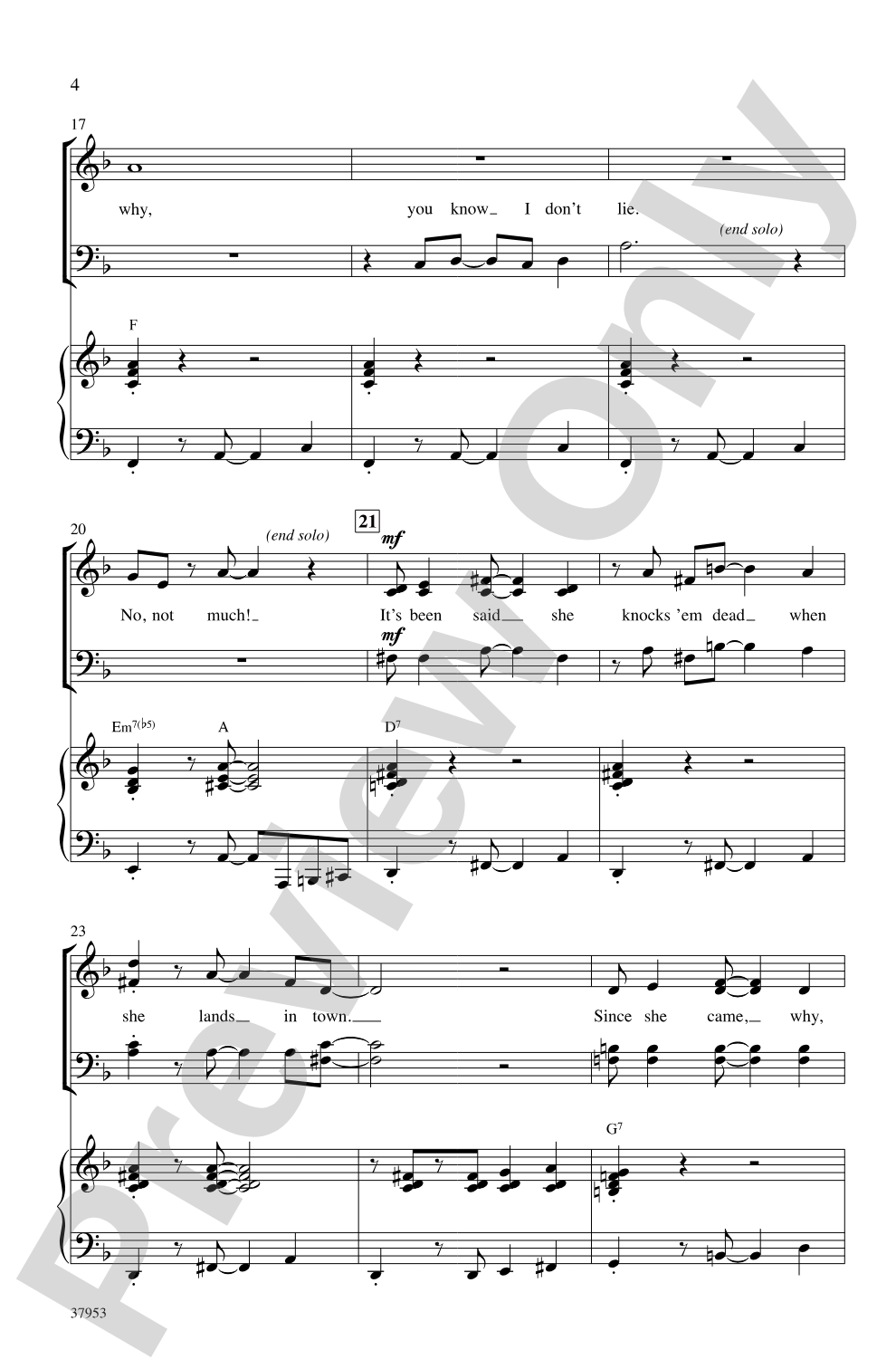

Sweet Georgia Brown: SATB Choral Octavo
Words and music by Ben Bernie, Maceo Pinkard, and Kenneth Casey / arr. Jay Althouse
Item: 00-PO-0001294
$1.90
Minimum order quantity: 20 copies
One moment…
Related Items
Sweet Georgia Brown: SoundTrax Digital Audio Download |
$26.99
|
View | |
Sweet Georgia Brown: SAB Choral Octavo |
$1.90
|
View | |
Sweet Georgia Brown: TB Choral Octavo |
$1.90
|
View | |
Sweet Georgia Brown: 2-Part Choral Octavo |
$1.90
|
View | |
Sweet Georgia Brown: Choral SoundPax |
$35.00
|
View | |
Sweet Georgia Brown: SATB Choral Octavo |
$1.90
|
View | |
Sweet Georgia Brown: SAB Choral Octavo |
$1.90
|
View | |
Sweet Georgia Brown: TB Choral Octavo |
$1.90
|
View | |
Sweet Georgia Brown: 2-Part Choral Octavo |
$1.90
|
View | |
Sweet Georgia Brown: Choral Octavo SoundTrax CD |
$26.99
|
View |
Description
Picture yourself walking the streets of New Orleans as you perform the first half of this popular jazz standard from the 1920s. Then listen as Jay's arrangement rocks to the end!


Sweet Georgia Brown: SATB Choral Octavo isn't in MakeMusic Cloud just yet...but it could be. Let us know you'd like to see it, and you'll help shape what comes next. In the meantime, start a free trial and dive into thousands of interactive titles your students can play along with today.
Request This Title
Tell us you want it.
Start Your Free Trial
Explore everything that's ready to play right now.
Sample Audio
1
Audio File
--:--
0:00
0:00
Sample Video
No sample videos found.
Additional Details
Series:
Alfred Pop Choral Series
Publisher:
Alfred Music
Page Count:
12
SKU:
00-PO-0001294
More about this title
About the Composer: Ben Bernie
Ben Bernie was a pianist, bandleader, and composer who rose to prominence during the Jazz Age of the 1920s. His work "Sweet Georgia Brown," co-written with Maceo Pinkard and Kenneth Casey, became one of the era's defining standards and has remained a fixture of jazz repertoire for over a century.
Why we love this
Jay Althouse's arrangement captures the swagger of a New Orleans street march in the first half, then pivots into a contemporary groove that keeps the energy fresh and prevents this familiar standard from feeling dated. The arrangement respects the song's heritage while giving singers a clear sense of forward momentum and character throughout.
What to expect
The piece opens with the relaxed, atmospheric warmth of a humid New Orleans street corner where music spills from doorways and storefronts. As the arrangement evolves, that nostalgia ignites into a modern groove that feels both grounded in history and alive in the present moment.
Who it's for
This arrangement works for choirs comfortable with jazz idiom and rhythmic independence. It suits groups looking for secular repertoire that bridges tradition and contemporary style, making it ideal for community choirs, college ensembles, or high school programs with jazz or pop interests.
How to get the most out of it
- Establish the New Orleans street feel in the opening section by keeping the rhythm section grounded and letting the melody breathe with a slight swagger; avoid rushing the tempo.
- When the arrangement shifts to the rock section, commit fully to the new energy; this isn't a gradual transition but a distinct gear change that needs confident execution from all parts.
- Balance the homophonic passages against any sustained harmony parts so the melody stays prominent without the accompaniment feeling thin.
- Use the recorded accompaniment to lock in the harmonic foundation, especially during the groove sections where rhythmic precision matters.
How to use it
Program this as a standalone feature that appeals to audiences familiar with jazz standards, or pair it with other American songbook repertoire to create a "Standards Night" concert. Its 12 pages and clear harmonic language make it accessible for mid-season rehearsal, allowing you to add variety to a program without derailing ensemble focus.
Skills your students will build
- Singing jazz phrasing and swing rhythms
- Navigating style transitions (ballad groove to rock feel)
- Maintaining rhythmic independence while blending with ensemble texture
- Interpreting dynamic contrast between intimate and energetic sections