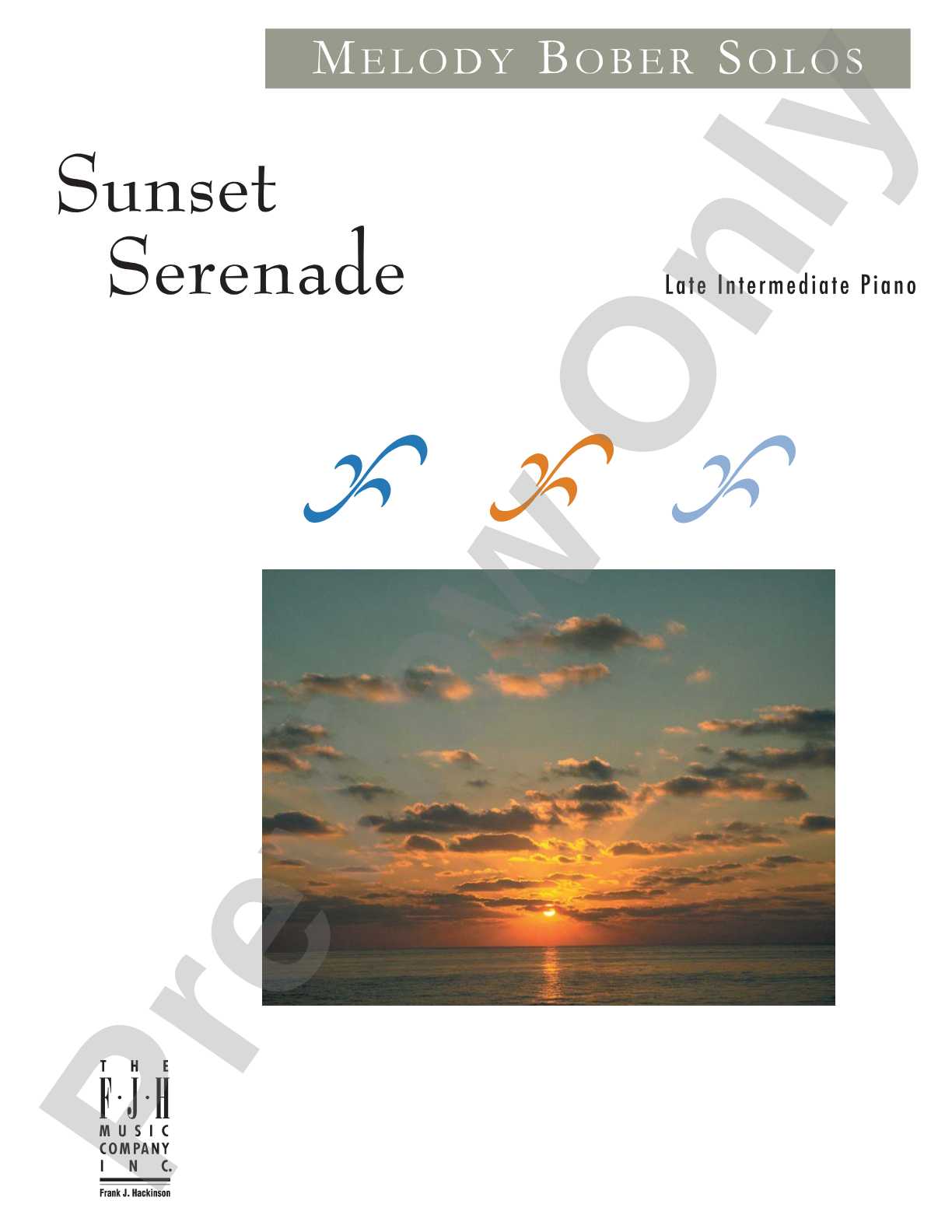
Sunset Serenade is a lyrical piece which presents a chordal melody with an arpeggiated accompaniment. It’s perfect for the intermediate student who is learning to voice chords.
Discover MakeMusic Cloud: thousands of interactive titles your students can play along with today.
Melody Bober composes piano music that connects directly with student learning. Her degree in music education from the University of Illinois at Champaign-Urbana and Master of Arts in piano performance from Minnesota State University, Moorhead grounded her in both pedagogy and performance. She studied with respected teachers including Joel Shapiro and Andrew Froelich for piano, Mary Hoffman for music education, and Tony Caramia for jazz.
Bober brings two decades of public school teaching, university-level instruction, and private studio work to her compositions. She serves as a church pianist and accompanist, and has directed church music programs. Her work as a clinician and workshop presenter has taken her across North America, where piano teachers seek out her pieces for their pedagogical clarity and musical craft.
Why we love this
Sunset Serenade gives intermediate students genuine musical satisfaction while teaching them to hear and voice chords. The lyrical melody sits naturally under the hands, and the arpeggiated accompaniment pattern supports the learning without becoming tedious. Bober's pedagogy shows: every note serves the student's understanding.
What to expect
Sunset Serenade captures the calm contemplation of day's end: unhurried, reflective, with gentle motion that never rushes. The arpeggiated accompaniment creates a sense of stillness punctuated by lyrical breathing, much like watching light fade gradually across a landscape.
Who it's for
Intermediate pianists ready to move beyond blocked chords and understand voice leading will find this piece rewarding. It suits students who have solid note-reading and hand independence but are beginning to think about harmonic color and chord voicing as expressive tools.
How to get the most out of it
Shape the melody by listening for the most important note in each phrase, typically on a strong beat or natural climax, rather than playing chords mechanically.
Practice hands separately first, then bring them together slowly so you can feel how the accompaniment pattern breathes with the melody's phrasing.
Experiment with pedal sparingly; the arpeggiated figures often stay clear without it, allowing the harmonic movement to speak distinctly.
Vary the dynamic through the piece by adjusting the accompaniment's fullness and the melody's tone, creating a sense of emotional narrative as the sun moves across the sky.
How to use it
Feature this in a studio recital alongside other character pieces, or pair it with works in contrasting moods to create dynamic program flow. It works equally well as a teaching piece in a student showcase or as a gentle interlude in a longer concert.
Skills your students will build
Voicing chords with awareness of upper and lower neighbor tones
Phrasing melody independently from accompaniment pattern
Playing arpeggiated figures with even rhythm and consistent tone quality
Listening to harmonic movement and tracking chord changes across measures
You May Also Like
Scan to Complete Your Purchase
Use your phone's camera to scan the code below
You'll log in on your phone and the order will be added to your account