

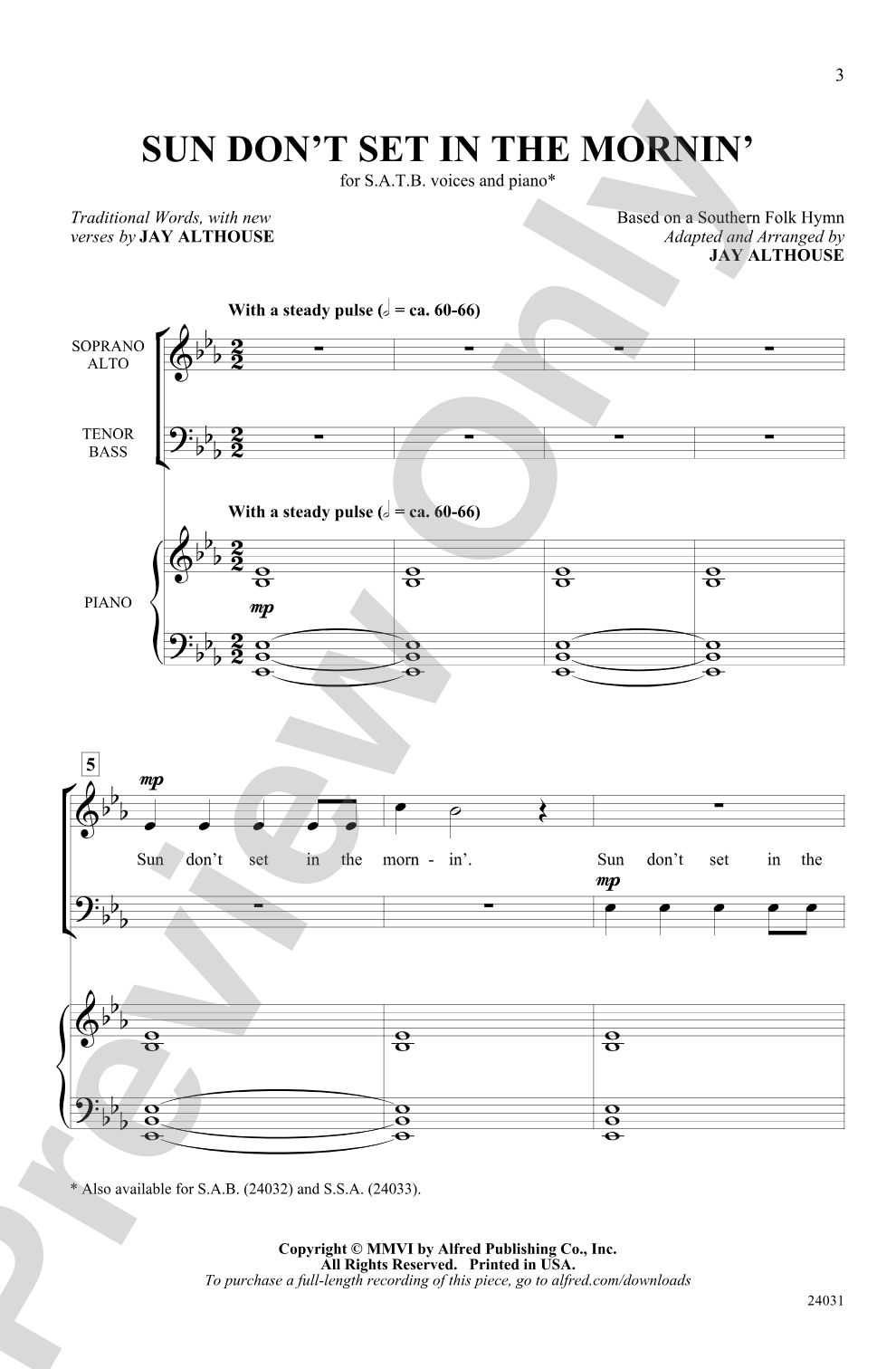

Sun Don't Set in the Mornin': SATB Choral Octavo
Based on a Southern Folk Hymn
Adapted and arranged, with additional words, by Jay Althouse
Item: 00-PO-0000073
$1.65
Minimum order quantity: 20 copies
Pickup currently not available
Related Items
Sun Don't Set in the Mornin': SAB Choral Octavo |
$1.65
|
View | |
Sun Don't Set in the Mornin': SSA Choral Octavo |
$1.65
|
View | |
Sun Don't Set in the Mornin': SATB Choral Octavo |
$1.65
|
View | |
Sun Don't Set in the Mornin': SAB Choral Octavo |
$1.65
|
View | |
Sun Don't Set in the Mornin': SSA Choral Octavo |
$1.65
|
View |
Description
This adaptation of an American folk hymn has a fascinating text: "Sun don't set in the mornin'," and "Water don't rise when the stars glow." But, ultimately, "light shines over the world." A haunting melody and a simple, open-sounding piano accompaniment set the scene.


Sun Don't Set in the Mornin': SATB Choral Octavo isn't in MakeMusic Cloud just yet...but it could be. Let us know you'd like to see it, and you'll help shape what comes next. In the meantime, start a free trial and dive into thousands of interactive titles your students can play along with today.
Request This Title
Tell us you want it.
Start Your Free Trial
Explore everything that's ready to play right now.
Sample Audio
1
Audio File
--:--
0:00
0:00
Sample Video
No sample videos found.
Additional Details
Series:
Alfred Choral Designs
Publisher:
Alfred Music
Page Count:
12
SKU:
00-PO-0000073
More about this title
About the Arranger: Jay Althouse

Jay Althouse holds degrees in Music Education and Music from Indiana University of Pennsylvania, where he received the Distinguished Alumni award. He spent eight years in the music publishing industry managing rights and licenses, serving on the Executive Board of the Music Publishers Association of America. As a composer, he has over 800 choral works in print performed across the English-speaking world and maintains membership in ASCAP, regularly receiving the Special Award for his compositions.
Beyond his own compositions, Althouse has collaborated extensively on educational resources and vocal literature. He co-wrote children's musicals with his wife Sally K. Albrecht, compiled respected vocal solo collections including Folk Songs for Solo Singers, and authored or co-authored several books for music classrooms: The Complete Choral Warm-up Book, Accent on Composers, Ready to Read Music, Sixty Music Quizzes, and One-Page Composer Bios. His choral arrangement I Hear America Singing, co-written with Albrecht, was performed by the San Francisco Girls and Boys Choirs at President Barack Obama's 2009 Inauguration. He serves on the National Advisory Board of the Folk Art Society of America and has contributed articles to its quarterly publication.
Why we love this
Althouse's arrangement honors the folk hymn's unsettling paradoxes while grounding them in an accessible musical setting. The open piano accompaniment and haunting melody create space for singers to connect with the text's spiritual arc, making this piece equally effective for concerts exploring folk traditions and for services seeking contemporary reflections on hope. Directors appreciate his gift for matching vocal texture to meaning without overcomplicating the arrangement.
What to expect
The opening phrases create an unsettled, almost mysterious mood, as if the singers are presenting a riddle or ancient wisdom. As the piece unfolds, that strange tension gradually resolves into affirmation, leaving audiences with a sense of hard-won peace rather than easy comfort.
Who it's for
This octavo suits choirs at the high school and adult levels, particularly those comfortable with folk idioms and spiritual texts. It works equally well for concert repertoire and sacred music settings, offering singers a piece that feels folk-authentic while remaining performance-ready without excessive rehearsal time.
How to get the most out of it
- Treat the text literally at first: let singers sit with the contradiction of 'sun don't set in the mornin'' before revealing its metaphorical power through phrasing and dynamic shape.
- Balance the four voices so the melody remains clear but the parts lock together as a unified chord. This transparency depends on careful blend in the middle voices.
- Work the piano part alongside the choir early in rehearsal. The open, simple accompaniment will feel sparse if singers rush; a patient tempo allows both elements to support each other.
- Shape the journey from paradox to resolution by gradually building energy and conviction through the final statement of 'light shines over the world.'
How to use it
Pair this with other American folk spirituals or contemporary settings of traditional texts for a concert exploring how folk wisdom addresses timeless questions. It also serves well as a closing piece in a mixed sacred program, where its movement from doubt to faith provides meaningful resolution. Consider programming it alongside works that challenge conventional thinking about light, hope, or spiritual truth.
Skills your students will build
- Singing folk-influenced melody with authenticity and restraint
- Balancing SATB voicing in open, sparse harmonic texture
- Connecting paradoxical text to musical interpretation and phrasing
- Sustaining energy through a slow-moving arrangement without dragging tempo