
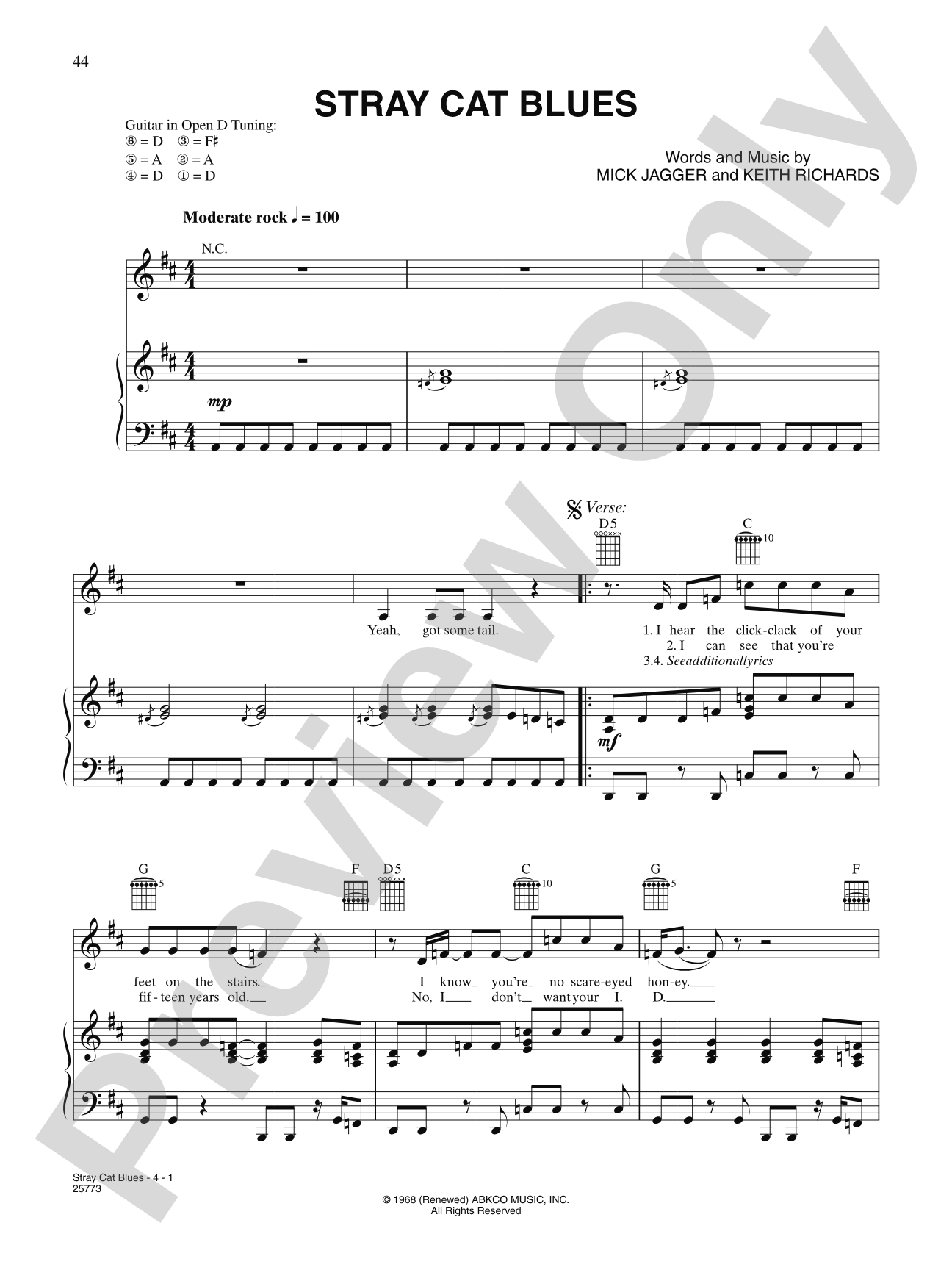

Stray Cat Blues: Piano/Vocal/Chords
The Rolling Stones
Item: 00-PS-0012172
$4.99
Pickup currently not available
Related Items
Dear Doctor: Piano/Vocal/Chords |
$5.99
|
View | |
Factory Girl: Piano/Vocal/Chords |
$4.99
|
View | |
Jigsaw Puzzle: Piano/Vocal/Chords |
$4.99
|
View | |
Parachute Woman: Piano/Vocal/Chords |
$4.99
|
View | |
Salt of the Earth: Piano/Vocal/Chords |
$4.99
|
View | |
The Rolling Stones: Beggars Banquet: Piano/Vocal/Chords Book |
$16.95
|
View | |
The Rolling Stones: Beggars Banquet: Authentic Guitar TAB Book |
$16.99
|
View |
Description
Alfred has expanded the Classic Album Editions series with the new Piano/Vocal/Chord edition of the Rolling Stones' legendary record Beggars Banquet.
The last record the Rolling Stones released with guitarist Brian Jones, Beggars Banquet includes the hit songs "Sympathy for the Devil" and "Street Fighting Man." The Piano/Vocal/Chords edition provides the lyrics along with piano and chord arrangements for all the songs on the records.
Titles are: Sympathy for the Devil * No Expectations * Dear Doctor * Parachute Woman * Jigsaw Puzzle * Street Fighting Man * Prodigal Son * Stray Cat Blues * Factory Girl * Salt of the Earth.


The last record the Rolling Stones released with guitarist Brian Jones, Beggars Banquet includes the hit songs "Sympathy for the Devil" and "Street Fighting Man." The Piano/Vocal/Chords edition provides the lyrics along with piano and chord arrangements for all the songs on the records.
Titles are: Sympathy for the Devil * No Expectations * Dear Doctor * Parachute Woman * Jigsaw Puzzle * Street Fighting Man * Prodigal Son * Stray Cat Blues * Factory Girl * Salt of the Earth.
Stray Cat Blues: Piano/Vocal/Chords isn't in MakeMusic Cloud just yet...but it could be. Let us know you'd like to see it, and you'll help shape what comes next. In the meantime, start a free trial and dive into thousands of interactive titles your students can play along with today.
Request This Title
Tell us you want it.
Start Your Free Trial
Explore everything that's ready to play right now.
Sample Audio
No sample audio found.
Sample Video
No sample videos found.
Additional Details
Series:
Alfred's Classic Album Editions
Publisher:
Alfred Music
Page Count:
52
SKU:
00-PS-0012172
More about this title
About the Composer: Mick Jagger
Mick Jagger emerged as one of rock music's most distinctive vocalists and songwriters, partnering with Keith Richards to create some of the most influential songs of the 20th century. His ability to craft memorable melodies, provocative lyrics, and songs that balance accessibility with artistic ambition made the Rolling Stones a defining force in rock music education and repertoire.
For musicians learning to interpret rock vocal music, Jagger's approach offers valuable lessons in phrasing, character development, and the interplay between rhythm and melody. His compositions across the Beggars Banquet album demonstrate how strong songwriting serves both commercial and artistic purposes, making them worthy subjects for serious study.
Why we love this
Beggars Banquet represents a watershed moment in rock history, and this Piano/Vocal/Chords edition opens access to the album's songwriting in a format that works equally well for solo singers, pianists arranging for students, and ensemble directors seeking authentic rock repertoire. The material spans blues-influenced ballads, proto-punk energy, and sophisticated arrangements, offering genuine musical substance alongside historical significance.
What to expect
Raw, inventive, and unapologetically ambitious. These songs blend blues traditions with contemporary rock structures, creating a sound that feels both rooted and revolutionary. The album's aesthetic mixes gritty realism with sophisticated musical craft, evoking the turbulent cultural moment of 1968 while remaining musically timeless.
Who it's for
Pianists and vocalists studying classic rock repertoire, whether in private lessons, choral or piano classes, or as soloists preparing recital material. Music educators building rock music units will find this collection offers both historical context and genuine musical depth. The chord symbols make it accessible to guitarists and other accompanists as well.
How to get the most out of it
- Attend closely to the rhythm section implied by the chord changes; these songs often have syncopated feels that require locking the vocal phrasing to the underlying groove rather than sitting on the beat.
- Study the original recordings to internalize the vocal inflections and phrasing choices that define each song, then adapt them to your own voice type and range.
- Use the chord symbols as a springboard for reharmonization or instrumental arrangement rather than as fixed voicings; many of these songs benefit from fresh harmonic interpretations.
- Pay particular attention to dynamic control in the quieter passages, especially in ballads like 'No Expectations,' where restraint often carries more weight than volume.
How to use it
Feature individual songs in recitals or showcase concerts to demonstrate how rock compositions function as serious vocal and piano literature. Assign selections as repertoire in voice or keyboard classes to develop interpretive skills in a genre students connect with emotionally. Use the material as part of a broader unit on popular music composition and arrangement.
Skills your students will build
- Reading and performing from lead sheets with chord symbols
- Adapting rock phrasing and rhythmic freedom within structured chord progressions
- Accompanying singers as a pianist using chords and implied rhythms
- Interpreting vocal character across blues, rock ballad, and harder rock styles
- Understanding how melody and harmonic movement work in classic rock songwriting