
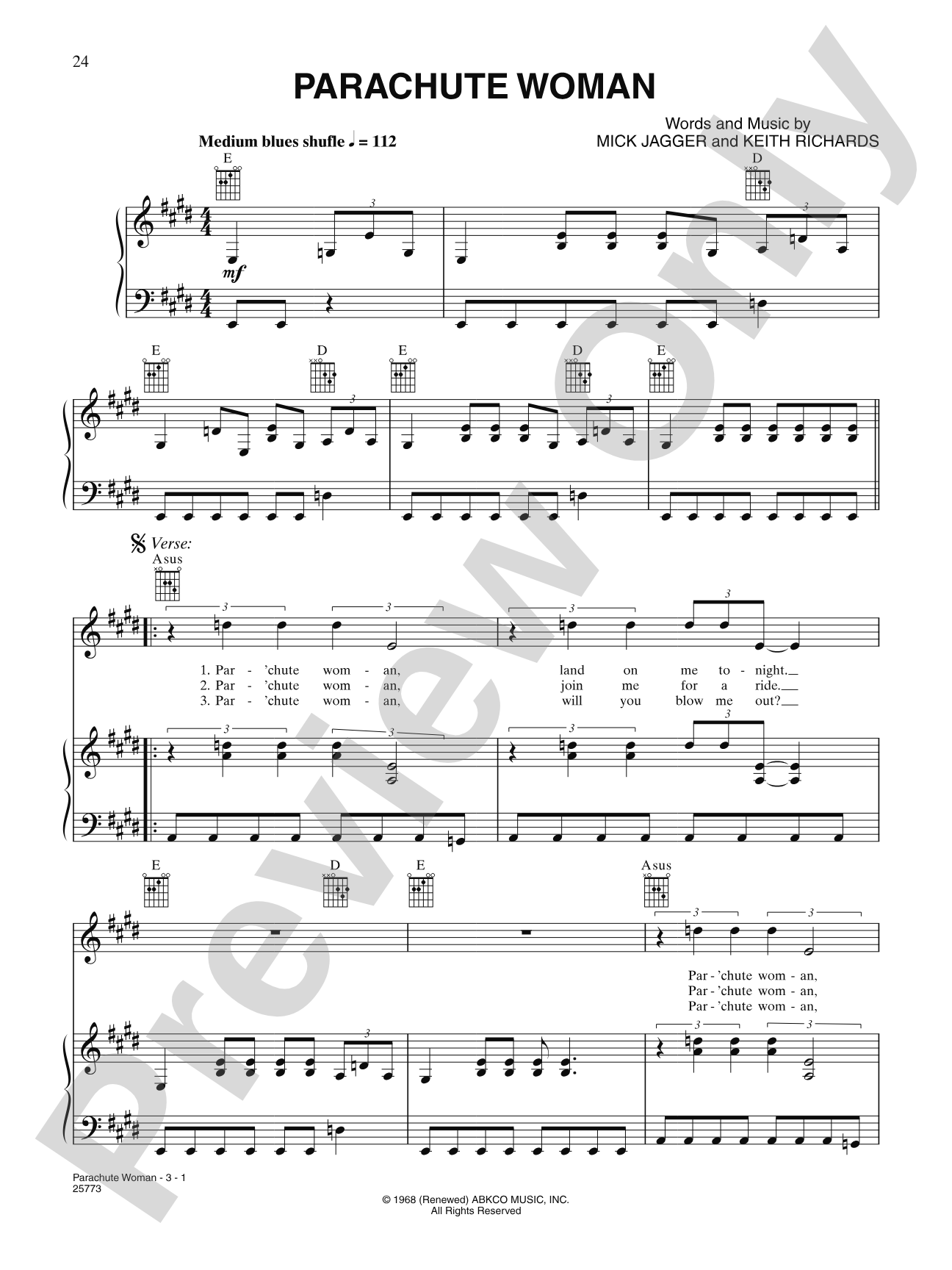

Parachute Woman: Piano/Vocal/Chords
The Rolling Stones
Item: 00-PS-0012170
$4.99
Pickup currently not available
Related Items
Dear Doctor: Piano/Vocal/Chords |
$5.99
|
View | |
Factory Girl: Piano/Vocal/Chords |
$4.99
|
View | |
Jigsaw Puzzle: Piano/Vocal/Chords |
$4.99
|
View | |
Stray Cat Blues: Piano/Vocal/Chords |
$4.99
|
View | |
Salt of the Earth: Piano/Vocal/Chords |
$4.99
|
View | |
The Rolling Stones: Beggars Banquet: Piano/Vocal/Chords Book |
$16.95
|
View | |
The Rolling Stones: Beggars Banquet: Authentic Guitar TAB Book |
$16.99
|
View |
Description
Alfred has expanded the Classic Album Editions series with the new Piano/Vocal/Chord edition of the Rolling Stones' legendary record Beggars Banquet.
The last record the Rolling Stones released with guitarist Brian Jones, Beggars Banquet includes the hit songs "Sympathy for the Devil" and "Street Fighting Man." The Piano/Vocal/Chords edition provides the lyrics along with piano and chord arrangements for all the songs on the records.
Titles are: Sympathy for the Devil * No Expectations * Dear Doctor * Parachute Woman * Jigsaw Puzzle * Street Fighting Man * Prodigal Son * Stray Cat Blues * Factory Girl * Salt of the Earth.


The last record the Rolling Stones released with guitarist Brian Jones, Beggars Banquet includes the hit songs "Sympathy for the Devil" and "Street Fighting Man." The Piano/Vocal/Chords edition provides the lyrics along with piano and chord arrangements for all the songs on the records.
Titles are: Sympathy for the Devil * No Expectations * Dear Doctor * Parachute Woman * Jigsaw Puzzle * Street Fighting Man * Prodigal Son * Stray Cat Blues * Factory Girl * Salt of the Earth.
Parachute Woman: Piano/Vocal/Chords isn't in MakeMusic Cloud just yet...but it could be. Let us know you'd like to see it, and you'll help shape what comes next. In the meantime, start a free trial and dive into thousands of interactive titles your students can play along with today.
Request This Title
Tell us you want it.
Start Your Free Trial
Explore everything that's ready to play right now.
Sample Audio
No sample audio found.
Sample Video
No sample videos found.
Additional Details
Series:
Alfred's Classic Album Editions
Publisher:
Alfred Music
Page Count:
52
SKU:
00-PS-0012170
More about this title
About the Composer: Mick Jagger
Mick Jagger co-wrote the songs on Beggars Banquet alongside Keith Richards during a period when the Rolling Stones were deepening their exploration of blues roots and raw rock expression. His songwriting on this record demonstrates a growing command of lyrical storytelling, moving beyond pop conventions into territory that was provocative and culturally significant for 1968.
As a composer and performer, Jagger shaped the sound of rock music across five decades. His work on Beggars Banquet represents a pivot toward artistic ambition and social commentary, qualities that have defined his most enduring contributions to the repertoire.
Why we love this
This collection captures songs that defined an era while remaining surprisingly accessible for singers and pianists working across skill levels. The arrangements preserve the essential character of each track without oversimplifying, making them genuinely rewarding to perform rather than merely playable. Programming material from Beggars Banquet signals artistic seriousness and opens conversations about how rock repertoire belongs in contemporary music education.
What to expect
Raw and blues-inflected, with an undercurrent of social edge. These arrangements convey the record's restless energy and its debt to American blues traditions while remaining grounded in the melody and harmony that made Beggars Banquet both commercially successful and artistically significant. Performance unfolds with the kind of controlled intensity that comes from restraint rather than spectacle.
Who it's for
Pianists and singers preparing solo recital material or ensemble repertoire drawn from rock music history. Voice students, piano students, and contemporary music ensemble members will find substantial material here that connects classical technique to popular repertoire. Teachers seeking authentic rock sources for cross-genre programming or music history study.
How to get the most out of it
- Study the original recordings carefully before settling on tempo and feel. These arrangements live closest to the source material when the rhythmic pocket and groove patterns reflect the band's approach to each song.
- Balance the chord symbols with the written piano part rather than treating them as separate instructions. The notation provides harmonic foundation; the chords offer flexibility for reharmonization or instrumental accompaniment if needed.
- Pay attention to lyrical phrasing and storytelling. These songs gain power when sung with attention to the narrative arc within each track, not merely as melody-and-harmony exercises.
- Adjust vocal range and key as needed for your singer's tessatura. Rock repertoire from this era was written for specific voices but rewards transposition and re-voicing to fit individual performers.
How to use it
Feature individual songs in recitals focused on rock or contemporary repertoire, or present a multi-song set as a thematic program. These pieces work well in courses examining popular music composition, rock history, or the evolution of songwriting across genres. The breadth of the album allows pairing with classical material to demonstrate how harmonic language, structure, and storytelling transcend genre boundaries.
Skills your students will build
- Reading chord symbols and realizing them on piano
- Interpreting rock rhythmic feels and swing patterns
- Vocal phrasing and narrative delivery in non-classical idioms
- Transposition and adaptation for different vocal ranges
- Understanding blues-based harmonic progressions in popular music