Storm Warning!: 2nd B-flat Clarinet Sheet Music Preview

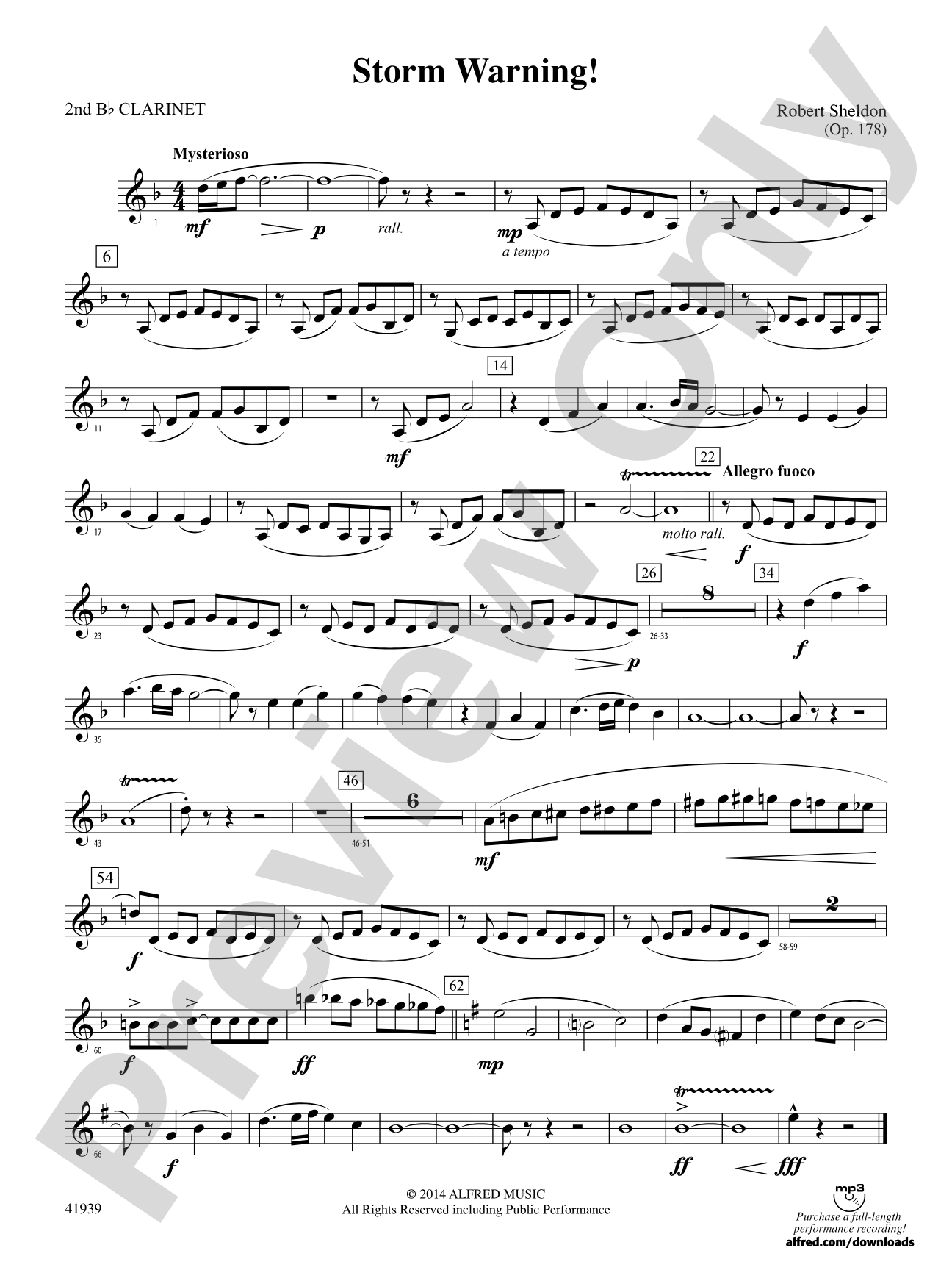
Storm Warning!: 2nd B-flat Clarinet

By Robert Sheldon

Grade: 2 (Medium Easy)

Item: 00-PC-0016421_C2

Digital Download
$3.00
Description
The shores of the Great Lakes are infamous for their intense storms. This composition attempts to paint a musical portrait of the beautiful lake shore before and during one of these events. (2:35) This title is available in MakeMusic Cloud.

Don't just read it, hear it, play along with it, and watch your students grow with it. In MakeMusic Cloud, Storm Warning!: 2nd B-flat Clarinet comes alive with professional accompaniment, adjustable tempo, and built-in practice tools that turn solo practice into real progress.

Sample Audio
0:00
0:00
Sample Video
Additional Details
Series: Young Symphonic
Publisher: Alfred Music
Page Count: 156
SKU: 00-PC-0016421_C2

More about this title

About the Composer: Robert Sheldon

Robert Sheldon

Robert Sheldon stands among the most frequently performed composers writing for wind band today. His works appear consistently on contest and concert programs worldwide, and ensembles across the globe champion his music. He co-authored Sound Innovations for Concert Band and has received major recognition from the American School Band Director's Association, Phi Beta Mu, and ASCAP.

Sheldon maintains an active schedule as a guest conductor for all-state and regional honor bands, and he regularly clinics at universities and state music education conferences. He has conducted performances at Carnegie Hall, Orchestra Hall, Boston Symphony Hall, the Sydney Opera House, and the Kennedy Center. His extensive international work has taken him to Japan, Canada, Italy, Germany, Australia, and China. VanderCook College of Music awarded him an honorary doctorate in 2020.

Why we love this

Sheldon excels at writing that captures vivid imagery without sacrificing musicality or accessibility. Storm Warning works as both a contest piece and a concert feature because the Grade 2 scoring gives every section something engaging to play while the dramatic arc and orchestration choices create the impact you need for a memorable program moment.

What to expect

You begin on a tranquil Great Lakes shoreline, with open textures and gentle motion evoking calm water and clear skies. Then the weather turns. The music builds intensity through driving rhythms and fuller orchestration, capturing the raw energy and power of a sudden storm rolling across the water. By the final moments, you experience the full force of nature rendered in sound.

Who it's for

Band directors looking for a Grade 2 piece with genuine concert impact and vivid musical storytelling. This works equally well for winter or spring contest entries and for concert programs where you want younger or developing bands to engage with descriptive music that rewards careful preparation.

How to get the most out of it

  • Shape the opening moments with dynamic restraint to establish the calm before the storm. The clarity of that peaceful section will make the turbulent music that follows hit harder.
  • Balance the full ensemble sound during the intense sections. With Grade 2 writing, voices can blend into each other if players aren't listening across sections.
  • Use the recorded accompaniment to lock ensemble rhythms and tempo during the storm passage, where the driving pulse matters most.
  • Build the climax gradually across the final sections rather than jumping to full volume too soon. The best dramatic payoff comes from patient crescendo work.

How to use it

Program this as a concert centerpiece or contest selection that showcases your band's ability to shape a narrative arc. The moderate length (2:35) pairs well with both faster, lighter pieces and slower, lyrical selections. It also serves as a confidence builder for Grade 2 ensembles approaching contest season.

Skills your students will build

  • Dynamic control and shaping across extended phrases
  • Ensemble balance during thick orchestration
  • Sectional independence within a unified sound
  • Responding to tempo and rhythmic precision in driving passages
  • Interpretive musicality through descriptive musical text

You May Also Like