
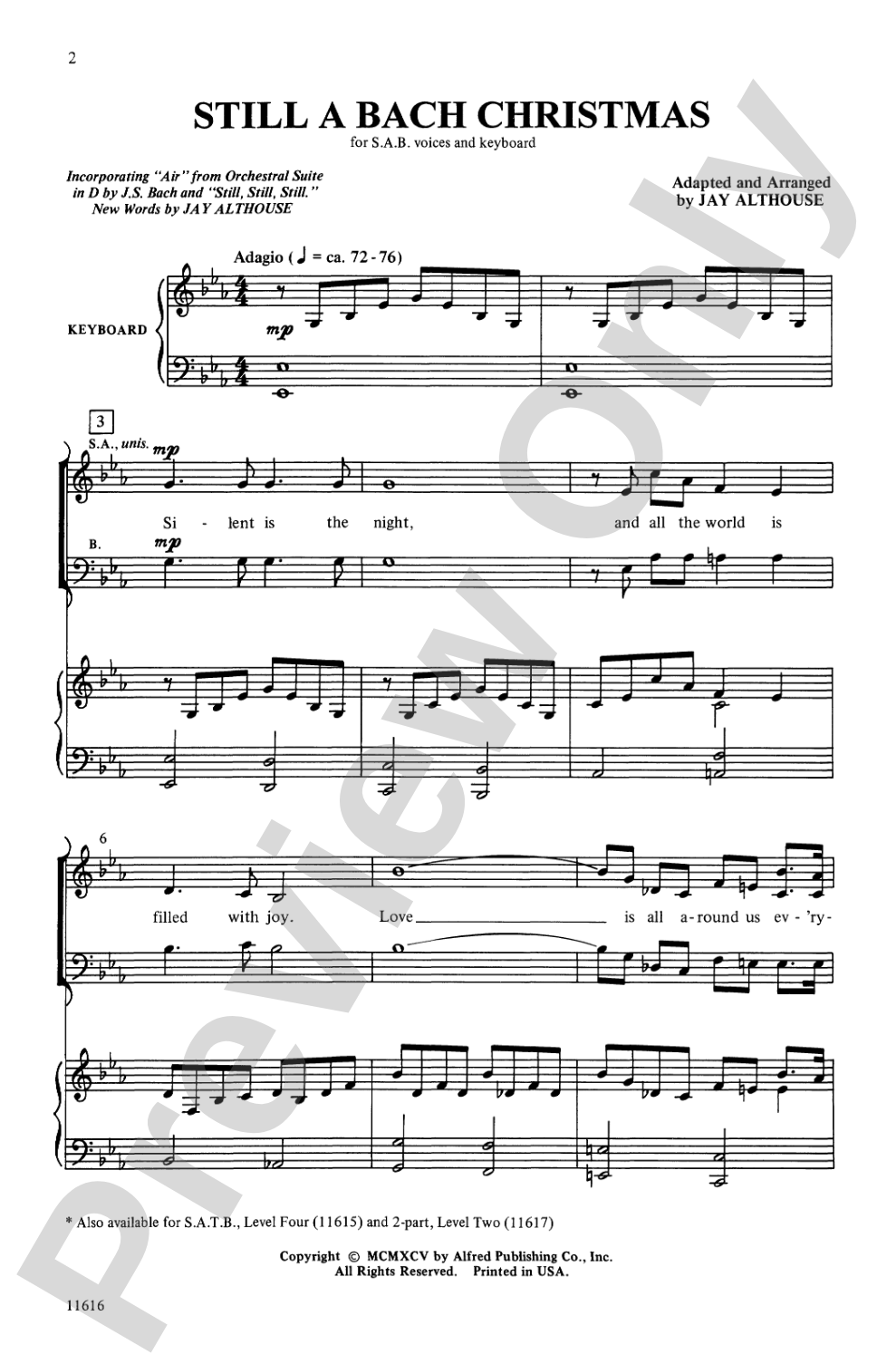

Still a Bach Christmas: SAB Choral Octavo
Music by Johann Sebastian Bach / arr. Jay Althouse
Item: 00-PO-0003880
$2.25
Minimum order quantity: 20 copies
Pickup currently not available
Description
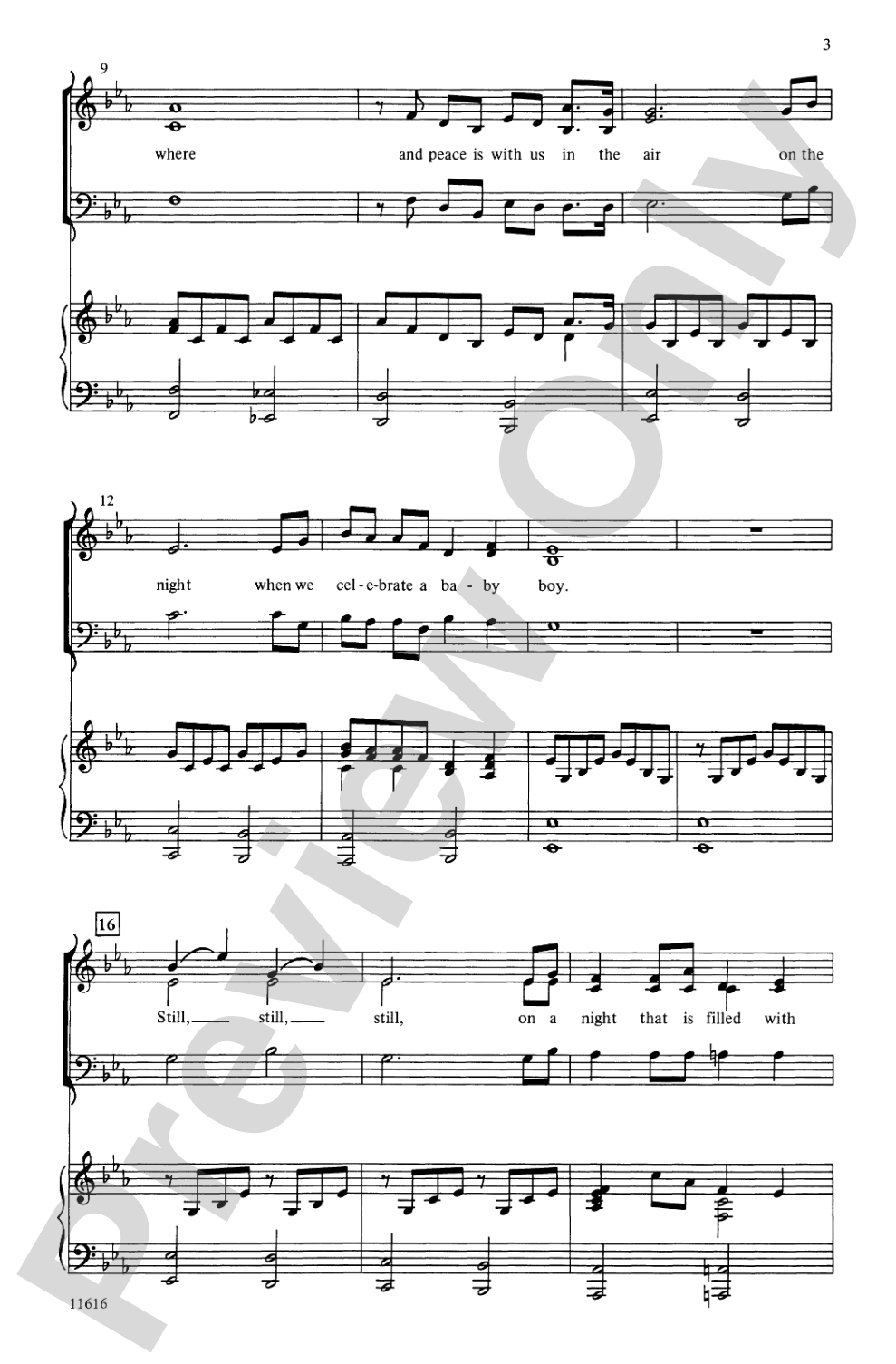
A well-crafted choral work incorporating Bach's famous "Air" from orchestral Suite in D, the best loved carol, "Still, Still, Still," and just a touch of "O Holy Night." A simple adaptation of Bach's keyboard harmonies is used throughout as the piano accompaniment. Sensitive and enchating. New text by the arranger. Could become a holiday classic!


Still a Bach Christmas: SAB Choral Octavo isn't in MakeMusic Cloud just yet...but it could be. Let us know you'd like to see it, and you'll help shape what comes next. In the meantime, start a free trial and dive into thousands of interactive titles your students can play along with today.
Request This Title
Tell us you want it.
Start Your Free Trial
Explore everything that's ready to play right now.
Sample Audio
No sample audio found.
Sample Video
No sample videos found.
Additional Details
Series:
Alfred Archive Edition: Alfred Choral Designs
Publisher:
Alfred Music
Page Count:
8
SKU:
00-PO-0003880
More about this title
About the Composer: Johann Sebastian Bach
Johann Sebastian Bach (1685-1750) shaped Western music more profoundly than perhaps any other composer. His mastery of counterpoint, harmonic language, and structural design established foundations that musicians still study today. Bach's output spans sacred cantatas, keyboard works, orchestral suites, and chamber music, each category demonstrating complete command of form and expressive depth.
For choral musicians, Bach's influence runs through every rehearsal. His approach to voice leading, harmonic rhythm, and text painting set the standard for how words and music unite. Even centuries after his death, arrangers draw on his genius because his musical ideas remain endlessly adaptable and spiritually resonant.
Why we love this
Jay Althouse's arrangement threads together three beloved sources—Bach's "Air," the gentle carol "Still, Still, Still," and a hint of "O Holy Night"—into something that feels both reverent and fresh. The SAB voicing makes this accessible without sacrificing the harmonic sophistication that comes from Bach's keyboard writing, and the new text binds everything into a cohesive whole. Programming this signals to your audience that your holiday concert honors both classical mastery and genuine warmth.
What to expect
The piece inhabits a contemplative, almost intimate space. Bach's "Air" brings architectural elegance and gentle melancholy; the carol section settles into familiar comfort; the whisper of "O Holy Night" adds a moment of profound simplicity. Throughout, the piano accompaniment grounds everything in clarity and warmth, creating music that feels both timeless and immediate.
Who it's for
This arrangement serves choirs seeking holiday repertoire that transcends typical seasonal fare. SAB voicing makes it appropriate for developing intermediate choirs while the Bach foundation appeals to ensemble directors who want substantive music. It works equally well in church concerts, school holiday programs, or interfaith community celebrations.
How to get the most out of it
- Balance the "Air" melody carefully between your soprano and alto lines; the interplay between them defines the piece's opening character and should feel conversational rather than competing.
- Shape the familiar carol section with restraint. The beauty lies in clarity of text and gentle harmonic support, not volume. Let the piano's simple Bach-derived voicings breathe.
- Attend to the transition between sections as a conductor. These moments reveal how thoughtfully Althouse connected the material; mark them in rehearsal so singers understand the emotional arc.
How to use it
Pair this with other Bach-based works or juxtapose it against contemporary holiday music to show the range of your ensemble's artistry. It serves beautifully as a concert closer or as a centerpiece for a classical-leaning holiday program. Consider featuring it as the finale of a multi-movement suite that explores different holiday traditions.
Skills your students will build
- Singing Bach-influenced harmonic language with accurate voice leading
- Balancing independence between voice parts in close harmony
- Interpreting text with sensitivity across multiple melodic sources
- Reading accidentals and harmonic rhythm in keyboard-derived arrangements
- Maintaining phrase direction across sectional transitions