
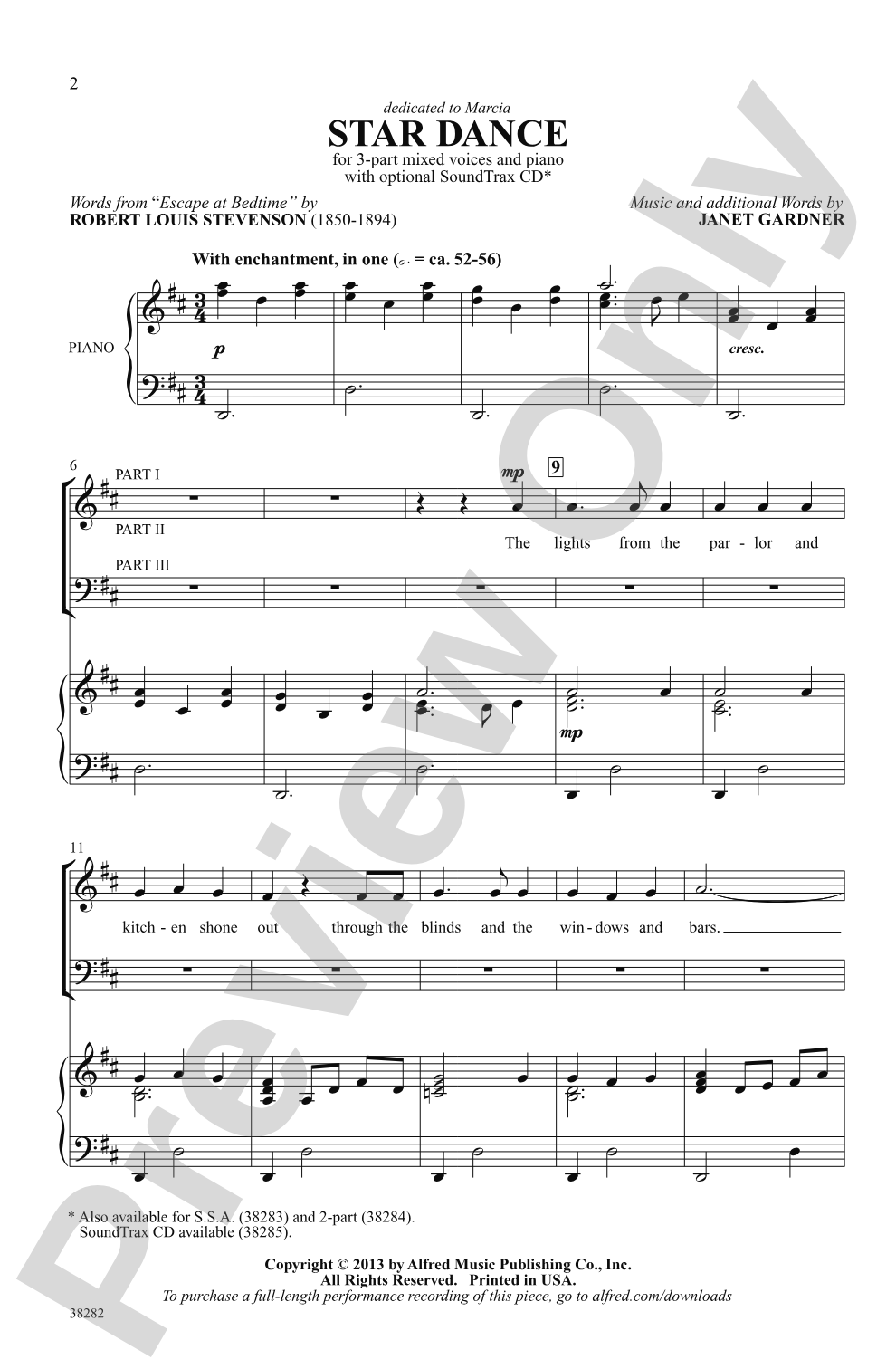
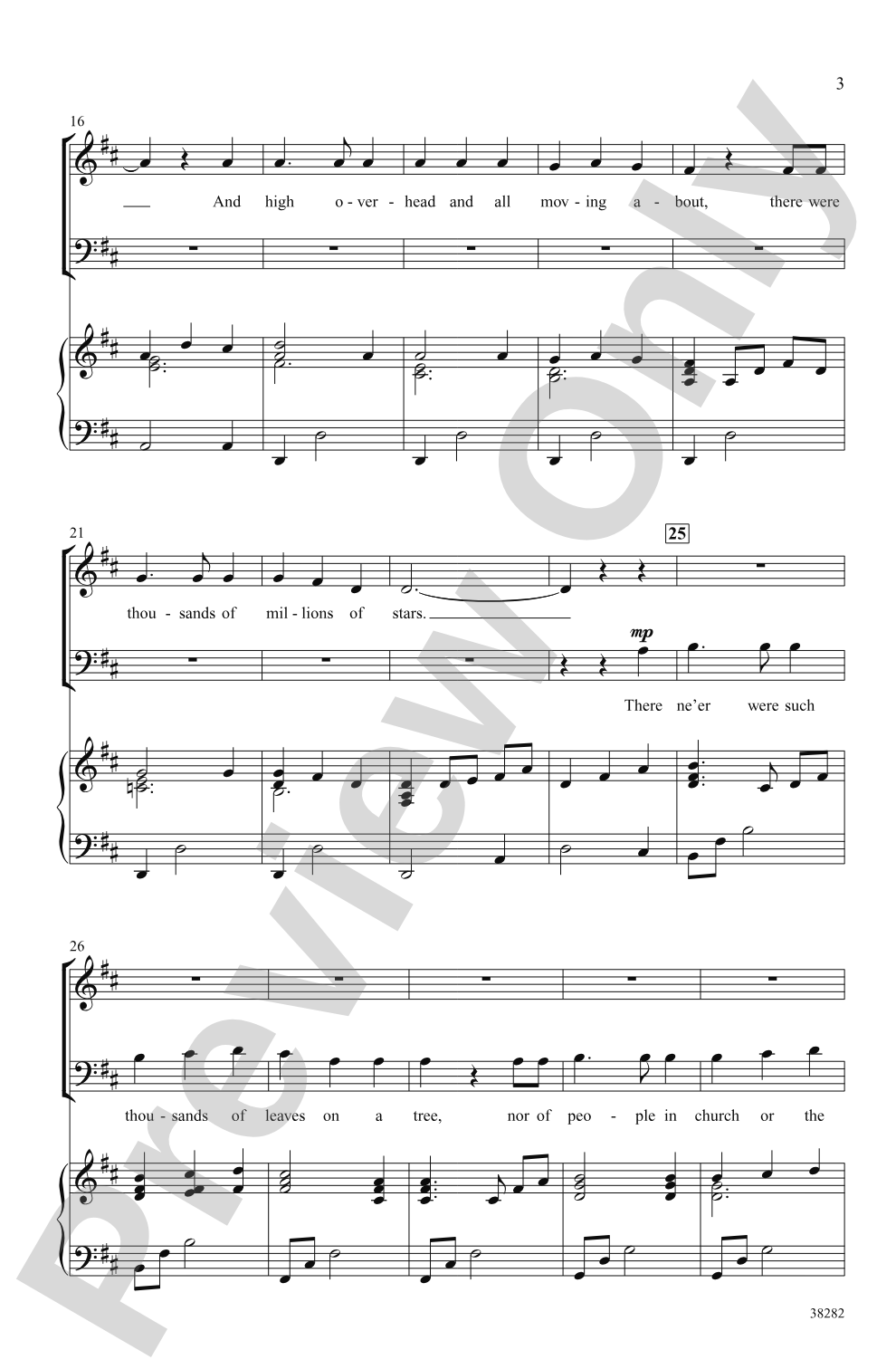
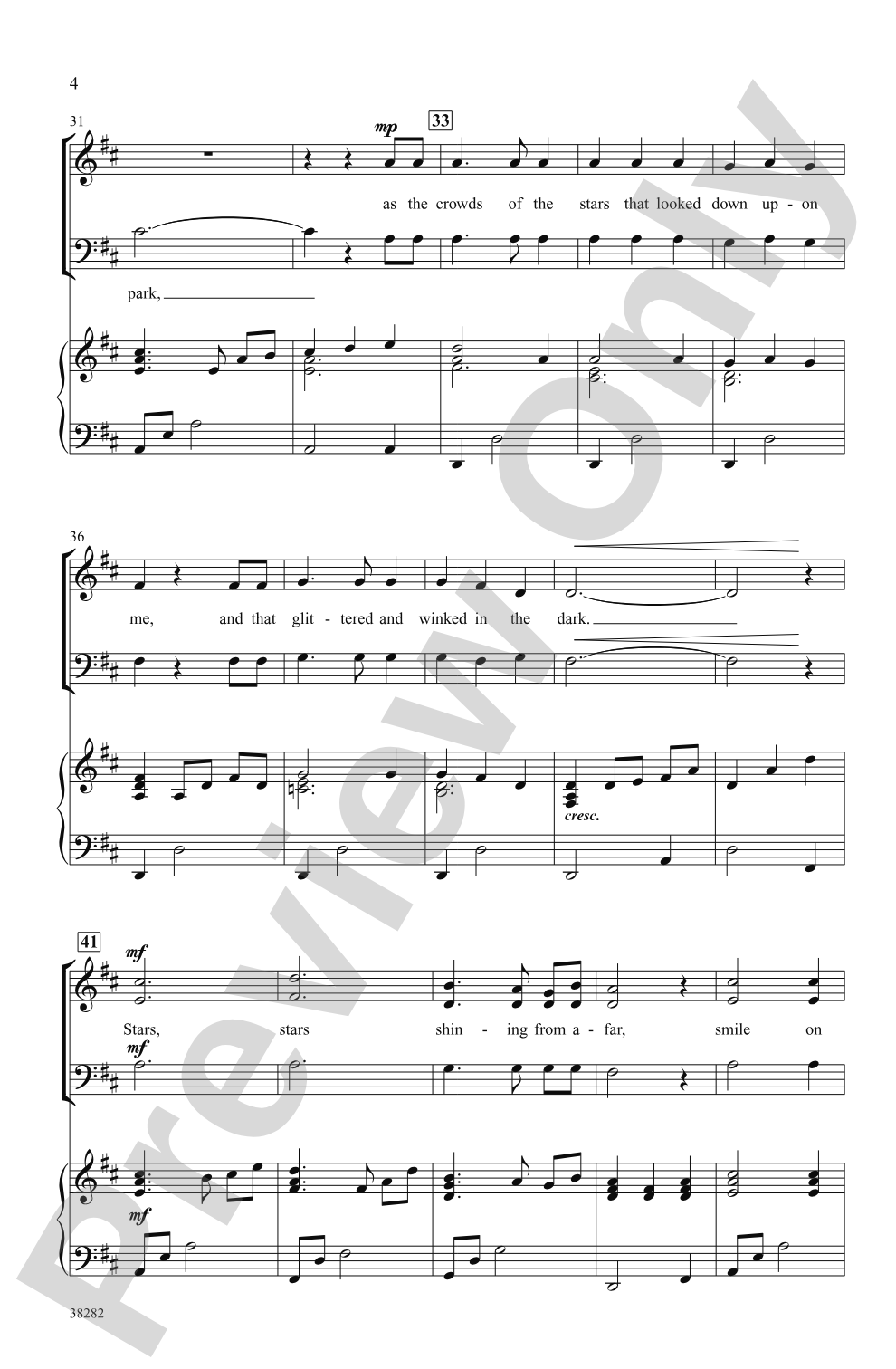

Star Dance: 3-Part Mixed (with Opt. Baritone) Choral Octavo
Words from "Escape at Bedtime" by Robert Louis Stevenson, music and additional words by Janet Gardner
Item: 00-PO-0001520
$2.05
Minimum order quantity: 20 copies
Pickup currently not available
Related Items
Star Dance: SoundTrax Digital Audio Download |
$27.99
|
View | |
Star Dance: SSA Choral Octavo |
$1.85
|
View | |
Star Dance: 2-Part Choral Octavo |
$1.85
|
View | |
Star Dance: 3-Part Mixed (with Opt. Baritone) Choral Octavo |
$2.05
|
View | |
Star Dance: SSA Choral Octavo |
$1.85
|
View | |
Star Dance: 2-Part Choral Octavo |
$1.85
|
View | |
Star Dance: Choral Octavo SoundTrax CD |
$27.99
|
View |
Description
Singers will simply shine when performing this lilting setting that celebrates the beauty of the stars. Independent counterlines, sensible ranges, readable rhythms, and notable dynamics make this a terrific song to teach and learn.


Star Dance: 3-Part Mixed (with Opt. Baritone) Choral Octavo isn't in MakeMusic Cloud just yet...but it could be. Let us know you'd like to see it, and you'll help shape what comes next. In the meantime, start a free trial and dive into thousands of interactive titles your students can play along with today.
Request This Title
Tell us you want it.
Start Your Free Trial
Explore everything that's ready to play right now.
Sample Audio
1
Audio File
--:--
0:00
0:00
Sample Video
No sample videos found.
Additional Details
Series:
Alfred Choral Designs
Publisher:
Alfred Music
Page Count:
12
SKU:
00-PO-0001520
More about this title
About the Composer: Janet Gardner

Janet Gardner studied music education at Concordia College in Moorhead, Minnesota, and spent 33 years teaching elementary general music in Montevideo, Minnesota. During her classroom career, she led workshops at state universities, presented clinics at state music conventions, and appeared as a composer and clinician at music festivals across the United States and Canada. Her contributions to music education earned her the 1995 Minnesota Music Classroom Teacher of the Year award, and she chaired the Minnesota Elementary Composition Contest for six years.
Gardner has composed numerous musicals for Alfred, including Bones!, Broadway Santa, The Granny Awards, The Highlight Zone, The Phantom of the Music Room, and Star Search, along with several choral pieces such as Godfrey Gordon Gustavus Gore, Nathan Nobb, The Tide Rises, The Tide Falls, and The Wind. Her work has received annual ASCAP recognition. Since retiring from classroom teaching in 2006, she continues composing and remains active in her community as a church musician, director of an ecumenical contemporary music ensemble, and board member of the Minnesota Valley Community Concert Association.
Why we love this
Gardner writes with a keen ear for what works in the middle school and early high school choir room: lines that sit well in developing voices, rhythms that are straightforward without feeling simplistic, and text that students actually want to sing. The poetic imagery of starlight gives singers something meaningful to connect to emotionally, while the independent counterlines keep the writing interesting and teach real harmonic awareness.
What to expect
Star Dance has a lyrical, floating quality that invites singers to sustain and shape long lines. The text's poetic celebration of stars creates an ethereal atmosphere while the readable rhythms keep the piece grounded and singable, making it feel like a natural, unforced expression rather than a technical exercise.
Who it's for
This octavo works beautifully for middle school and early high school choirs looking for accessible yet musically substantial repertoire. It's equally at home in a community choir or recreational ensemble where singers want to experience real three-part writing without excessive technical demands.
How to get the most out of it
- Bring out the independence of each line during rehearsal by having parts sing separately first, then layer them in pairs before combining all three. This builds confidence and clarity in a piece that asks singers to maintain their own melodic shape.
- Shape the notable dynamics marked throughout to create natural arc and contrast; avoid treating them as arbitrary markings. These shifts in volume are essential to the piece's emotional journey.
- If using the recorded accompaniment, rehearse with it early and often so singers anchor to the harmonic support rather than drifting into the accompaniment's groove.
- Consider the optional baritone part as a way to add depth and warmth to your lower voice line without forcing tenors or altos down beyond their comfort range.
How to use it
Program this as a concert opener or thoughtful ballad amid more energetic selections; its serene character provides excellent contrast and sets a reflective mood. It's also well suited to spring concerts, celestial or nature-themed programs, or any context where you want to showcase your singers' ability to blend voices and sustain musical line.
Skills your students will build
- Singing independent melodic lines within a three-part texture
- Listening to and balancing against other voice parts
- Shaping dynamics to create musical phrase and expression
- Sustaining legit tone through longer melodic passages
- Reading and performing SAB voicing with optional expansion to four parts