Slow Rockin' Christmas Sheet Music Preview

Slow Rockin' Christmas: 3-Part Mixed Choral Octavo

Music by Jay Althouse

Item: 00-PO-0004579

Digital Download
$2.25

Minimum order quantity: 20 copies

Description
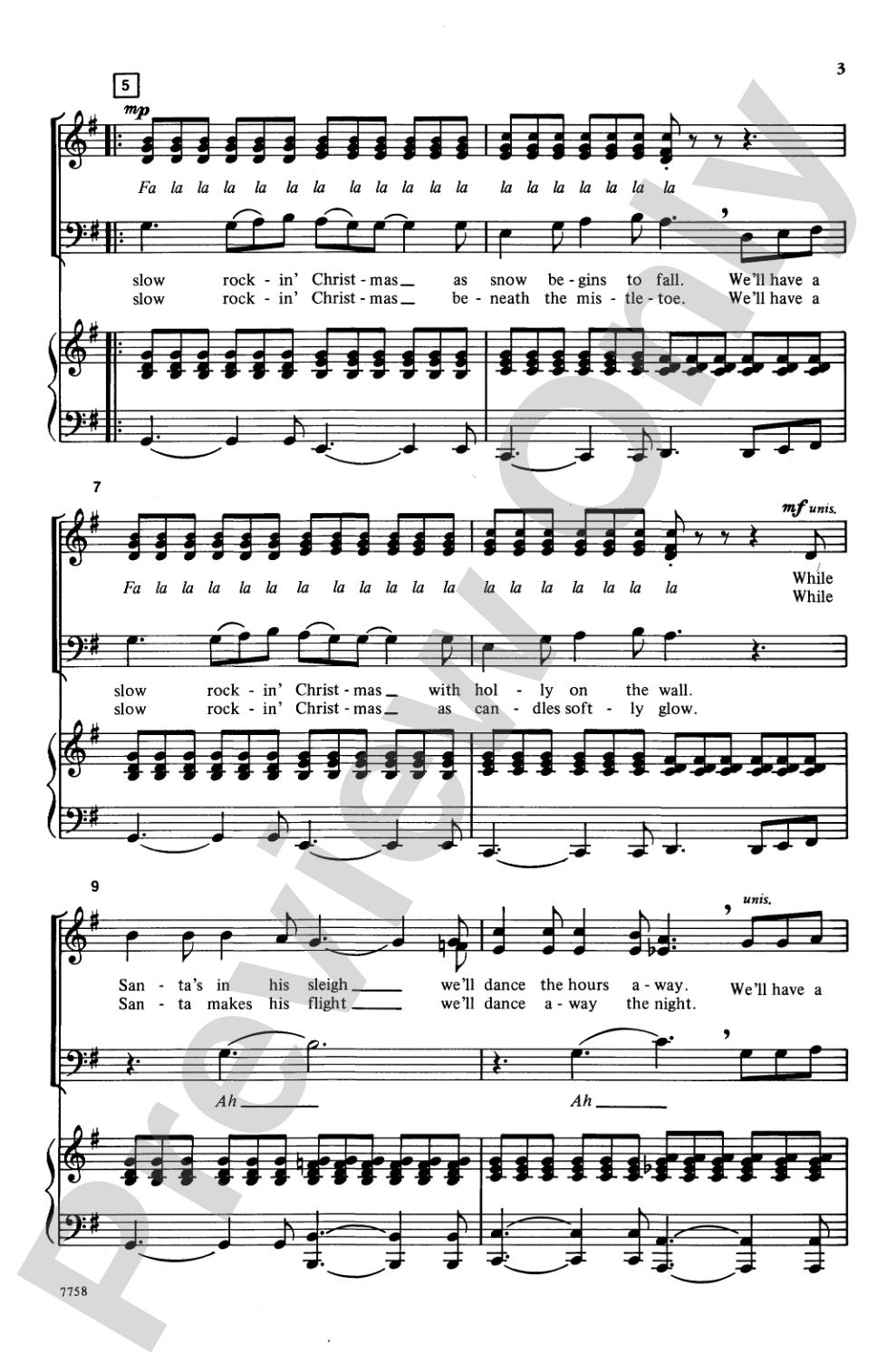
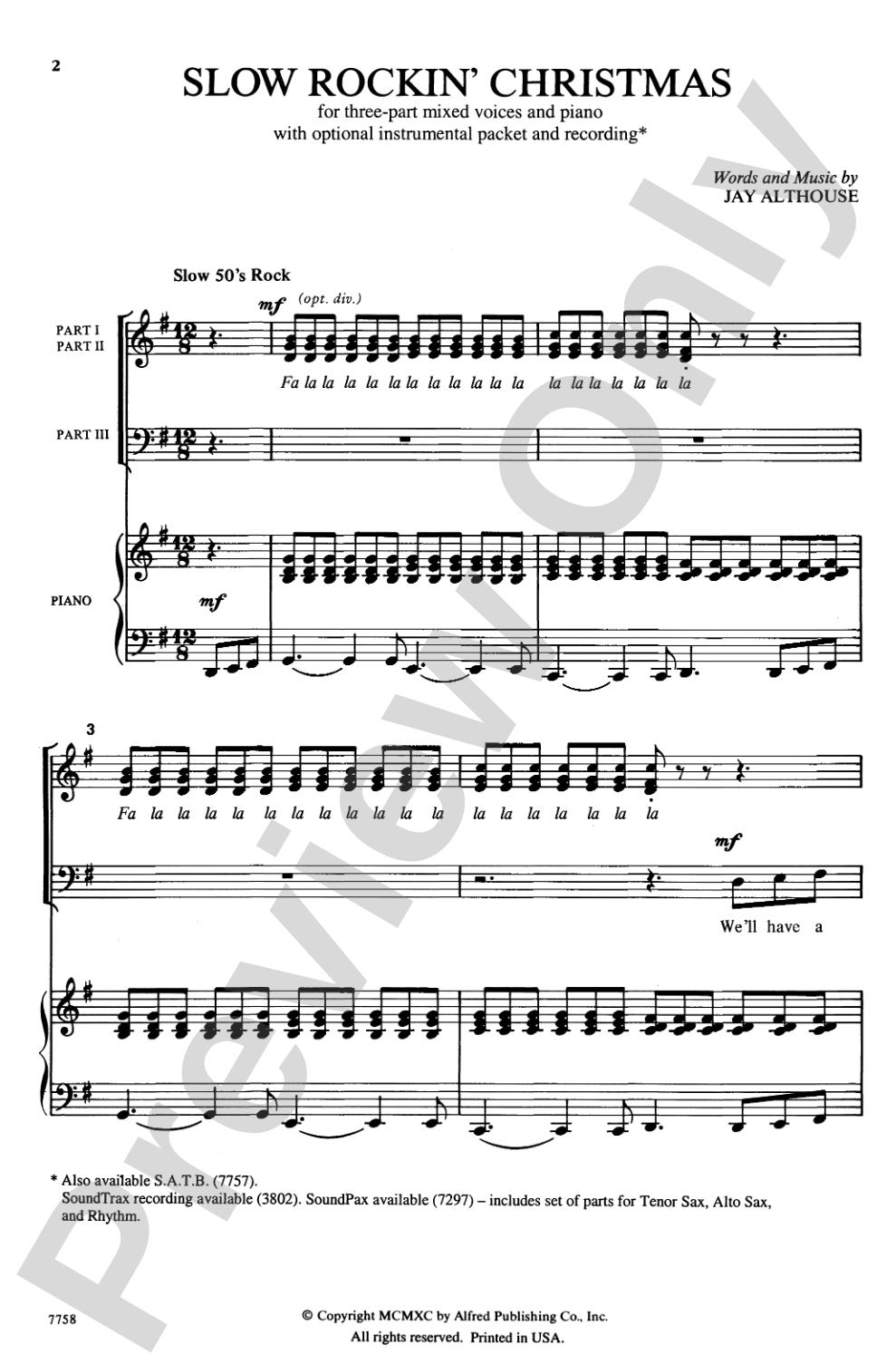
Jay's done it again with another 50s era piece your singers are sure to enjoy. Features the men with the girls singing 'fa la la' backups. Use the optional SoundTrax cassette for a guaranteed sucess. A real Christmas 'blast from the past.' The 50's never go out of style!

Slow Rockin' Christmas: 3-Part Mixed Choral Octavo isn't in MakeMusic Cloud just yet...but it could be. Let us know you'd like to see it, and you'll help shape what comes next. In the meantime, start a free trial and dive into thousands of interactive titles your students can play along with today.

Sample Audio
No sample audio found.
Sample Video
Additional Details
Series: Alfred Archive Edition: Alfred Choral Designs
Publisher: Alfred Music
Page Count: 8
SKU: 00-PO-0004579

More about this title

About the Composer: Jay Althouse

Jay Althouse

Jay Althouse holds degrees in Music Education and Music from Indiana University of Pennsylvania, where he was later honored as a Distinguished Alumnus. His career spans both the publishing and composing worlds: he spent eight years as a rights and licenses administrator at a major educational music publisher and served on the Executive Board of the Music Publishers Association of America. Today he is recognized as a prolific composer with more than 800 choral works in print across all levels of difficulty.

Althouse's output extends far beyond composition. He has co-written children's musicals with his wife Sally K. Albrecht, curated and arranged celebrated vocal solo collections, and co-authored influential books including The Complete Choral Warm-up Book and Accent on Composers. His pedagogical reach includes reproducible classroom materials on music reading, assessment, and composer study. A member of ASCAP and regular recipient of their Special Award, Althouse resides in North Carolina and serves on the National Advisory Board of the Folk Art Society of America.

Why we love this

This octavo captures the fun and accessibility that make Althouse's catalog so enduring: a mid-century sound that feels instantly familiar without requiring complicated vocal gymnastics. The SAB voicing keeps parts singable for mixed choirs at any level, while the scoring (men and treble voices with 'fa la la' backups) creates clear textural interest that makes rehearsal straightforward but performance feel polished.

What to expect

Nostalgic and playful, with an infectious 1950s groove that sits somewhere between doo-wop sincerity and vaudeville wink. The arrangement breathes ease and joy, the kind of piece that feels like a gift to singers rather than a technical challenge.

Who it's for

This piece works for any mixed choir looking to add holiday flavor without heavy lifting. The three-part SAB voicing makes it accessible to developing singers while offering enough style and personality to engage a mature ensemble.

How to get the most out of it

  • Establish a solid swing feel in early rehearsals. The 1950s groove depends on rhythmic precision and ensemble locking, so spend time on the backups before layering in the main melody.
  • Balance the 'fa la la' parts carefully so they support without overshadowing the main vocal line. Have the backup singers listen for the melody and adjust dynamics accordingly.
  • Record a rehearsal run-through to hear how well the parts blend. This piece benefits from clarity between sections, and a playback helps singers adjust tuning and blend across the SAB voicing.

How to use it

Slot this into a holiday concert as a palate cleanser after a serious sacred work, or pair it with other secular Christmas novelties to create an entire set of vintage-flavored fun. It works equally well as an audience opener that establishes a lighter mood for the remainder of the program.

Skills your students will build

  • Singing in three-part harmony (SAB voicing)
  • Rhythmic precision in swing and backbeat styles
  • Textural independence (singing supporting vocal parts while hearing the melody)
  • Ensemble balance and blend across different voice ranges

You May Also Like