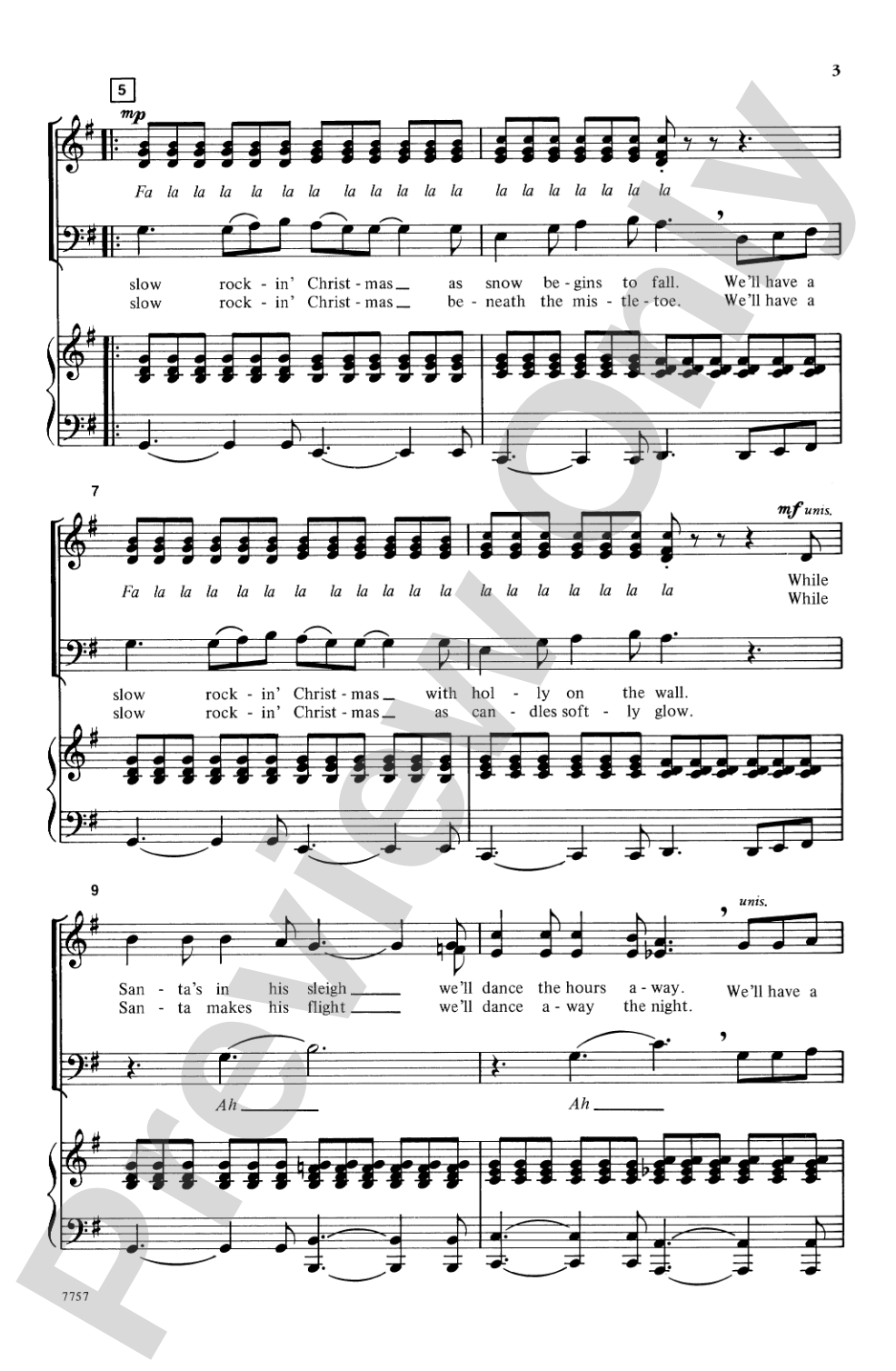
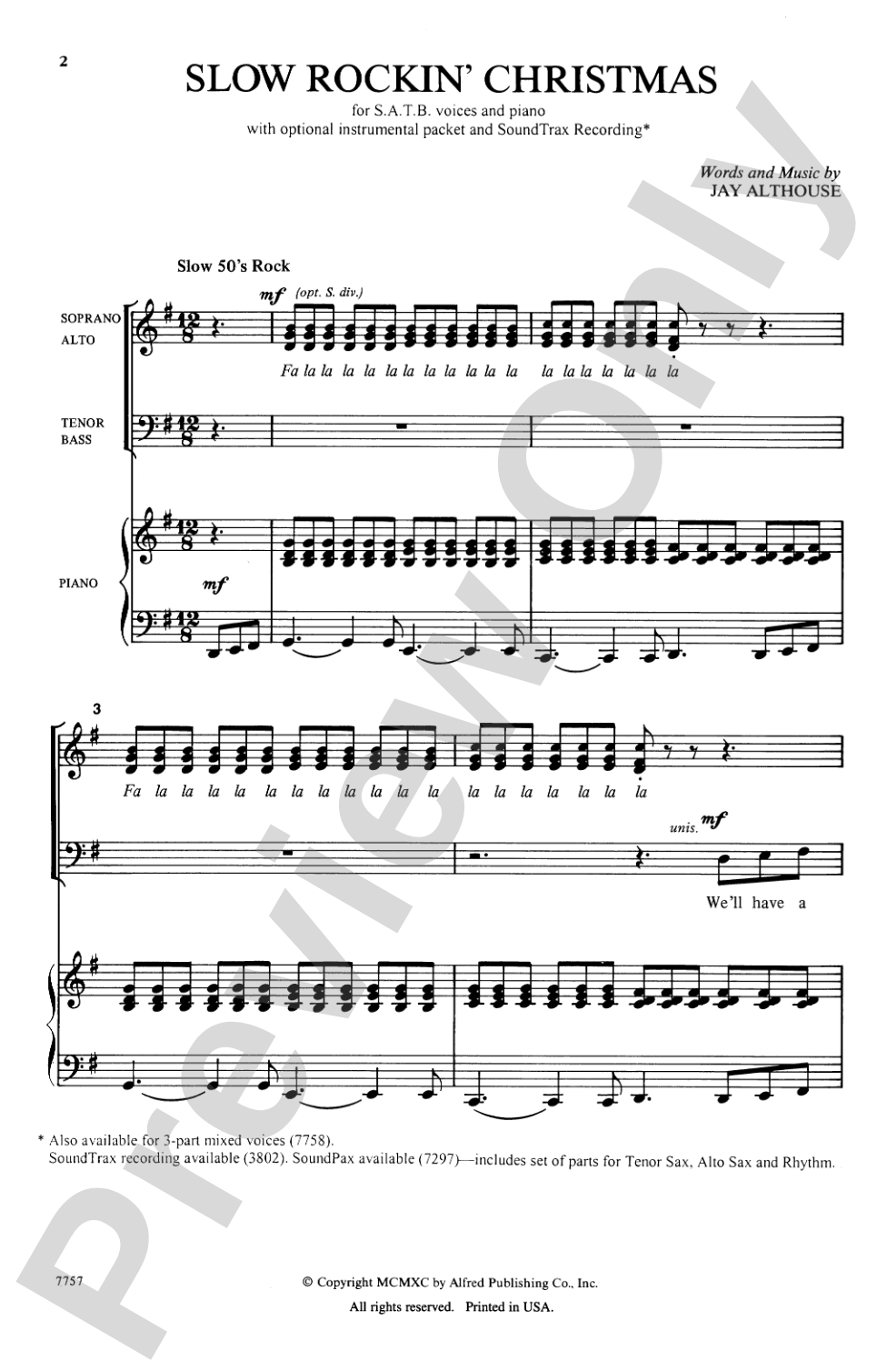
Slow Rockin' Christmas Sheet Music Preview

Slow Rockin' Christmas: SATB Choral Octavo

Music by Jay Althouse

Item: 00-PO-0004578

Digital Download
$2.25

Minimum order quantity: 20 copies

Description
Jay's done it again with another 50s era piece your singers are sure to enjoy. Features the men with the girls singing 'fa la la' backups. Use the optional SoundTrax cassette for a guaranteed sucess. A real Christmas 'blast from the past.' The 50's never go out of style!

Slow Rockin' Christmas: SATB Choral Octavo isn't in MakeMusic Cloud just yet...but it could be. Let us know you'd like to see it, and you'll help shape what comes next. In the meantime, start a free trial and dive into thousands of interactive titles your students can play along with today.

Sample Audio
No sample audio found.
Sample Video
Additional Details
Series: Alfred Archive Edition: Alfred Choral Designs
Publisher: Alfred Music
Page Count: 8
SKU: 00-PO-0004578

More about this title

About the Composer: Jay Althouse

Jay Althouse

Jay Althouse holds degrees in Music Education and Music from Indiana University of Pennsylvania, where he earned the Distinguished Alumni award. Early in his career, he spent eight years managing rights and licenses for a major educational music publisher and served on the Executive Board of the Music Publishers Association of America. As a prolific composer, Althouse has created more than 800 choral works performed worldwide and maintains active membership in ASCAP, receiving the ASCAP Special Award regularly for his contributions to standard music.

Beyond composition, Althouse has collaborated with his wife, Sally K. Albrecht, on children's musicals and vocal collections including Folk Songs for Solo Singers. He co-authored The Complete Choral Warm-up Book and Accent on Composers, and created classroom resources such as Ready to Read Music and One-Page Composer Bios. His choral composition I Hear America Singing, co-written with Albrecht, was performed by the San Francisco Girls and Boys Choirs at President Barack Obama's inauguration in 2009. Althouse resides in North Carolina and serves on the National Advisory Board of the Folk Art Society of America.

Why we love this

Althouse's gift for accessible, stylistically authentic arrangements shines here. The dividing of parts (men singing the melody while women provide 'fa la la' harmonies) creates a fun, theatrical dynamic that singers genuinely enjoy learning and performing. It's the kind of novelty piece that actually lands well in a holiday concert without feeling frivolous.

What to expect

Smooth and groovy, with a winking nod to doo-wop and 1950s pop sensibility. The contrast between the male-sung melody and the female backup voices creates a playful call-and-response feel that's instantly charming and easy for audiences to enjoy.

Who it's for

Directors programming a holiday concert want variety in tone and energy, and this piece delivers novelty appeal without sacrificing musicality. It works well for choirs comfortable with part independence and ready to embrace a fun, retro character.

How to get the most out of it

  • Balance the 'fa la la' voices carefully so they support without overshadowing the melody line sung by the men. This playful contrast only works when both layers are equally committed.
  • Lean into the 50s rhythmic style; let the groove settle into the pocket rather than pushing the tempo forward.
  • If using the recorded accompaniment, rehearse with it early and often so singers internalize the groove before performance.

How to use it

Place this in the second half of a holiday concert when you want to shift from reverent or traditional pieces into something lighter and more energetic. It pairs well alongside other secular selections and gives your ensemble a chance to showcase personality and fun alongside more straightforward repertoire.

Skills your students will build

  • Balancing independent melodic and harmonic lines within a single arrangement
  • Singing with stylistic authenticity in a specific historical idiom (1950s pop/doo-wop)
  • Listening across voice parts to maintain rhythmic cohesion in grooved music

You May Also Like