
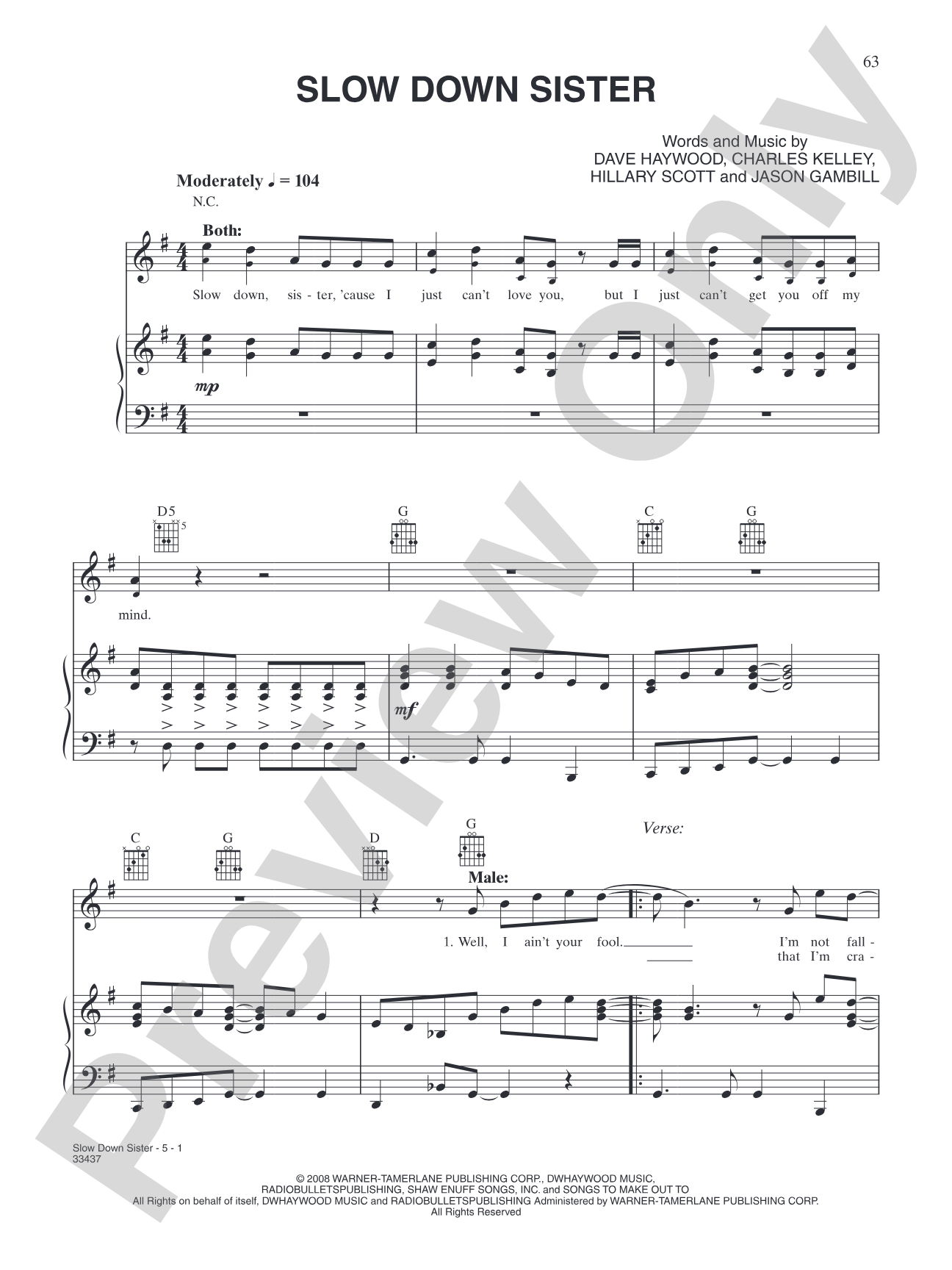

Slow Down Sister: Piano/Vocal/Chords
Lady Antebellum
Item: 00-PS-0011464
$4.99
One moment…
Related Items
Love Don't Live Here: Piano/Vocal/Chords |
$5.99
|
View | |
All We'd Ever Need: Piano/Vocal/Chords |
$5.99
|
View | |
Things People Say: Piano/Vocal/Chords |
$5.99
|
View | |
Can't Take My Eyes Off You: Piano/Vocal/Chords |
$5.99
|
View | |
One Day You Will: Piano/Vocal/Chords |
$5.99
|
View | |
Home is Where the Heart Is: Piano/Vocal/Chords |
$5.99
|
View | |
Love's Lookin' Good On You: Piano/Vocal/Chords |
$5.99
|
View |
Description
The album-matching sheet music to Lady Antebellum's gold-certified debut! This remarkable album has generated multiple hit singles that resonate not only with country fans, but pop fans as well. Features color photos along with sheet music for tunes such as "Love Don't Live Here," "Lookin' for a Good Time," and "I Run to You."


Slow Down Sister: Piano/Vocal/Chords isn't in MakeMusic Cloud just yet...but it could be. Let us know you'd like to see it, and you'll help shape what comes next. In the meantime, start a free trial and dive into thousands of interactive titles your students can play along with today.
Request This Title
Tell us you want it.
Start Your Free Trial
Explore everything that's ready to play right now.
Sample Audio
No sample audio found.
Sample Video
No sample videos found.
Additional Details
Publisher:
Alfred Music
Page Count:
84
SKU:
00-PS-0011464
More about this title
About the Composer: Dave Haywood
Dave Haywood is a composer and founding member of Lady Antebellum, the country-pop trio that reshaped modern country music in the late 2000s. His collaborative songwriting with band members Charles Kelley and Hillary Scott helped define the group's signature sound: polished country harmonies with pop accessibility and emotionally direct lyrics. Haywood's work on the debut album established him as a writer capable of crafting songs that perform equally well on country radio and mainstream pop playlists.
In the context of music education, Haywood's compositions offer contemporary examples of song structure, vocal arrangement, and lyrical storytelling that connect with student musicians who engage with current popular music. His writing demonstrates how country and pop traditions intersect, making the material pedagogically valuable for teaching songwriting craft and harmonic sophistication.
Why we love this
This collection captures songs that became cultural touchstones for an entire generation of listeners, and that recognition makes them compelling material for students who need repertoire that feels relevant and current. The sheet music arrangement balances accessibility with harmonic interest, allowing pianists to accompany singers without oversimplifying the song's emotional depth. Programming these pieces in recitals or concerts signals that your curriculum values the music students actually listen to and care about.
What to expect
These songs carry the warmth and intimacy of acoustic country songwriting wrapped in polished, radio-ready production. The melodies settle comfortably in the voice, the chord progressions feel both familiar and sophisticated, and the emotional directness of the lyrics creates songs that feel immediate and genuine even in a practice room or performance space.
Who it's for
This book serves pianists and singers preparing contemporary popular music for recitals, auditions, or casual performance contexts. It works equally well for students building confidence with songs they know and love, and for music educators seeking repertoire that bridges classical training with students' real musical interests. Accompanists will find clear chord charts and accessible vocal lines that don't require excessive transposition or simplification.
How to get the most out of it
- Shape the vocal line with attention to phrasing rather than strict metrical punctuation; these songs breathe like contemporary pop, not show tunes.
- Let the piano arrangement support the vocal narrative without overwhelming it; these pieces are fundamentally song-driven, not piano-feature arrangements.
- Balance the sung harmony parts carefully, especially in the choruses where multiple vocal lines create the signature Lady Antebellum blend.
- Use the chord symbols to inform your harmonic interpretation at the piano; small adjustments in voicing and rhythm can enhance the contemporary feel.
How to use it
Feature individual selections in student recitals or cabaret-style events where contemporary repertoire belongs. Use the material to encourage cross-genre study, showing singers how country songwriting traditions inform pop music structure. The 84-page collection works well as a repertoire resource throughout a year rather than as a single concert unit.
Skills your students will build
- Reading chord symbols and contemporary harmonic notation
- Accompanying singers with sensitivity to vocal phrasing and breath points
- Interpreting contemporary song melodies with musical intention
- Navigating pop and country song structures (verse, chorus, bridge patterns)
- Balancing keyboard support with vocal prominence in ensemble singing