
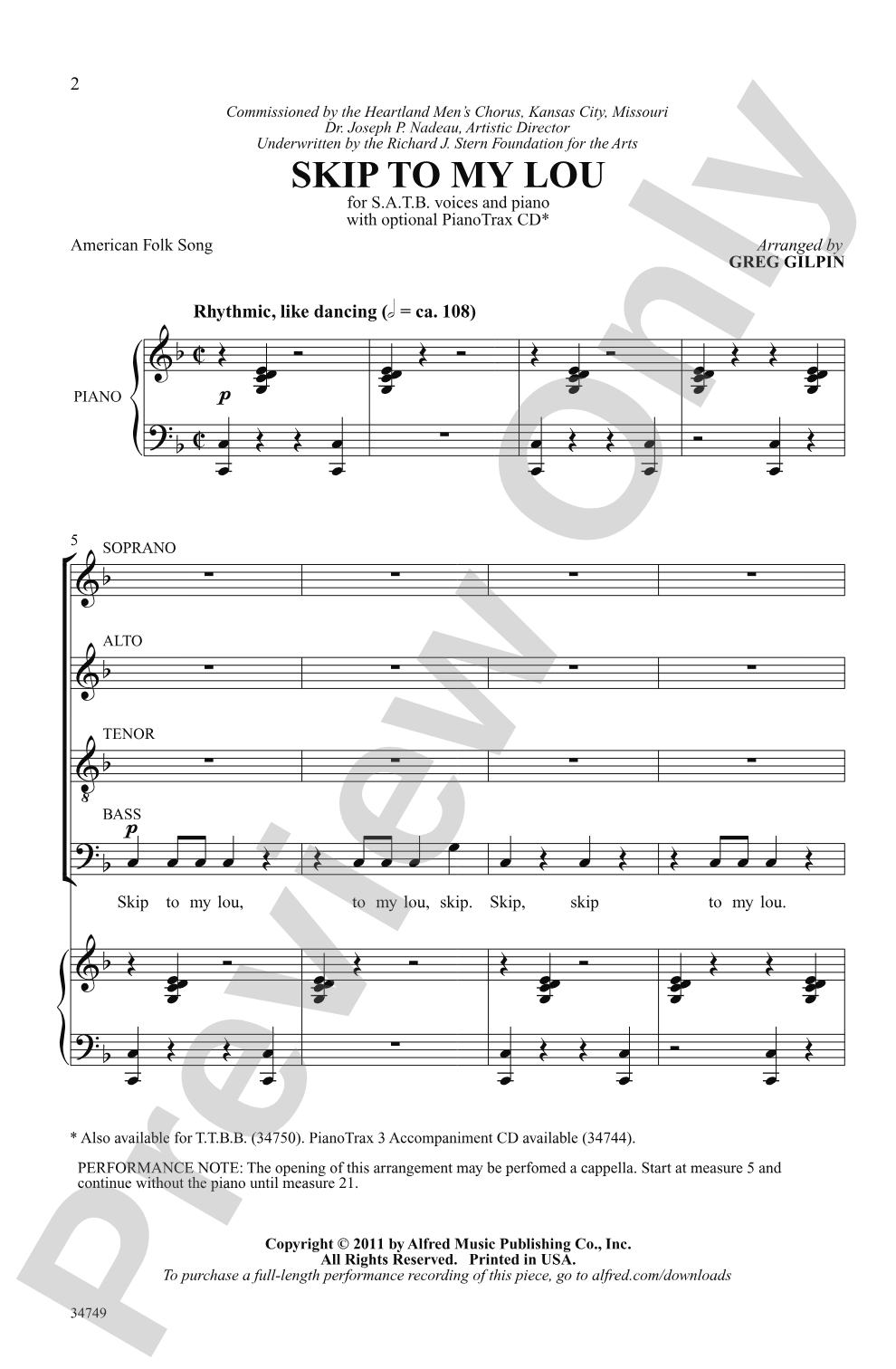
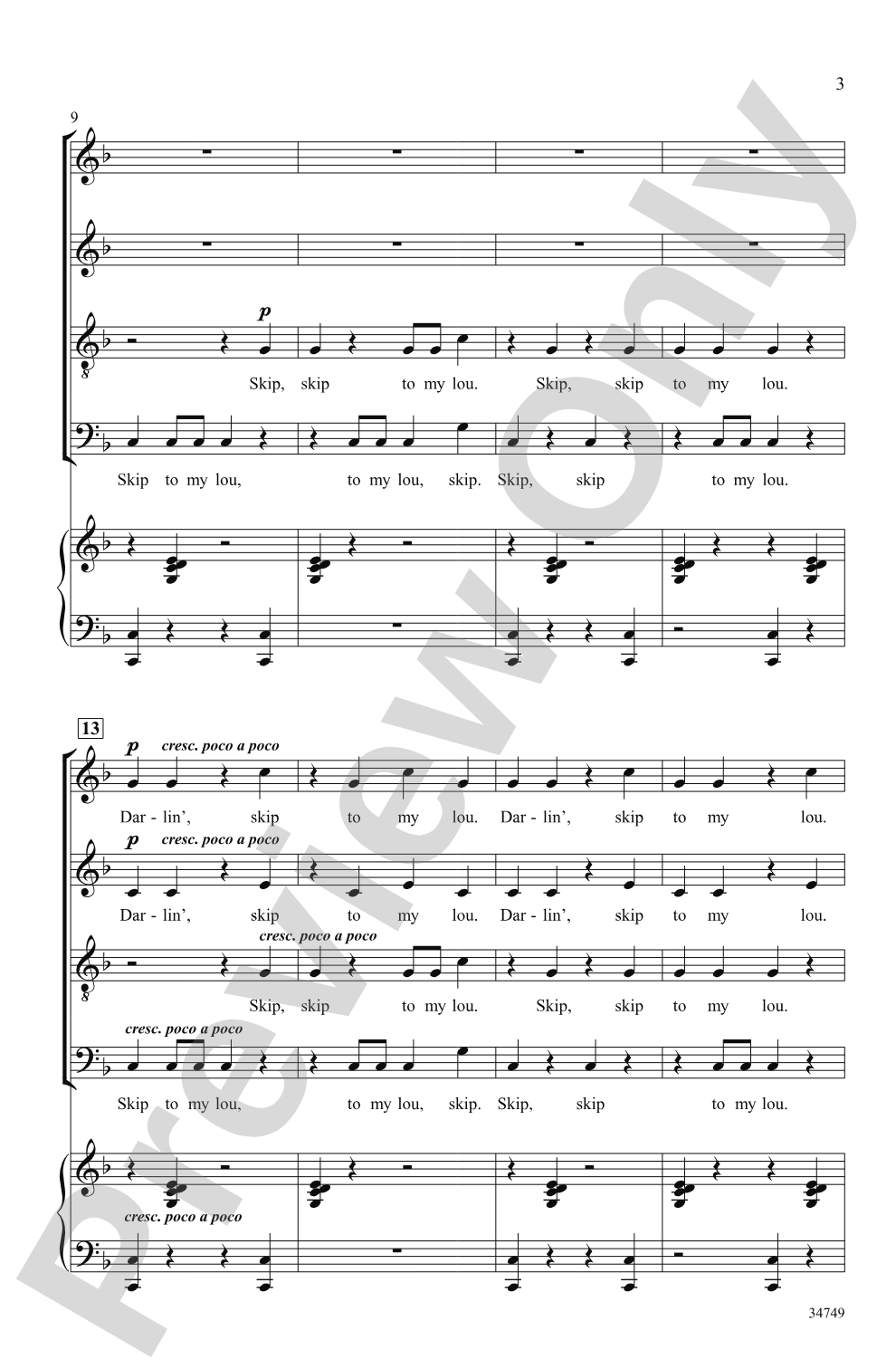
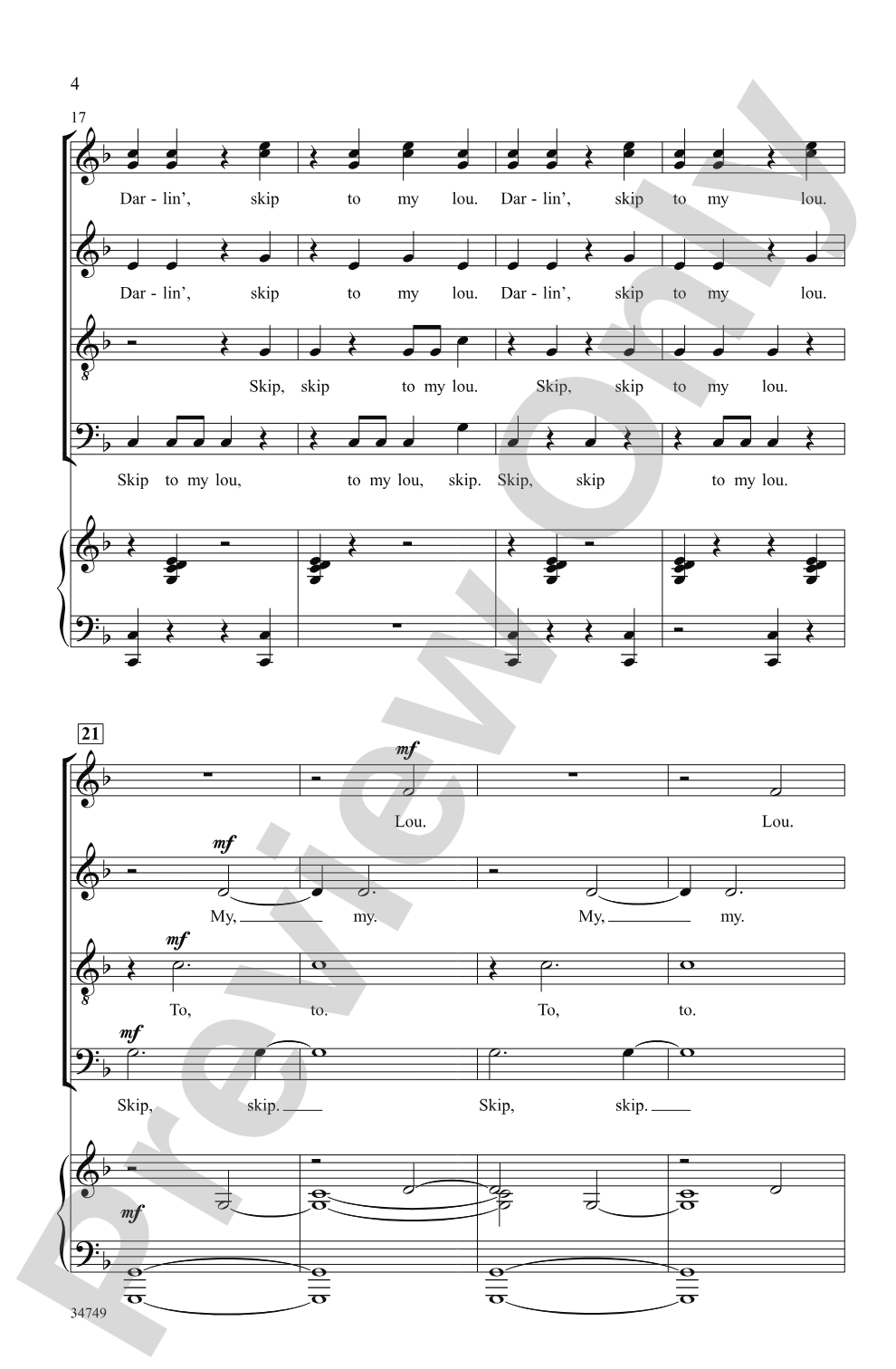

Skip to My Lou: SATB Choral Octavo
American Folk Song / arr. Greg Gilpin
Item: 00-PO-0000868
$1.95
Minimum order quantity: 20 copies
Pickup currently not available
Description
Solid arranging techniques and a playful spirit give this old dance a few new steps. Listen for the add-on ostinati, ear-bending chord progressions, unexpected rhythmic twists, falsetto tenors, descant sopranos, poignant "lost my partner" solos, and . . . buzzing bees?! Sounds silly, but requires serious singing. Featured on PianoTrax 3 Accompaniment CD (00-34744).


Skip to My Lou: SATB Choral Octavo isn't in MakeMusic Cloud just yet...but it could be. Let us know you'd like to see it, and you'll help shape what comes next. In the meantime, start a free trial and dive into thousands of interactive titles your students can play along with today.
Request This Title
Tell us you want it.
Start Your Free Trial
Explore everything that's ready to play right now.
Sample Audio
1
Audio File
--:--
0:00
0:00
Sample Video
No sample videos found.
Additional Details
Series:
Alfred Choral Designs
Publisher:
Alfred Music
Page Count:
16
SKU:
00-PO-0000868
More about this title
About the Arranger: Greg Gilpin

Greg Gilpin has established himself as a prolific choral arranger and conductor with performances spanning North America, Australia, Europe, and Iceland. His work has taken him to prestigious venues including Carnegie Hall, Lincoln Center, the Sydney Opera House, and Royal Festival Hall, while his compositions and arrangements have earned ASCAP recognition. As Director of Educational Choral Publications for Shawnee Press, he shapes the choral repertoire available to school and community ensembles nationwide.
Beyond his choral work, Gilpin has expanded into film scoring, composing the award-winning score for the short film "Rosie's Rescue," and has collaborated with acclaimed opera singer Angela Brown on new concert arrangements. He holds active membership in ACDA, NAfME, and Phi Mu Alpha Sinfonia, and brings diverse professional experiences to his creative output across multiple disciplines.
Why we love this
Gilpin transforms a familiar folk tune into something genuinely fresh without losing its accessibility. The arrangement respects the playful DNA of the original while layering in sophisticated harmonies, textural variety through ostinati and descants, and enough personality quirks (buzzing bees, falsetto tenors, solo moments) to keep singers engaged across multiple rehearsals and performances.
What to expect
The piece has a sophisticated playfulness that refuses to feel condescending or overly cute. Ear-bending harmonies and clever voicing choices create moments of genuine musical surprise, while the ostinati and descants give the arrangement architectural depth that unfolds freshly each time a choir performs it.
Who it's for
This arrangement works for intermediate to advanced high school choirs and community ensembles seeking a sophisticated treatment of familiar repertoire that still lands as fun and accessible. Directors looking to program something that challenges singers' technique and musicality while entertaining audiences will find the blend of humor, harmonic interest, and singable lines especially rewarding.
How to get the most out of it
- Balance the add-on ostinati carefully so they support rather than obscure the melodic line. Establish each layer separately in rehearsal before combining voices.
- The falsetto tenor passages need secure breath support and consistent vowel shaping to sound intentional rather than strained. Isolate these sections and give tenors time to find comfort in the higher range.
- Shape the "lost my partner" solos with genuine emotional weight despite the piece's overall lightness. These moments provide contrast and showcase individual singers.
- Attend to the unexpected rhythmic twists by marking them clearly in scores and drilling those specific measures until they sit naturally within the ensemble's pulse.
How to use it
Pair this with other Gilpin arrangements to showcase his distinct compositional voice, or program it as a concert centerpiece where you want to demonstrate that folk material can sustain serious artistic treatment. It works equally well as a spring concert opener that engages the audience immediately or as part of a themed program exploring variations on traditional melodies.
Skills your students will build
- Singing layered ostinati and independent voice lines in SATB texture
- Sustaining falsetto technique with vocal security and blend
- Interpreting unexpected harmonic movement and non-traditional chord progressions
- Executing rhythmic figures that depart from predictable meters and patterns
- Balancing solo passages with ensemble singing in the same piece
- Reading and performing descant soprano lines above standard SATB voicing