
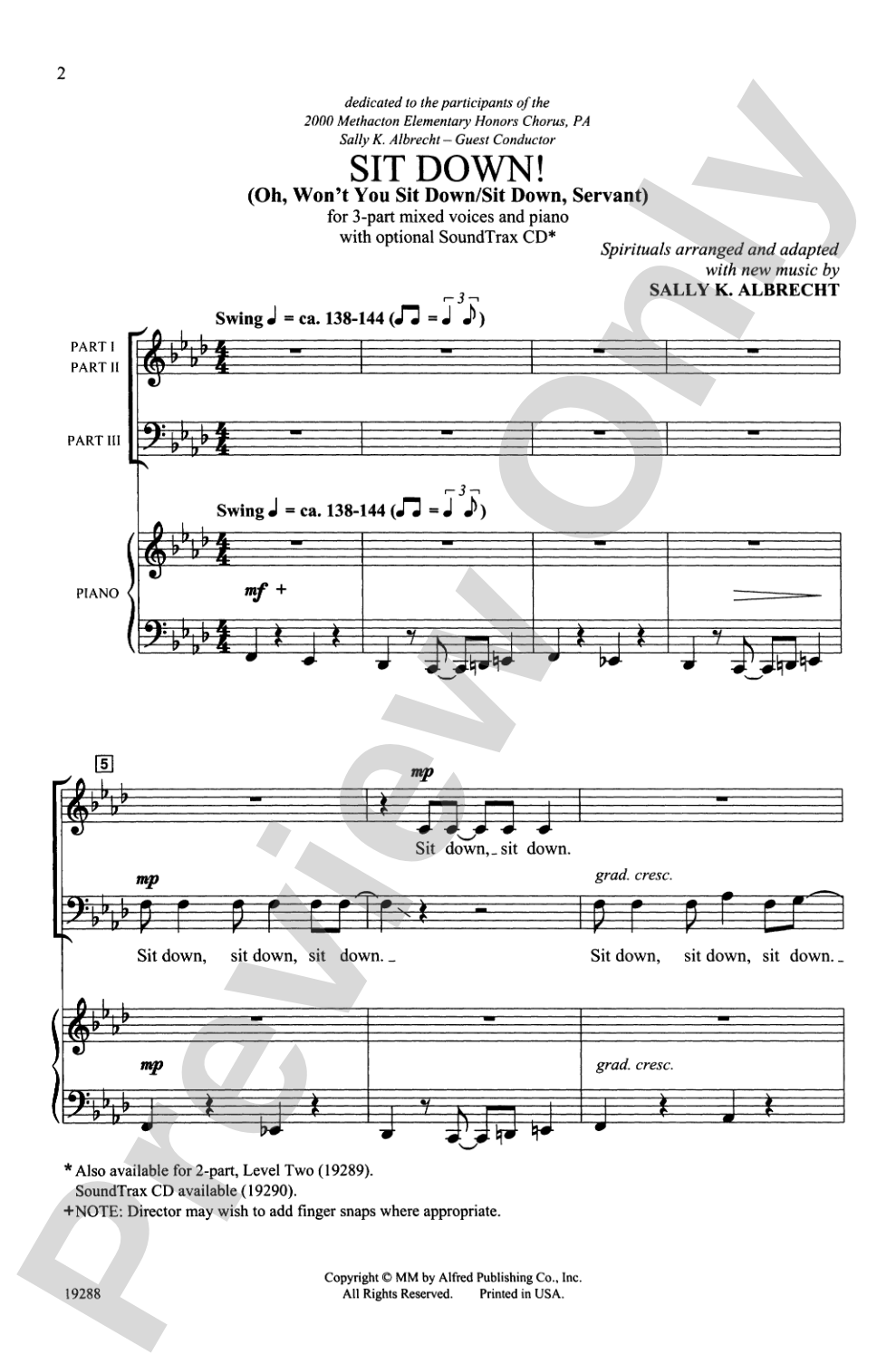

Sit Down!: 3-Part Mixed Choral Octavo
Oh, Won't You Sit Down? / Sit Down, Servant
Arr. Sally K. Albrecht
Item: 00-PO-0002163
$2.25
Minimum order quantity: 20 copies
Pickup currently not available
Description
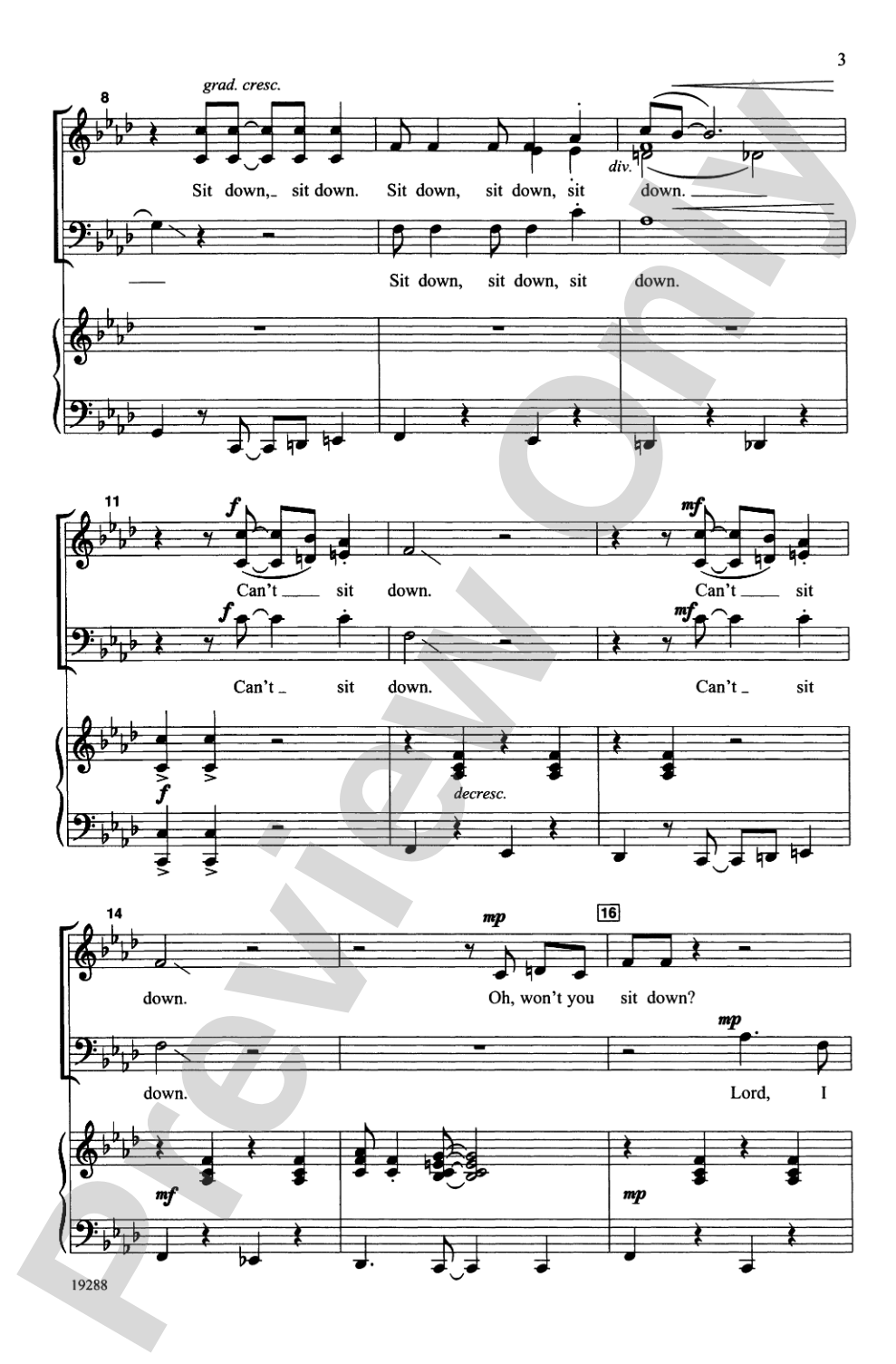
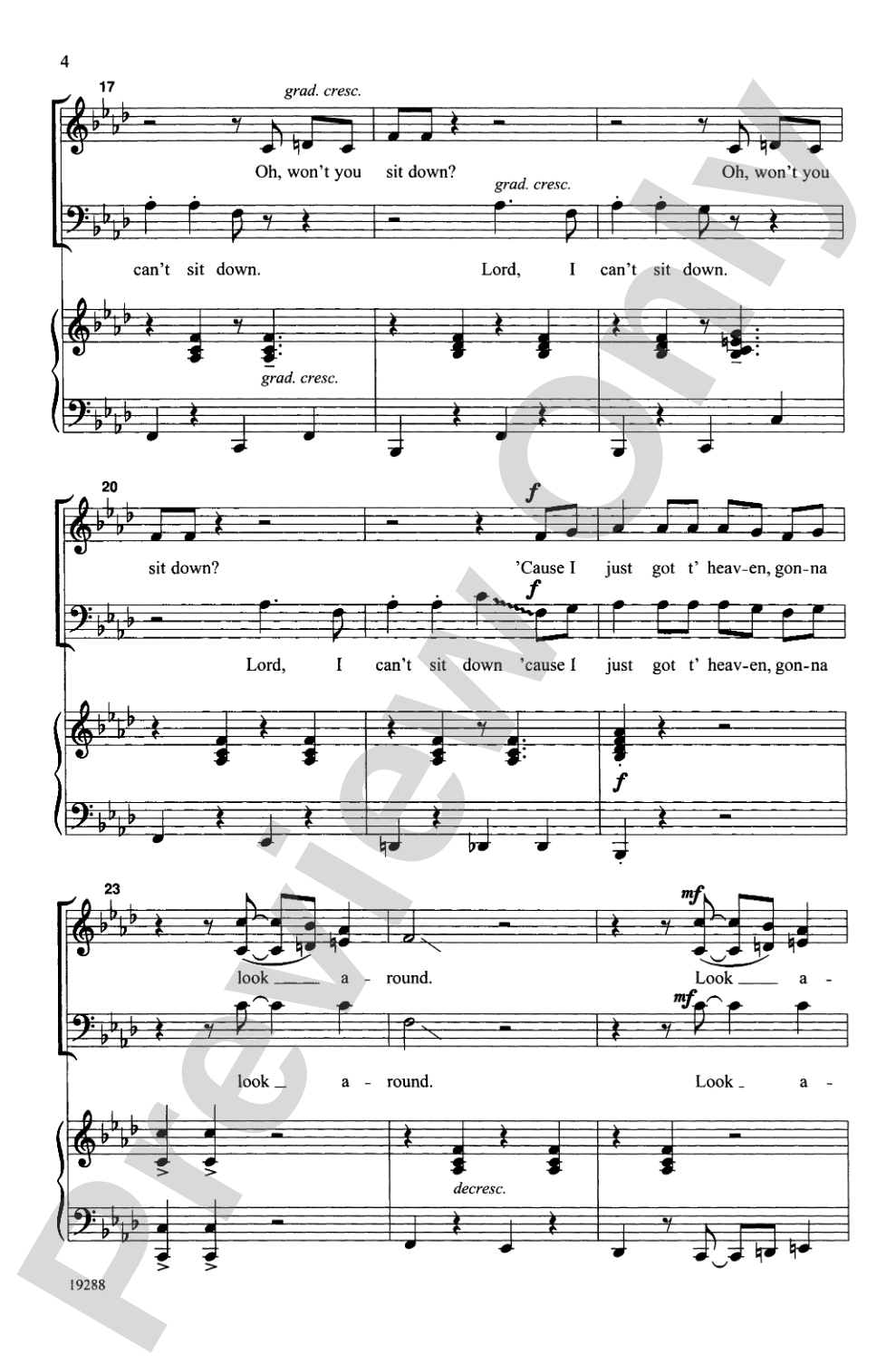
Here's a unique partnering of two spirituals: "Oh, Won't You Sit Down" and "Sit Down, Servant." Each melody is presented individually, then combined with an additional counter-line (high voices in the 3-part edition, an optional descant in the 2-part edition). Limited range for boys in the 3-part edition, so it's great for changing male voices. Don't miss the swinging SoundTrax CD that will add excitement to your performance. A new spiritual classic arrangement. Included on Sally's "In the Spotlight!" Video, #19803.


Sit Down!: 3-Part Mixed Choral Octavo isn't in MakeMusic Cloud just yet...but it could be. Let us know you'd like to see it, and you'll help shape what comes next. In the meantime, start a free trial and dive into thousands of interactive titles your students can play along with today.
Request This Title
Tell us you want it.
Start Your Free Trial
Explore everything that's ready to play right now.
Sample Audio
1
Audio File
--:--
0:00
0:00
Sample Video
Additional Details
Series:
Alfred Archive Edition: Alfred Choral Designs
Publisher:
Alfred Music
Page Count:
12
SKU:
00-PO-0002163
More about this title
About the Arranger: Sally K. Albrecht

Sally K. Albrecht has shaped American choral music for decades as a composer, conductor, and clinician with a distinctive focus on choral movement and accessibility. Since 1987, she has been a consistent recipient of the ASCAP Special Music Award and maintains over 600 published choral works alongside 75 larger musicals and songbooks. Her conducting credits include honor choir festivals at Lincoln Center, Carnegie Hall, and The Kennedy Center, and she spent more than thirty years directing school choral and vocal publications for major educational publishers, including Alfred Music.
Educated at Rollins College (B.A., 1976) and the University of Miami (M.A. in Drama, 1977; M.M. in Accompanying, 1979), Albrecht has taught at Oakland University, Jersey City State College, and Meredith College. She served as Chair of the Board of Trustees for the Omicron Delta Kappa National Leadership Honor Society and received the organization's "Pillar of Leadership" award. In 2021, both the University of Miami Frost School of Music and Rollins College honored her with Distinguished Alumna Awards. She lives in Wake Forest, North Carolina, with her husband, composer and arranger Jay Althouse.
Why we love this
Albrecht's pairing of two beloved spirituals creates a satisfying arc that lets singers experience each melody on its own before hearing the richness of the combination. The SAB voicing is genuinely considerate of boys' voices, with limited range that honors the realities of changing voices while keeping the part meaningful and musical. The addition of a recorded accompaniment turns what could be a straightforward rehearsal piece into something your students will actually want to perform.
What to expect
There's an immediacy and warmth to these spirituals that draws listeners in from the first moment. When the melodies interweave, the texture becomes richer without becoming dense, and the recorded accompaniment brings a natural swing that makes the whole arrangement feel alive and celebratory.
Who it's for
Directors working with mixed choirs that include unchanged and changing male voices will find this arrangement especially practical. It works equally well in middle school, high school, and community choir settings where you need a piece that feels both spiritually grounded and accessible to singers at different vocal development stages.
How to get the most out of it
- Balance the high counter-line carefully so it enhances rather than overshadows the main melodies; soprano voices often need gentle reminders to support rather than lead.
- Use the recorded accompaniment in early rehearsals to establish the groove and swinging character, then gradually reduce its role as singers internalize the harmonic foundation.
- Shape each spiritual individually during the first section of the piece before students tackle the combined melodic writing; this layered approach makes the full arrangement feel less crowded.
- Encourage the baritones to lock in with the bass line of the accompaniment; their part grounds the whole arrangement and gives confidence to the ensemble.
How to use it
Pair this with other spirituals to create a substantial set, or use it as a standalone moment of spiritual reflection in a broader concert. Its manageable length and buoyant character make it ideal for spring concerts, cultural celebration programs, or settings where you want to honor the tradition authentically without requiring advanced technical demands from your singers.
Skills your students will build
- Singing counter-melodic lines while maintaining awareness of the primary melody
- Blending voices across three parts, particularly balancing soprano lines with lower voices
- Sustaining ensemble sound in a spiritual idiom with appropriate rhythmic phrasing
- Reading and performing SAB voicing with sensitivity to changing voice ranges
- Responding to recorded accompaniment while maintaining independence and musicality