
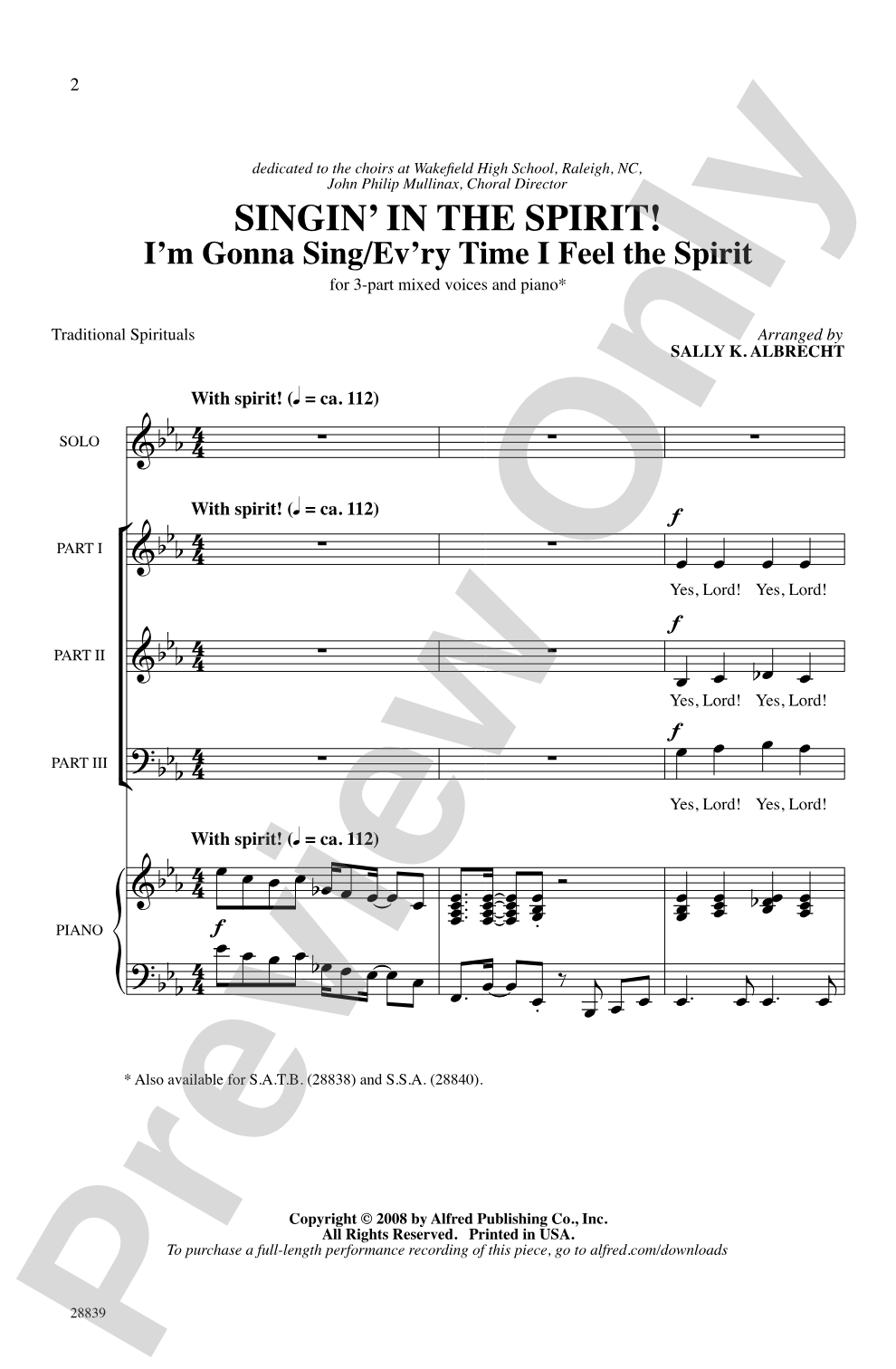

Singin' in the Spirit: 3-Part Mixed Choral Octavo
I'm Gonna Sing / Ev'ry Time I Feel the Spirit
Traditional Spirituals / arr. Sally K. Albrecht
Item: 00-PO-0000584
$1.75
Minimum order quantity: 20 copies
Pickup currently not available
Description
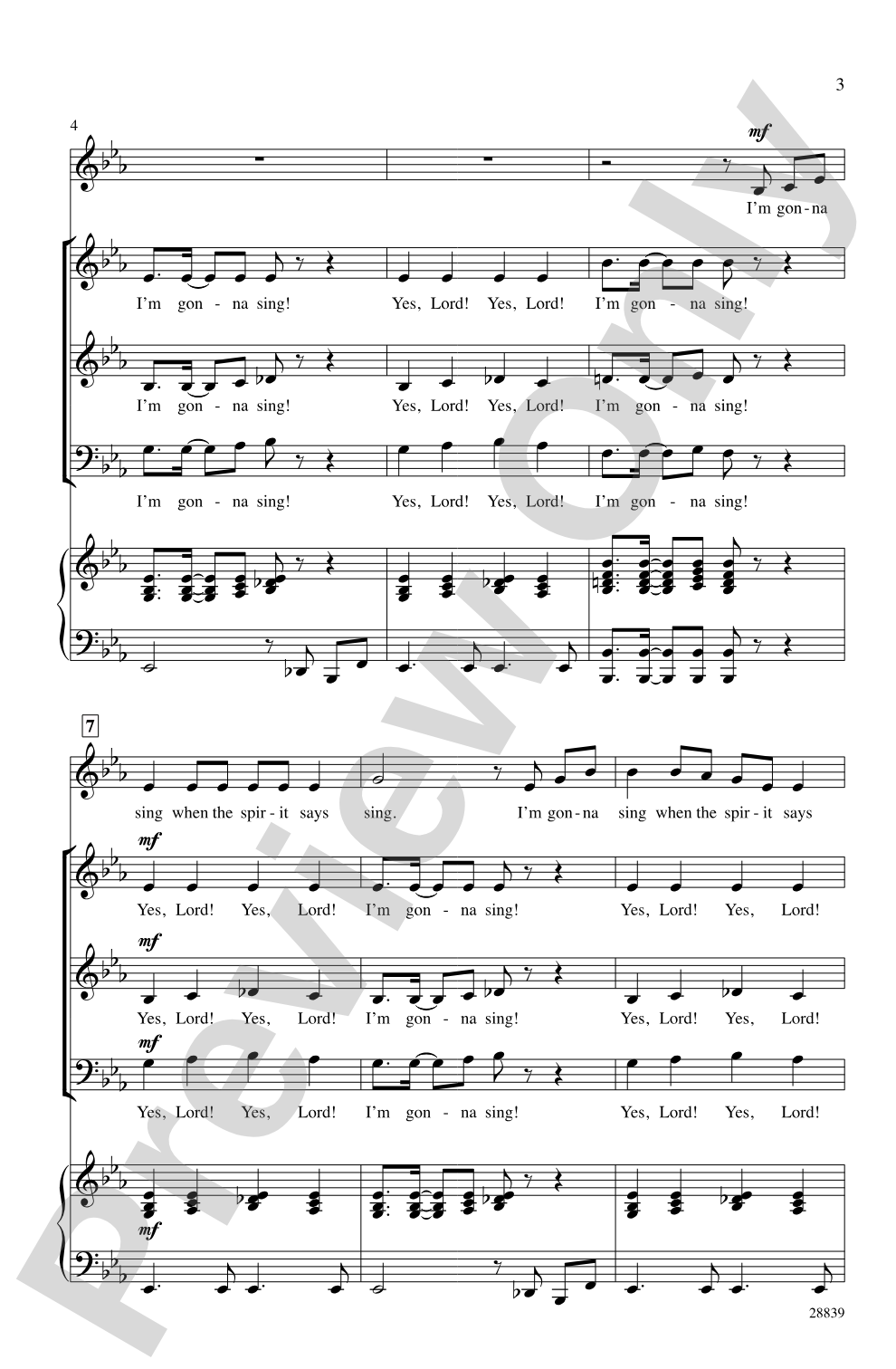
Here's a winning combination of favorite traditional spirituals, featuring an opening solo for any voice, a driving piano accompaniment, and inventive, well-written vocal lines. A dramatic and energized addition to any concert.


Singin' in the Spirit: 3-Part Mixed Choral Octavo isn't in MakeMusic Cloud just yet...but it could be. Let us know you'd like to see it, and you'll help shape what comes next. In the meantime, start a free trial and dive into thousands of interactive titles your students can play along with today.
Request This Title
Tell us you want it.
Start Your Free Trial
Explore everything that's ready to play right now.
Sample Audio
1
Audio File
--:--
0:00
0:00
Sample Video
No sample videos found.
Additional Details
Series:
Alfred Choral Designs
Publisher:
Alfred Music
Page Count:
12
SKU:
00-PO-0000584
More about this title
About the Arranger: Sally K. Albrecht
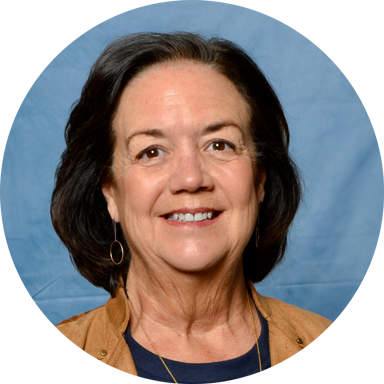
Sally K. Albrecht has shaped American choral music for over three decades as a composer, conductor, clinician, and publishing director. Her catalogue includes more than 600 choral works and 75 larger songbooks and musicals, earning her annual ASCAP Special Music Awards since 1987. She has led honor choirs at major venues including Lincoln Center, Carnegie Hall, and The Kennedy Center, and served as Director of School Choral, Vocal, and Elementary Publications at Alfred Music.
Albrecht holds degrees from Rollins College (B.A. in Music and Theater, 1976), the University of Miami (M.A. in Drama, 1977, and M.M. in Accompanying, 1979), and has taught at Oakland University, Jersey City State College, and Meredith College. In 2021, she received the Distinguished Alumna Award from both the University of Miami Frost School of Music and Rollins College, where she serves on the Board of Trustees. A native of Cleveland, Ohio, she lives in Wake Forest, North Carolina, with her husband, composer and arranger Jay Althouse.
Why we love this
Albrecht captures the spiritual's core energy without oversimplifying the voicing. The opening solo moment invites personal expression from your strongest singer, while the 3-part mixed writing stays accessible enough for mixed-ability choirs yet delivers real harmonic color. The piano accompaniment drives the piece forward with purpose, making this arrangement feel both authentic and concert-ready.
What to expect
Energized and purposeful. The traditional spirituals are rooted in resilience and joy, and Albrecht's arrangement channels that with forward momentum and rich harmonies that build without sentimentality. You'll feel the piano driving underneath, the voices weaving together, and the opening solo ringing out with dignity and power.
Who it's for
Mixed choirs of all levels, from secondary school to community ensembles, who want to honor the spiritual tradition with strong arranging and genuine musicality. The SAB voicing accommodates limited ranges while the piece itself demands confident singing and breath control, making it rewarding for choirs ready to step beyond unison.
How to get the most out of it
- Assign the opening solo strategically. Choose a singer whose tone can carry the piece's emotional weight with conviction, whether they're soprano, alto, or tenor; the solo works across the range.
- Shape the piano part as a rhythmic foundation. The accompaniment isn't just support; it's integral to the "driving" character, so ensure your pianist locks into the groove and doesn't rush.
- Build dynamic contrast across the piece. Spirituals thrive on call-and-response energy and textural shifts, so plan moments where the full choir swells and places where voices thin for intimacy.
- Encourage legit vocal tone without requiring classical training. The piece celebrates the spiritual tradition, which invites a warmer, more speech-like quality than you might use in art song.
How to use it
Anchor a concert section on sacred or American music traditions. The dramatic character and accessibility make it an ideal bridge between lighter choral fare and deeper repertoire, or pair it as a strong closing statement for a program celebrating cultural heritage and spiritual expression.
Skills your students will build
- Independent part singing in 3-part mixed voicing
- Sustaining line through syncopated or rhythmically complex accompaniment
- Blending and balancing parts in close harmony
- Singing solo with ensemble support and confidence
- Understanding spiritual tradition and appropriate vocal style