
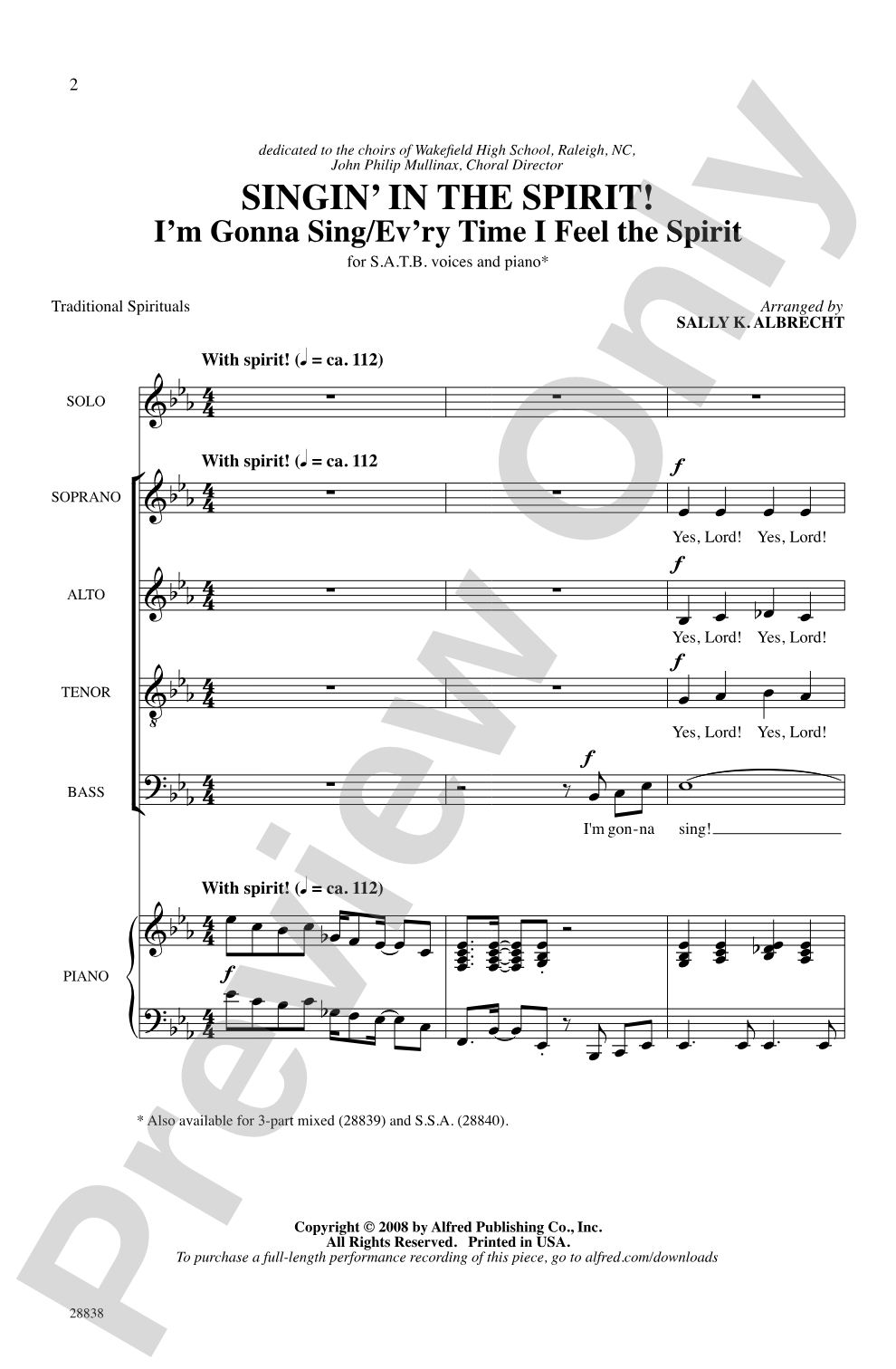
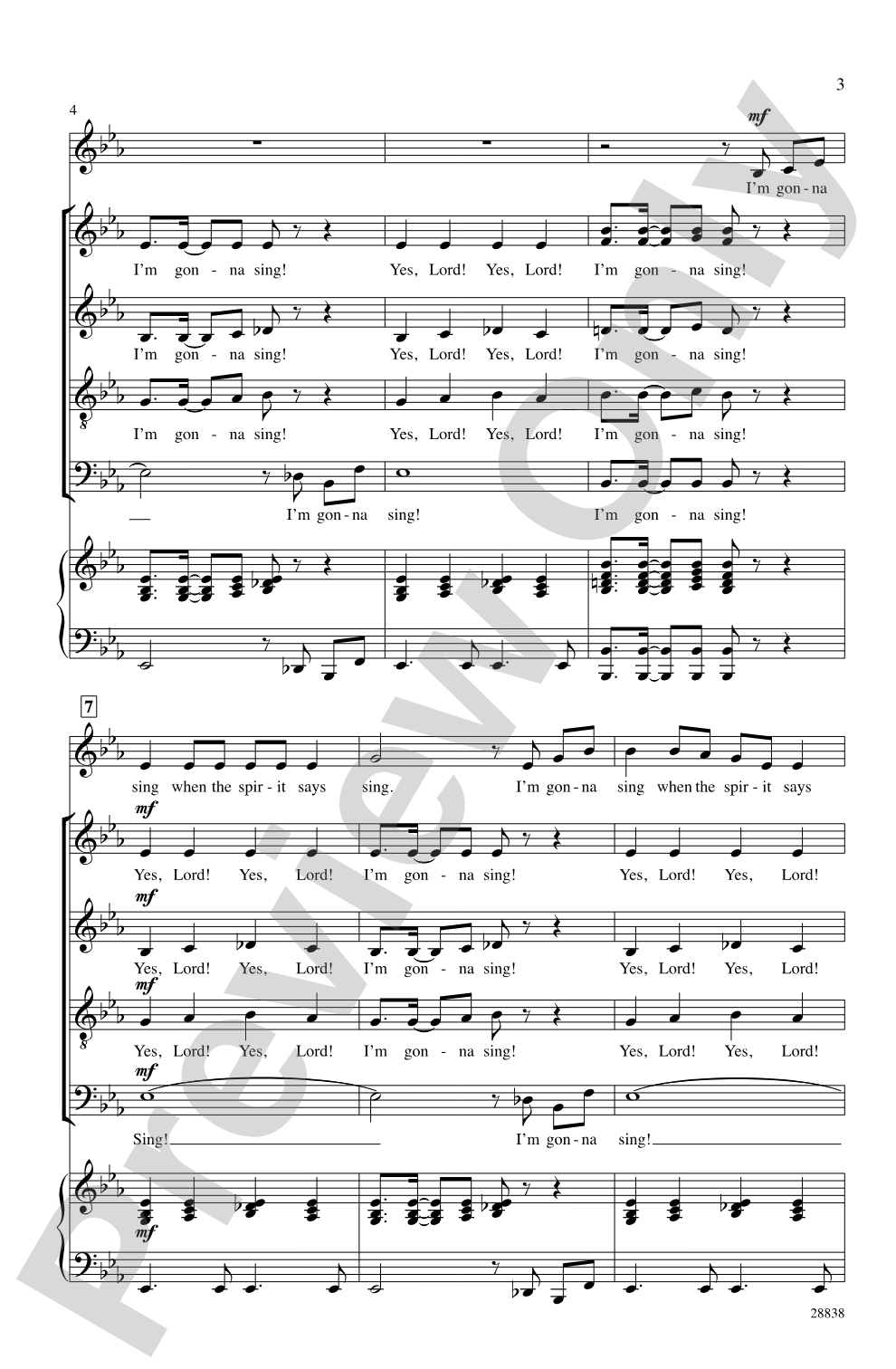

Singin' in the Spirit: SATB Choral Octavo
I'm Gonna Sing / Ev'ry Time I Feel the Spirit
Traditional Spirituals / arr. Sally K. Albrecht
Item: 00-PO-0000583
$1.75
Minimum order quantity: 20 copies
Pickup currently not available
Description
Here's a winning combination of favorite traditional spirituals, featuring an opening solo for any voice, a driving piano accompaniment, and inventive, well-written vocal lines. A dramatic and energized addition to any concert.


Singin' in the Spirit: SATB Choral Octavo isn't in MakeMusic Cloud just yet...but it could be. Let us know you'd like to see it, and you'll help shape what comes next. In the meantime, start a free trial and dive into thousands of interactive titles your students can play along with today.
Request This Title
Tell us you want it.
Start Your Free Trial
Explore everything that's ready to play right now.
Sample Audio
1
Audio File
--:--
0:00
0:00
Sample Video
No sample videos found.
Additional Details
Series:
Alfred Choral Designs
Publisher:
Alfred Music
Page Count:
12
SKU:
00-PO-0000583
More about this title
About the Arranger: Sally K. Albrecht
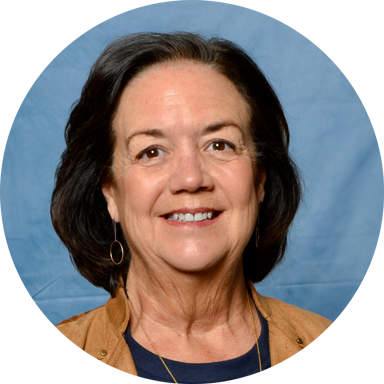
Sally K. Albrecht has shaped American choral music for decades as a composer, arranger, and conductor with deep roots in music education publishing. Her catalog of over 600 choral works and 75 larger stage pieces reflects a career spent understanding what works in rehearsal and on concert stages across the country. She has conducted honor choirs at prestigious venues including Lincoln Center, Carnegie Hall, and The Kennedy Center, and served for more than thirty years as Director of School Choral, Vocal, and Elementary Publications at major educational publishers, culminating in her tenure at Alfred Music.
Albrecht holds degrees from Rollins College (B.A. in Music and Theater, 1976), the University of Miami (M.A. in Drama, 1977; M.M. in Accompanying, 1979), and has taught at Oakland University, Jersey City State College, and Meredith College. A consistent recipient of the ASCAP Special Music Award since 1987, she has been recognized with the Distinguished Alumna Award from both Rollins College and the University of Miami Frost School of Music. She lives in Wake Forest, North Carolina, with her husband, composer and arranger Jay Althouse.
Why we love this
Albrecht's gift for vocal writing shines here; the opening solo (flexible for any voice) draws in the audience immediately, while the SATB lines that follow stay singable without sacrificing impact. The driving piano part energizes the whole texture and gives your accompanist genuine musical material to play. This arrangement delivers the spiritual tradition with genuine style, giving your concert the kind of dramatic arc that audiences remember.
What to expect
The piece radiates spiritual conviction grounded in tradition, yet arranged with modern ensemble sophistication. The opening solo invites intimacy before the choir joins in a wave of harmony, creating moments of both vulnerability and collective strength. The driving piano accompaniment propels the music forward with urgency and joy.
Who it's for
This octavo works for any SATB choir seeking meaningful sacred repertoire with real musical substance. Whether your singers are experienced ensemble members or developing musicians building confidence, Albrecht's writing supports both the soloist and the full choir in ways that feel accessible yet musically rewarding.
How to get the most out of it
- Give the opening soloist room to breathe and lead the piece. This is their moment to set the emotional tone before the choir enters.
- Balance the four parts carefully so the arrangement's inventive voicing comes through; avoid letting upper voices overwhelm the harmonic foundation.
- Work the piano accompaniment into early rehearsals so the rhythmic energy is established from the start; it drives the entire piece.
- Shape the phrase endings together as a choir to maintain the drama without letting energy drop.
How to use it
Program this as a concert centerpiece or as part of a thematic set exploring sacred music and spiritual traditions. The combination of solo voice with full choir voicing makes it equally effective as a concert opener (drawing the audience in quickly) or as a showcase piece for a featured soloist supported by the ensemble. At twelve pages, it's substantial enough to anchor a concert segment without overwhelming a program built around shorter works.
Skills your students will build
- Flexible voicing and doubling (any voice singing the opening solo)
- Blending four distinct SATB lines within a single arrangement
- Ensemble listening and balance in harmonically inventive writing
- Interpretive phrasing across spiritual and traditional styles
- Rhythmic precision supported by active piano accompaniment