
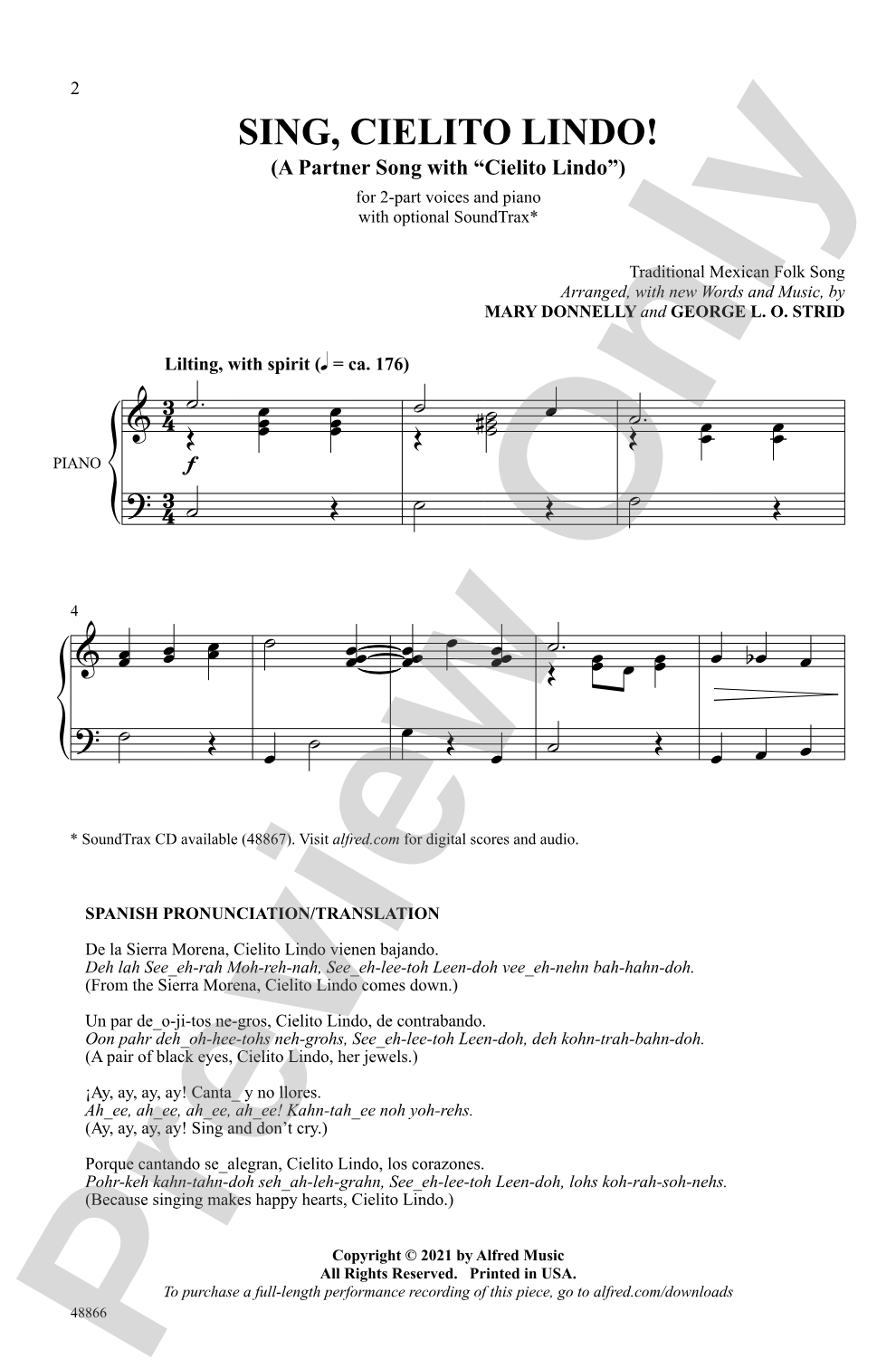

Sing, Cielito Lindo!: 2-Part Choral Octavo
A Partner Song with the Traditional Mexican Folk Song "Cielito Lindo"
Arr., with new words and music, by Mary Donnelly and George L. O. Strid
Item: 00-PO-0006658
$2.05
Minimum order quantity: 20 copies
Pickup currently not available
Description
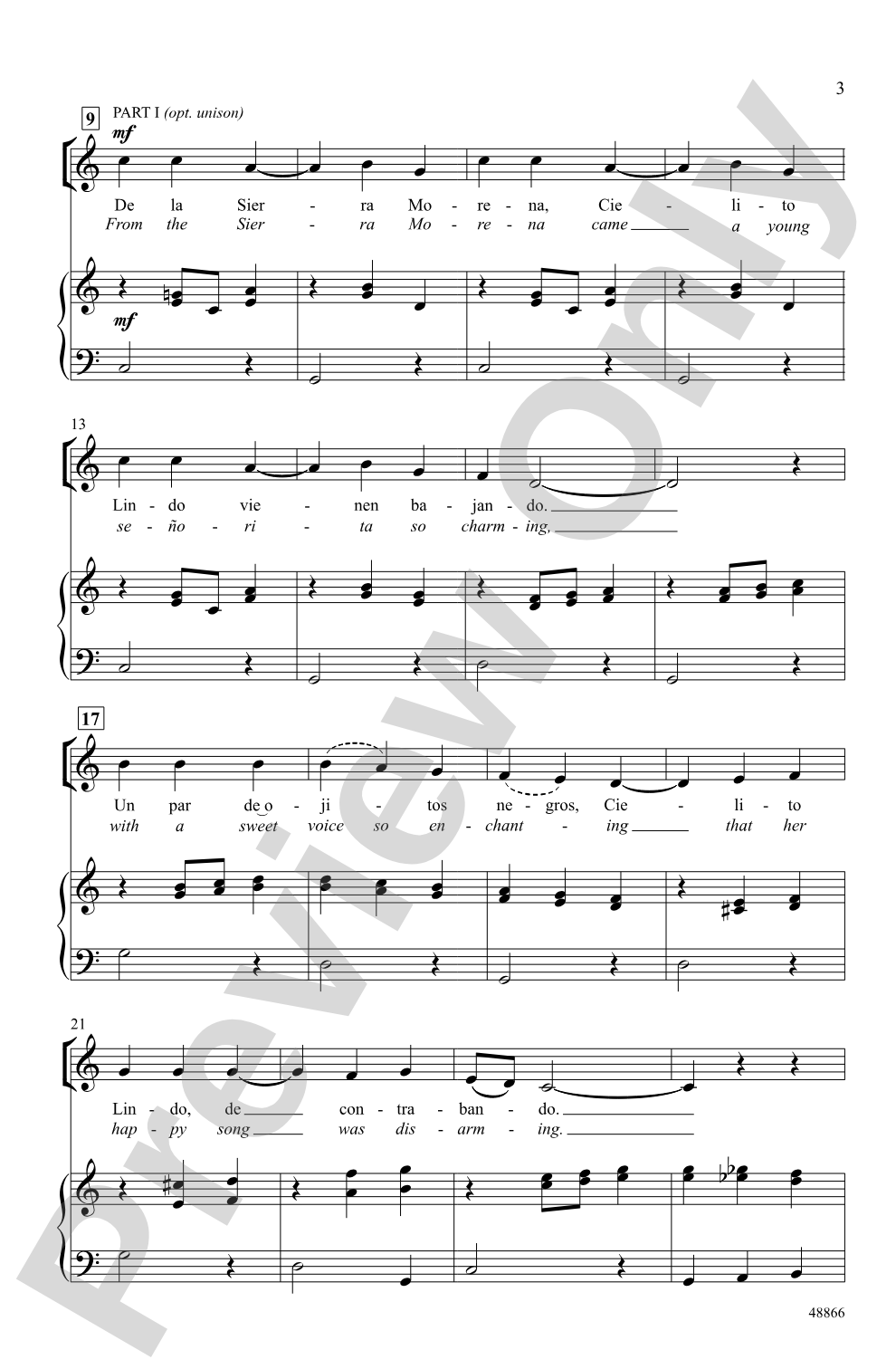
That marvelous moment when two previously sung melodies first fit together is an important milestone for developing groups. And there's nothing like a well-crafted partner song arrangement to take you there. Over the years, George Strid and Mary Donnelly have set the standard for quality partner songs, and this treatment of the well-known Mexican folk tune is no exception. Sing both lines in English or teach Spanish words using the included pronunciation guide. Seriously, if you want to take steps toward harmony, follow the magic formula: A, then B, then together. "¡Ay, ay, ay, ay!"


Sing, Cielito Lindo!: 2-Part Choral Octavo isn't in MakeMusic Cloud just yet...but it could be. Let us know you'd like to see it, and you'll help shape what comes next. In the meantime, start a free trial and dive into thousands of interactive titles your students can play along with today.
Request This Title
Tell us you want it.
Start Your Free Trial
Explore everything that's ready to play right now.
Sample Audio
1
Audio File
--:--
0:00
0:00
Sample Video
Additional Details
Series:
Alfred Choral Designs
Publisher:
Alfred Music
Page Count:
12
SKU:
00-PO-0006658
More about this title
About the Composer: Mary Donnelly

Mary Donnelly grew up in Reno, Nevada and studied English and French at the University of Nevada, Reno. While still an undergraduate, she founded two children's choruses, an experience that redirected her toward music education. She went on to earn a Master's Degree in Education from Lesley College in Cambridge, Massachusetts, where she focused on arts integration across the curriculum.
Donnelly spent thirty years teaching general music and choir in the Washoe County School District, retiring after a career devoted to making music accessible to young singers. In 1985, she began collaborating with George Strid when their principal asked them to write a musical for Reading Week. That first project, The Million Dollar Mystery, launched a prolific partnership that has produced over two hundred songs and twenty-five musicals. She holds memberships in ACDA, NEA, and ASCAP.
Why we love this
This arrangement captures exactly what makes partner songs so powerful for developing choirs: two distinct melodic lines that feel complete on their own, then harmonically satisfying when sung together. Donnelly and Strid have built their reputation on understanding this progression, and their treatment of this beloved Mexican folk tune respects both the melody and the learning curve. The included Spanish pronunciation guide makes it genuinely accessible to teach in both languages without requiring specialized expertise.
What to expect
Bright, celebratory, and deeply satisfying. There's a moment of discovery when the second part clicks into place over the first, creating a richness that wasn't there before. The folk melody carries warmth and familiarity, while the partner arrangement adds depth without overwhelming younger singers.
Who it's for
This octavo works beautifully for middle school and upper elementary choirs ready to tackle their first sustained partner song experience. Singers need solid unison singing skills but don't yet need advanced harmonic independence; the arrangement is designed to build that confidence gradually.
How to get the most out of it
- Establish both melodic lines separately with secure singing before layering them. Have each section sing their part independently multiple times, focusing on pitch accuracy and musical phrasing.
- Use the recorded accompaniment to reinforce the harmonic foundation while students are learning their individual lines. This helps singers hear how their part sits within the fuller arrangement.
- Pay attention to blend and balance where the two parts intersect. The magic moment comes when both lines are equally heard, not when one dominates.
- If teaching Spanish lyrics, work through the pronunciation guide section by section, then have singers practice the Spanish version with the English version as a reference before combining them.
How to use it
Program this as a gateway piece on a concert where you're introducing audiences to your choir's growing sophistication in harmony. It pairs well with unison folk songs and works equally effectively in a multicultural concert or a general spring concert. Consider placing it midway through a set to show the progression from unison singing to simple part work.
Skills your students will build
- Singing independent melodic lines while maintaining awareness of a contrasting part
- Balancing and blending two-part harmony
- Reading two-part choral notation and following individual lines
- Singing in Spanish using provided pronunciation guide
- Transitioning from unison to partner song structure with musical continuity