
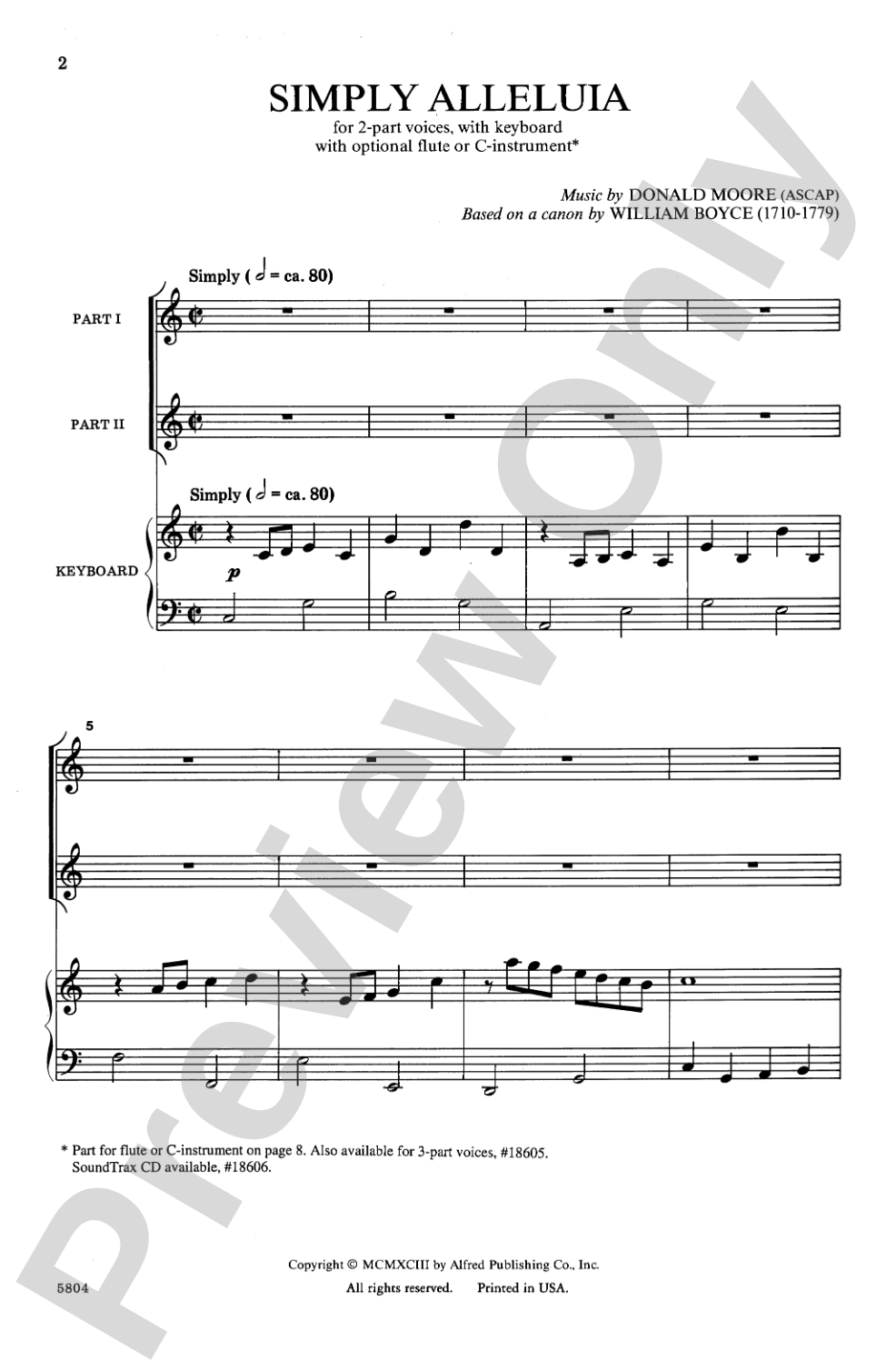
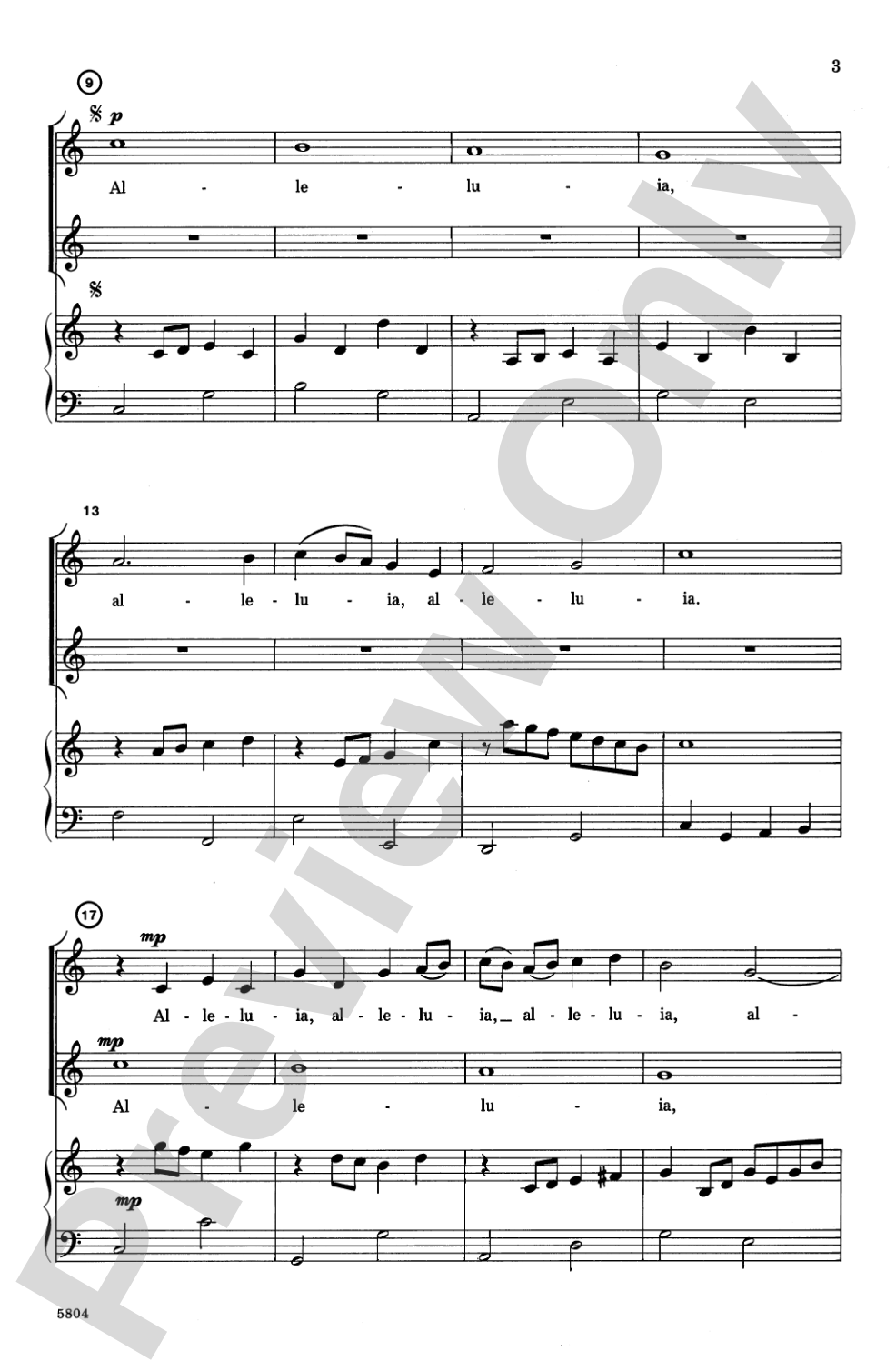

Simply Alleluia: 2-Part Choral Octavo
Music by William Boyce / arr. Donald Moore
Item: 00-PO-0004490
$2.25
Minimum order quantity: 20 copies
Pickup currently not available
Description
Give your young choir the opportunity to sing a classic melody with this new work by Donald Moore based on a canon by William Boyce (1710-1779). It's a simple and effective teaching piece suitable for concert performance. Both voice parts are given an opportunity to sing the melody before an optional flute joins in. Light, joyous singing. Good for teaching pitch control. For general or Christmas use.


Simply Alleluia: 2-Part Choral Octavo isn't in MakeMusic Cloud just yet...but it could be. Let us know you'd like to see it, and you'll help shape what comes next. In the meantime, start a free trial and dive into thousands of interactive titles your students can play along with today.
Request This Title
Tell us you want it.
Start Your Free Trial
Explore everything that's ready to play right now.
Sample Audio
1
Audio File
--:--
0:00
0:00
Sample Video
No sample videos found.
Additional Details
Series:
Alfred Archive Edition: Alfred Choral Designs
Publisher:
Alfred Music
Page Count:
8
SKU:
00-PO-0004490
Instrumentation:
Opt. Flute
More about this title
About the Composer: William Boyce
William Boyce (1710-1779) was a dominant figure in English music during the mid-18th century, serving as organist at the Chapel Royal and later as Master of the King's Music. His compositional output ranged from sacred anthems and services to instrumental works, and he was particularly skilled at writing music that balanced technical sophistication with accessibility for performers of varying abilities.
Boyce's influence on English choral music was substantial, and his works remain staples of the choral repertoire. His ability to craft memorable melodies within clear harmonic structures made his music ideal for both liturgical use and teaching purposes, a quality that explains why his material continues to be arranged and performed in schools and churches today.
Why we love this
This arrangement gives young singers a chance to engage with a genuine Baroque melody without simplifying it into something unrecognizable. Donald Moore's 2-part setting honors Boyce's original while creating real musical substance: both parts get the tune, the optional flute part adds textural variety, and the piece teaches pitch control through its emphasis on clean melodic line rather than relying on harmony to cover imprecision.
What to expect
Serene and celebratory at once. The melody floats with a sense of lightness and inevitability, the kind of tune that feels like it's always been there. The canon structure creates a gentle conversation between the two voice parts, leading to moments of genuine warmth when they sing together.
Who it's for
Young choirs with secure reading skills and singers comfortable with independent part-singing. This works especially well for choirs in grades 4-8 or beginning high school groups that need repertoire bridging the gap between unison singing and more complex part arrangements.
How to get the most out of it
- Shape the melody with gentle rises and falls rather than singing it in a straight line; the canon structure suggests natural phrase contours that will emerge if singers listen to the line's architecture.
- When the flute enters, ensure the choir doesn't swell in volume to compete; the flute's role is to add brightness and independence, not to double the voices.
- Use the recorded accompaniment to establish a steady, unhurried tempo that allows young singers to breathe naturally and sustain vowels without strain.
- Focus rehearsal time on the moment when both parts sing the melody simultaneously; this is where singers will truly hear the quality of their intonation and blend.
How to use it
Pair this with other sacred or festive material for a concert that doesn't demand a full-length oratorio or cantata. Its moderate length and straightforward arrangement make it ideal as an opener to a concert or as a bridge piece between more demanding works. Works equally well for holiday concerts, spring choral showcases, or as part of a program exploring Baroque choral writing.
Skills your students will build
- Singing independent melodic lines while maintaining awareness of another part
- Pitch control and sustained intonation in 2-part texture
- Recognition and performance of Baroque melodic style
- Responding to optional instrumental doubling and adjusting blend accordingly