
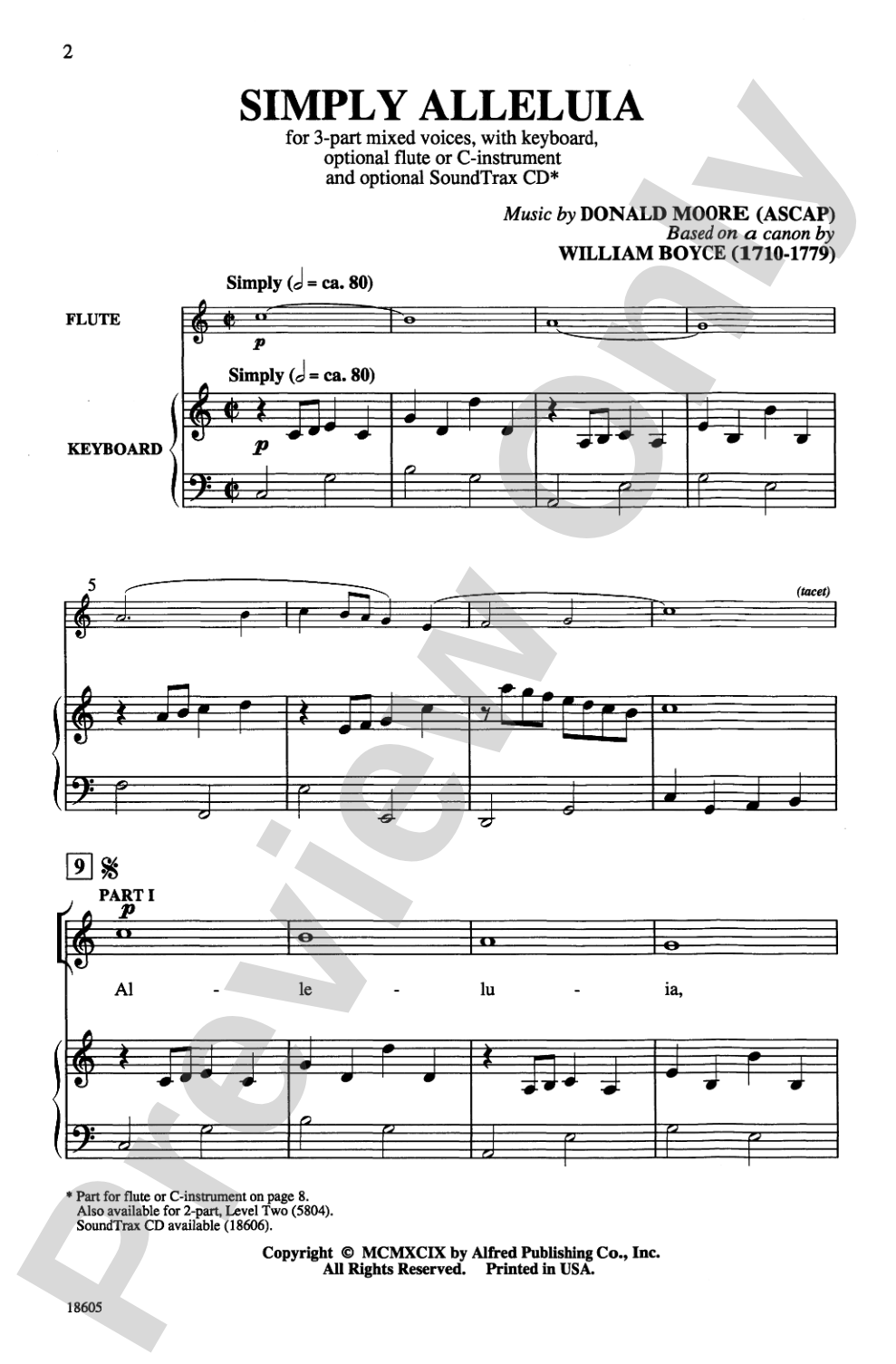
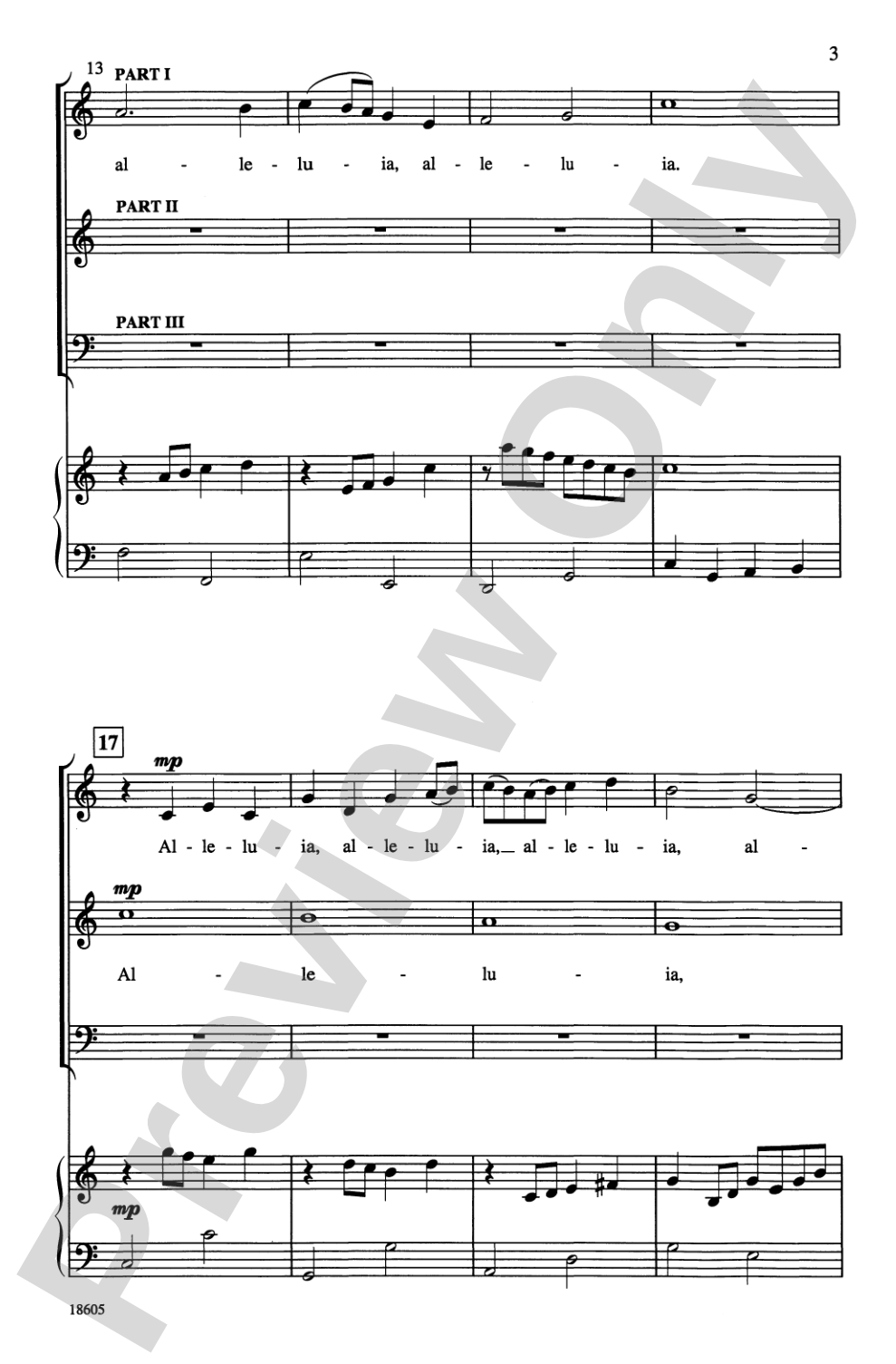

Simply Alleluia: 3-Part Mixed Choral Octavo
Music by William Boyce / arr. Donald Moore
Item: 00-PO-0004066
$2.25
Minimum order quantity: 20 copies
Pickup currently not available
Description
Now available in 3-Part Mixed, this arrangement of a William Boyce canon has been a popular choice in the 2-part edition. The canon is easy to sing and a simple flute part enhances the vocal scoring. Simple A-B-A form.


Simply Alleluia: 3-Part Mixed Choral Octavo isn't in MakeMusic Cloud just yet...but it could be. Let us know you'd like to see it, and you'll help shape what comes next. In the meantime, start a free trial and dive into thousands of interactive titles your students can play along with today.
Request This Title
Tell us you want it.
Start Your Free Trial
Explore everything that's ready to play right now.
Sample Audio
1
Audio File
--:--
0:00
0:00
Sample Video
No sample videos found.
Additional Details
Series:
Alfred Archive Edition: Alfred Choral Designs
Publisher:
Alfred Music
Page Count:
8
SKU:
00-PO-0004066
Instrumentation:
Opt. Flute
More about this title
About the Composer: William Boyce
William Boyce (1711-1779) was one of England's most significant composers of the 18th century, contributing substantially to both sacred and secular music during a career that spanned the Georgian era. He served as Composer to the Chapel Royal and Master of the King's Music, positions that shaped the musical life of London and established him as a leading figure in British musical culture. His works for chorus remain staples of the choral repertoire, valued for their melodic clarity, structural elegance, and accessibility to singers of varying abilities.
Why we love this
The canon format gives singers something immediately satisfying to execute: clean, singable lines that lock together naturally. Boyce's gift for melody shines in this arrangement, and the optional flute part provides an elegant textural choice that lifts the piece without complicating rehearsal. It's the kind of work that builds confidence in younger singers while sounding genuinely accomplished in performance.
What to expect
A clear, buoyant hymn-like quality emerges from the canon structure, giving the music both a mathematical precision and a genuine warmth. The simple A-B-A form feels inevitable and satisfying, like a musical prayer that repeats itself for emphasis. Singers experience the pleasure of a melody that sits comfortably in the voice while creating harmony around it.
Who it's for
Choirs with solid fundamentals who are ready for 3-part mixed voicing work well here. The piece suits middle school and early high school singers, community choirs, and church music programs looking for accessible yet substantive sacred music. No soloists required; the entire piece moves efficiently in the ensemble.
How to get the most out of it
- Balance the three parts so no single line dominates; if your singers are uneven in strength, consider the spatial arrangement in the rehearsal space to help parts blend evenly.
- Shape phrases gently across the bar lines rather than attacking each measure; this maintains the song-like quality of Boyce's writing and avoids a clipped, mechanical feel.
- If adding the optional flute, have the flute player double the soprano line lightly to reinforce pitch and add warmth without covering the vocals.
How to use it
Anchor this in an all-sacred concert or use it to open a spring concert with something bright and celebratory. The eight-page score keeps rehearsal time reasonable, making it ideal for programs built around longer works. Its connection to the Baroque tradition pairs naturally with period-appropriate instrumental music or with other works from the Alfred Archive Edition series.
Skills your students will build
- Singing in canon with maintained pitch independence
- Balancing three-part mixed voicing with equal clarity
- Shaping longer phrases across multiple measures
- Coordinating optional instrumental accompaniment with vocal parts