
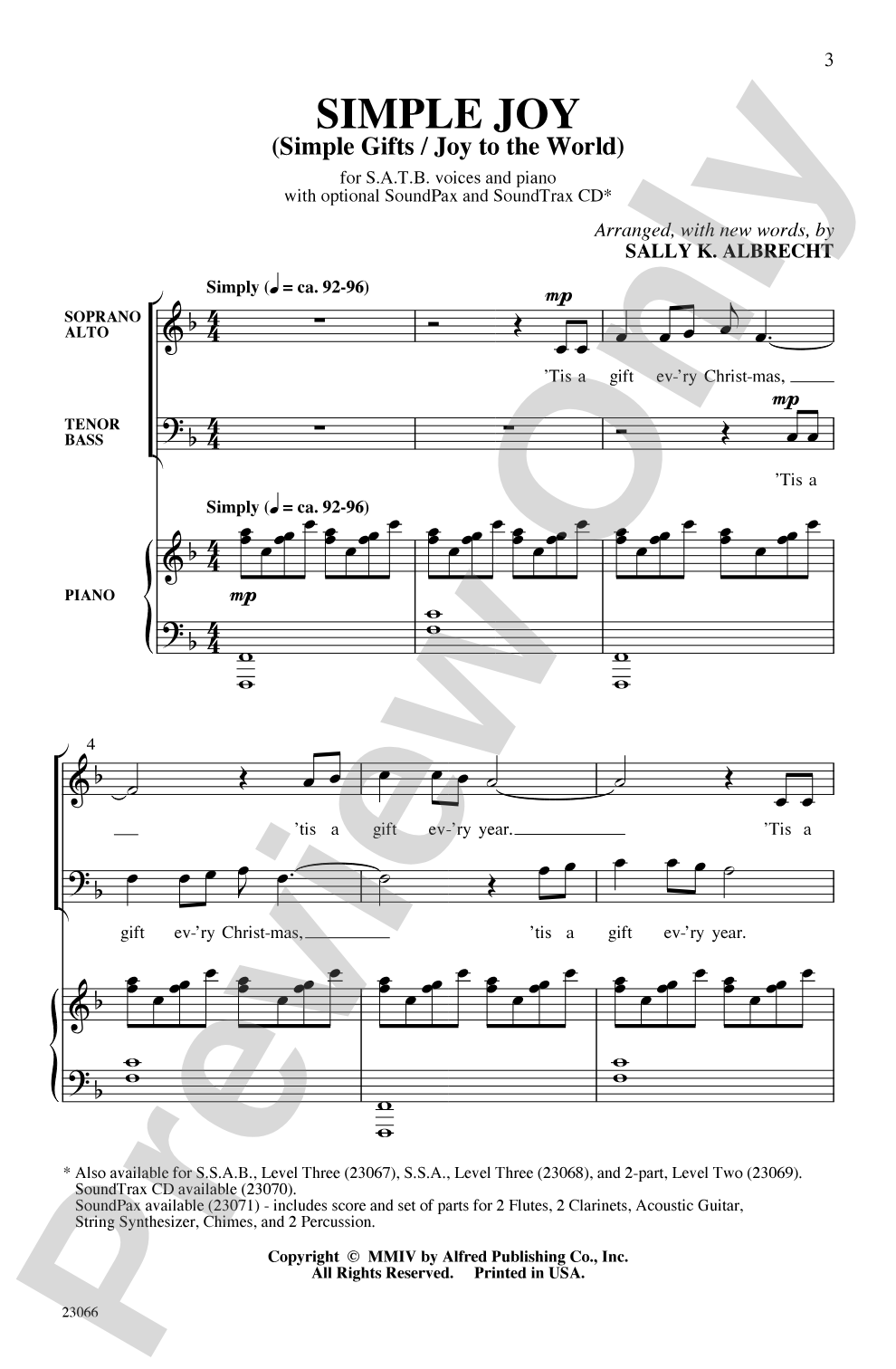

Simple Joy (Simple Gifts / Joy to the World): SATB Choral Octavo
Arr. Sally K. Albrecht
Item: 00-PO-0007942
$1.65
Minimum order quantity: 20 copies
Pickup currently not available
Related Items
Simple Joy (Simple Gifts / Joy to the World): 2-Part Choral Octavo |
$2.25
|
View | |
Simple Joy (Simple Gifts / Joy to the World): Choral SoundPax |
$25.00
|
View | |
Simple Joy (Simple Gifts / Joy to the World): SATB Choral Octavo |
$1.65
|
View | |
Simple Joy (Simple Gifts / Joy to the World): SSA Choral Octavo |
$1.65
|
View | |
Simple Joy (Simple Gifts / Joy to the World): 2-Part Choral Octavo |
$2.25
|
View | |
Simple Joy (Simple Gifts / Joy to the World): Choral Octavo SoundTrax CD |
$26.99
|
View | |
Simple Joy (Simple Gifts / Joy to the World): Choral SoundPax |
$25.00
|
View |
Description
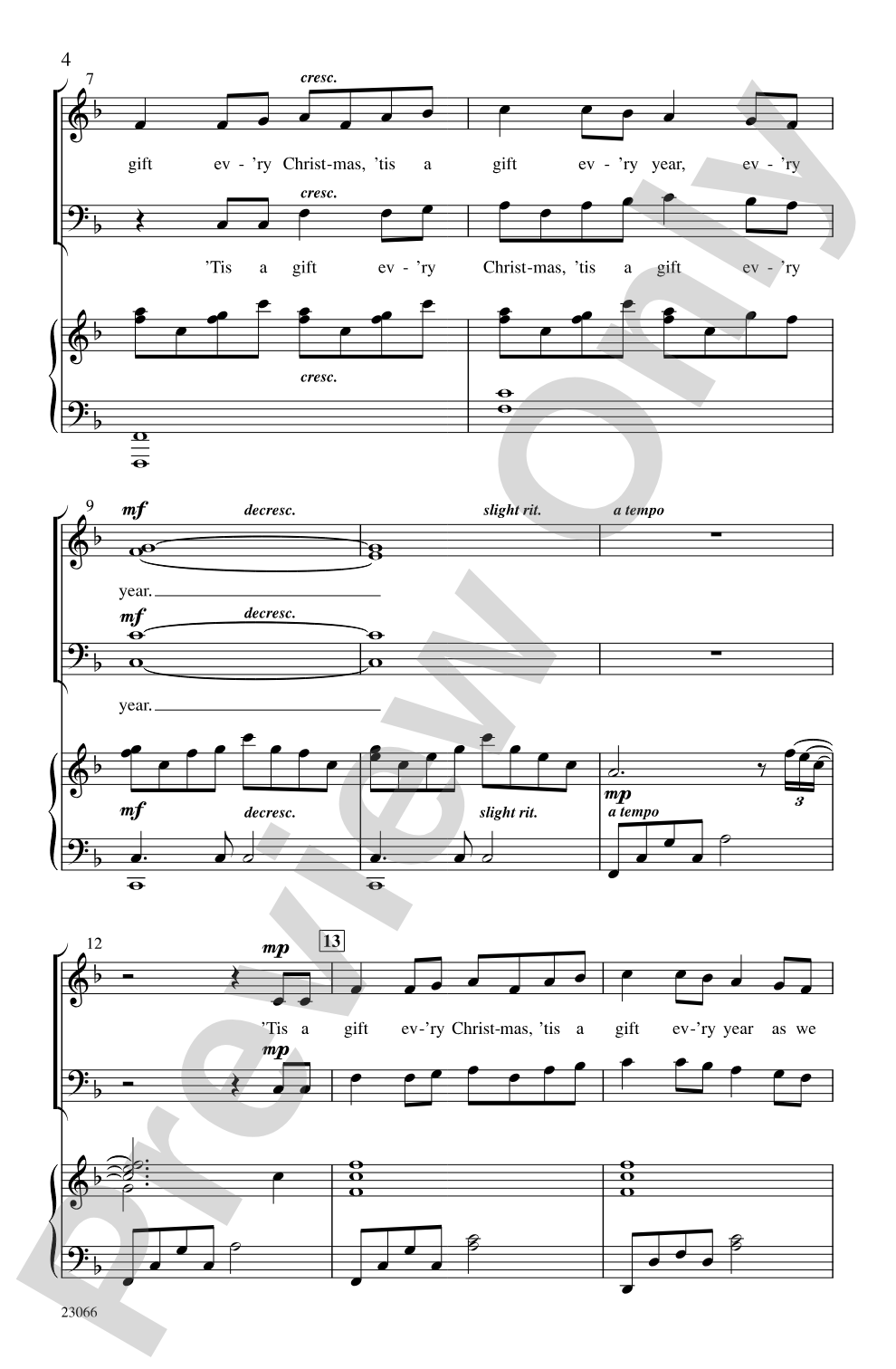
Sally K. Albrecht shows her choral artistry in this stunning arrangement entitled Simple Joy. A creative pairing of the Shaker tune "Simple Gifts" and Handel's "Joy to the World" with the addition of beautiful new lyrics, an integral accompaniment figure, and a glorious, majestic finish. Choirs of all levels will be at their best this Christmas with logical part writing in all voicings. The optional SoundTrax CD and instrumental SoundPax are striking.


Simple Joy (Simple Gifts / Joy to the World): SATB Choral Octavo isn't in MakeMusic Cloud just yet...but it could be. Let us know you'd like to see it, and you'll help shape what comes next. In the meantime, start a free trial and dive into thousands of interactive titles your students can play along with today.
Request This Title
Tell us you want it.
Start Your Free Trial
Explore everything that's ready to play right now.
Sample Audio
1
Audio File
--:--
0:00
0:00
Sample Video
No sample videos found.
Additional Details
Series:
Alfred Choral Designs
Publisher:
Alfred Music
Page Count:
12
SKU:
00-PO-0007942
More about this title
About the Arranger: Sally K. Albrecht

Sally K. Albrecht has shaped choral music education for more than thirty years as a composer, conductor, and publisher. Her catalog exceeds 600 published works, and she has received the ASCAP Special Music Award annually since 1987. She served as Director of School Choral, Vocal, and Elementary Publications for Alfred Music, and has conducted honor choirs at Lincoln Center, Carnegie Hall, and The Kennedy Center.
Albrecht holds degrees from Rollins College (B.A. in Music and Theater, 1976), the University of Miami (M.A. in Drama, 1977; M.M. in Accompanying, 1979), and has taught at Oakland University, Jersey City State College, and Meredith College. She received the Distinguished Alumna Award from both the University of Miami Frost School of Music and Rollins College in 2021.
Why we love this
Albrecht's pairing of two beloved melodies creates something genuinely fresh without sacrificing singability or musical substance. The part writing across all voice sections reflects her decades of understanding what actually works in rehearsal, and the optional instrumental accompaniment and recorded backing tracks make this accessible to programs with any level of accompaniment support.
What to expect
The arrangement moves between intimate reflection and radiant celebration. The Shaker melody opens with quiet clarity, then gradually incorporates Handel's familiar tune until both melodies intertwine, creating warmth and light that builds toward a triumphant close.
Who it's for
This works for any choral ensemble seeking a Christmas piece with genuine musical substance. Whether your singers are high school musicians, community choir members, or adult ensembles, the logical voice leading ensures everyone has a satisfying part to sing.
How to get the most out of it
- Balance the interplay between the two melodic lines carefully during sections where they overlap; the sopranos and tenors often carry the primary material while altos and basses support the harmonic foundation.
- Let the accompaniment figure breathe as a character in its own right rather than simply supporting the choir, especially in the opening measures where it establishes the piece's identity.
- Build gradually toward the majestic finish; this arrangement's arc depends on restraint in earlier sections so the final moments land with genuine impact.
- Shape phrases by listening to the recorded accompaniment, which models natural phrasing and tempo relationships even when your choir performs live with a pianist.
How to use it
Use this as the centerpiece of a Christmas concert or a closing number for a mixed holiday program. Its moderate difficulty sits comfortably in the middle of your set, allowing your ensemble to showcase precision and expressiveness without requiring extensive rehearsal time.
Skills your students will build
- Balancing independent melodic lines within four-part texture
- Executing smooth phrase connections across sectional divisions
- Interpreting dynamic and textural contrast in choral writing
- Adapting vocal tone to match sacred choral style
- Reading rhythmically clean notation in standard SATB format