
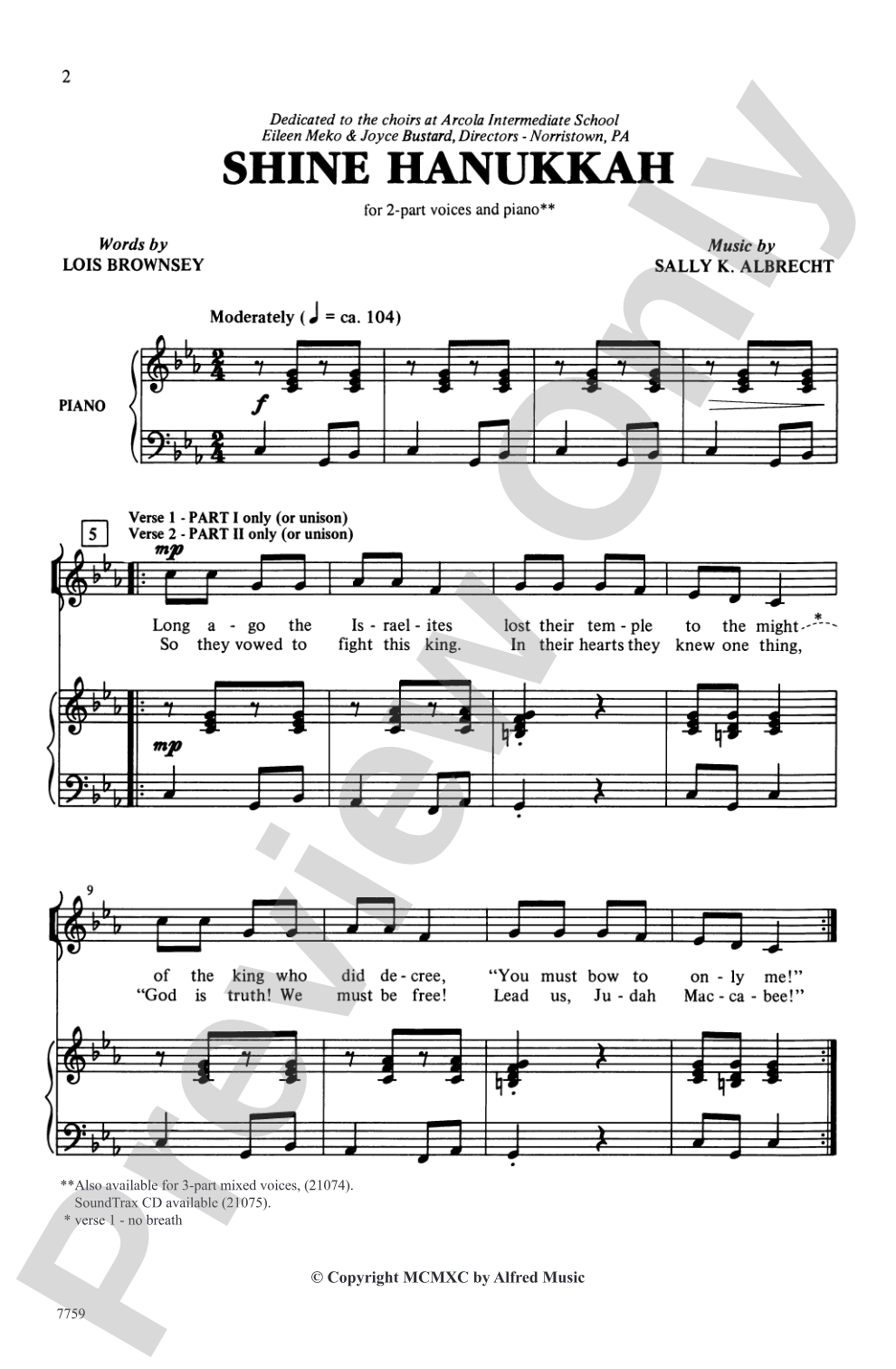

Shine Hanukkah: 2-Part Choral Octavo
Music by Sally K. Albrecht and Lois Brownsey
Item: 00-PO-0006738
$2.25
Minimum order quantity: 20 copies
Pickup currently not available
Description
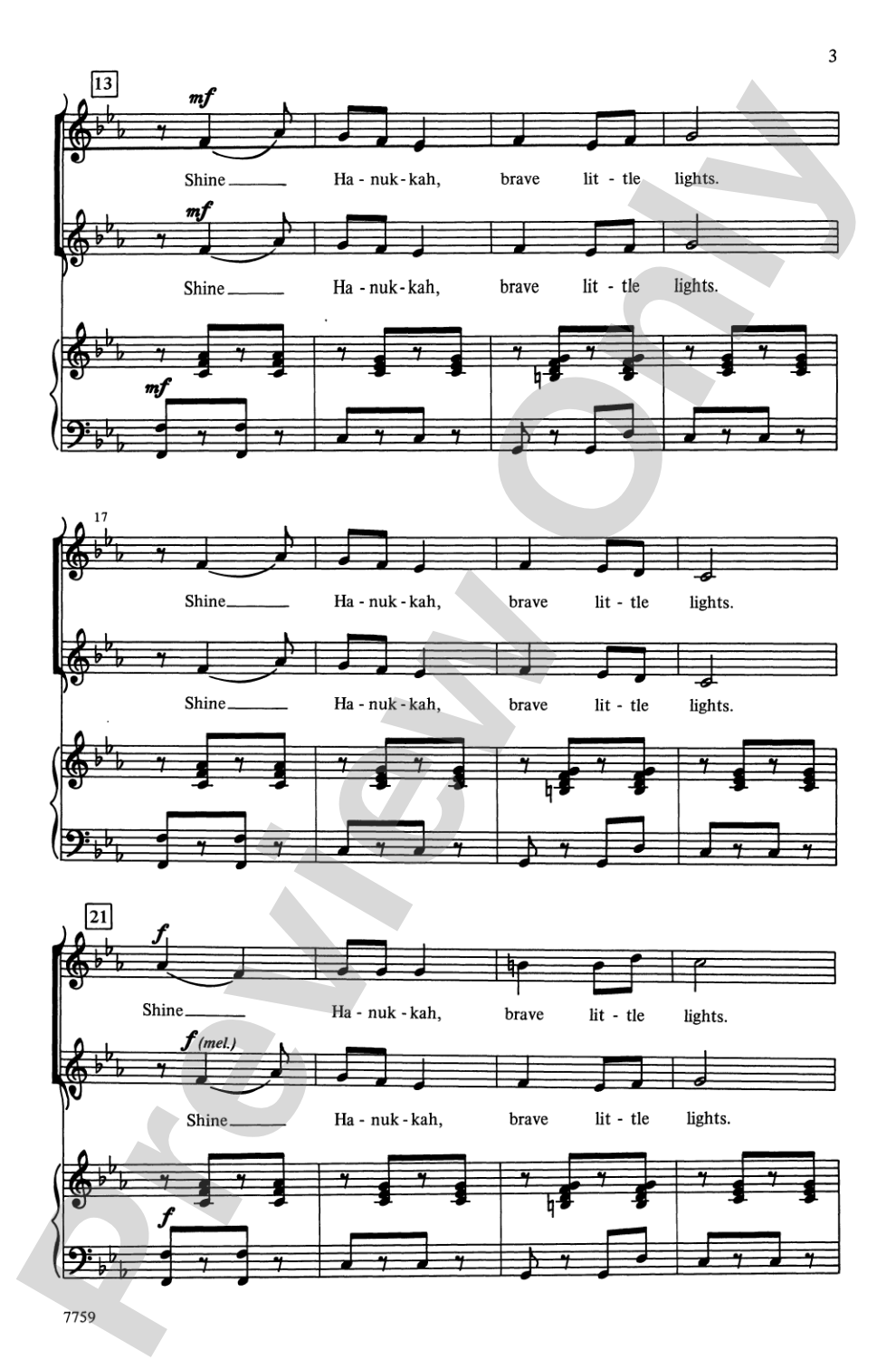
The story of Hanukkah unfolds in this special 2-part selection. Part I and Part II share the melody line, giving all your singers a chance to shine. A slower middle section contrasts with the 2-beat minor melody. An optional descant tops off the arrangement.


Shine Hanukkah: 2-Part Choral Octavo isn't in MakeMusic Cloud just yet...but it could be. Let us know you'd like to see it, and you'll help shape what comes next. In the meantime, start a free trial and dive into thousands of interactive titles your students can play along with today.
Request This Title
Tell us you want it.
Start Your Free Trial
Explore everything that's ready to play right now.
Sample Audio
1
Audio File
--:--
0:00
0:00
Sample Video
No sample videos found.
Additional Details
Series:
Alfred Archive Edition: Alfred Choral Designs
Publisher:
Alfred Music
Page Count:
8
SKU:
00-PO-0006738
More about this title
About the Composer: Sally K. Albrecht

Sally K. Albrecht has shaped choral music education for over three decades, serving as Director of School Choral, Vocal, and Elementary Publications at major educational music publishers, including Alfred Music. Her compositional output spans more than 600 choral works and 75 musicals and songbooks, earning her ASCAP Special Music Awards annually since 1987. She is particularly recognized for integrating movement and storytelling into choral performance, and has conducted honor choirs at prestigious venues including Lincoln Center, Carnegie Hall, and The Kennedy Center.
Albrecht holds degrees from Rollins College (B.A. in Music and Theater, 1976), the University of Miami (M.A. in Drama, 1977, and M.M. in Accompanying, 1979), and has taught at Oakland University, Jersey City State College, and Meredith College. A Cleveland native now based in North Carolina, she received the Distinguished Alumna Award from both the University of Miami Frost School of Music and Rollins College in 2021, and serves on the Board of Trustees at Rollins.
Why we love this
This arrangement gives every singer a moment at the center rather than burying half your ensemble in harmony. The design of Part I and Part II sharing the melody means your singers hear themselves singing the story, building confidence and ownership. The optional descant and contrasting middle section add harmonic depth without requiring complex part independence.
What to expect
The opening Minor melody has a contemplative, folk-like quality that grounds the Hanukkah narrative. When the piece slows for its middle section, the mood becomes introspective and reverent, then resurfaces with renewed energy. The optional descant lifts the final statement into something celebratory.
Who it's for
Choirs with limited part-singing experience or younger singers who need confidence-building repertoire. This piece works equally well for community choirs, church choirs, and school groups observing Hanukkah or exploring Jewish heritage in a winter concert.
How to get the most out of it
- Highlight the shift from the 2-beat minor melody to the slower middle section by adjusting your conducting tempo slightly early; this signals the singers the emotional turn before they hear it from the accompaniment.
- Balance the optional descant carefully so it enriches rather than overshadows the main melody line; consider doubling it with your strongest singers if your ensemble is still building blend.
- Use the recorded accompaniment during early rehearsals to lock the minor key intonation; many singers drift sharp in this harmonic context.
How to use it
Program this as part of a winter holiday or interfaith concert where you want to represent Jewish traditions authentically. It pairs well with other heritage pieces and sits comfortably in a 30-minute concert alongside secular winter repertoire or other sacred selections. The 8-page length makes it substantive enough for a standalone number without dominating a short concert.
Skills your students will build
- Reading and singing in 2-part harmony with shared melody line
- Intonation in minor keys and modal contexts
- Expressive phrasing across contrasting tempos
- Understanding and performing Jewish liturgical and cultural content
- Optional descant reading for advancing singers