
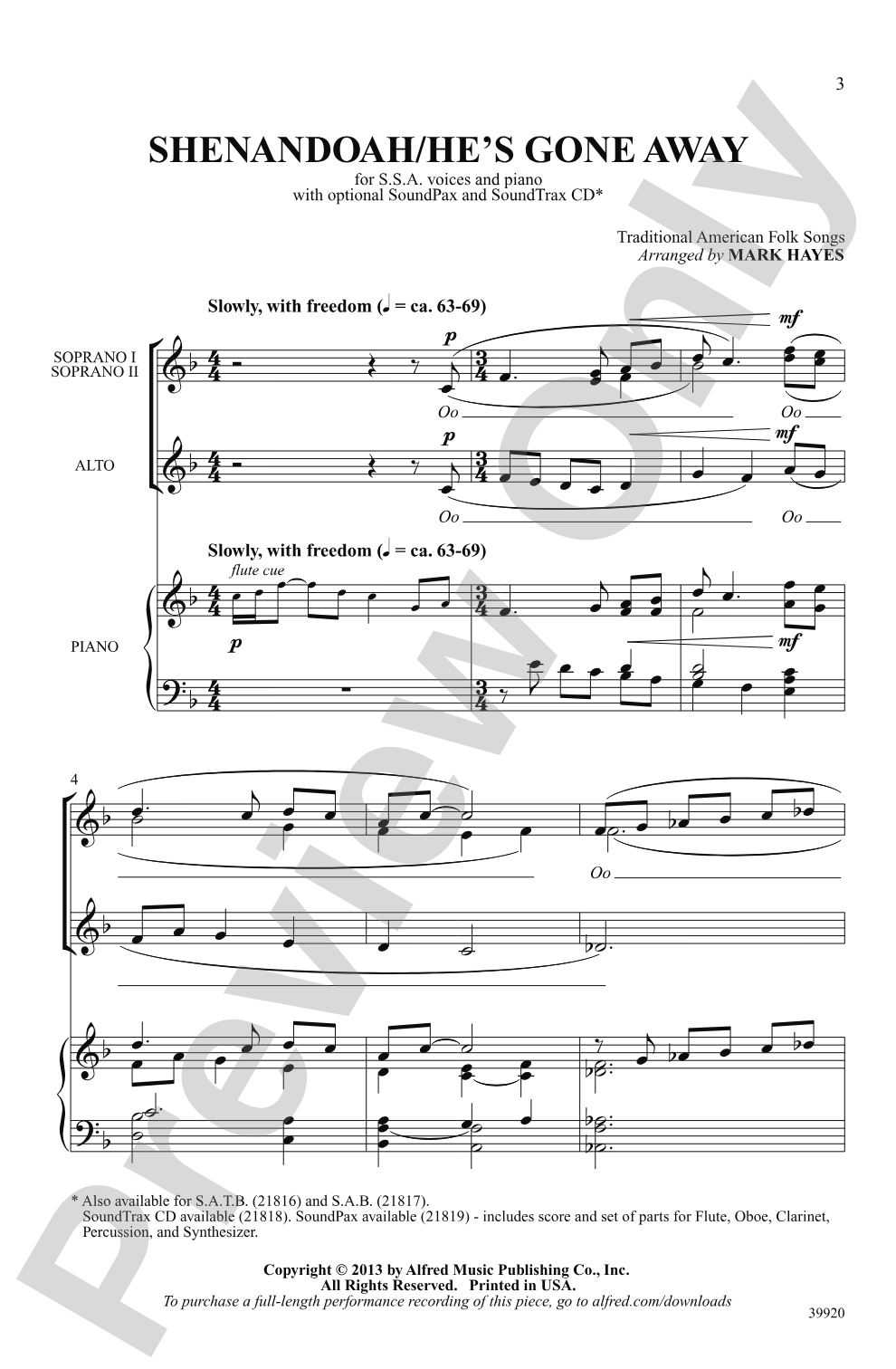
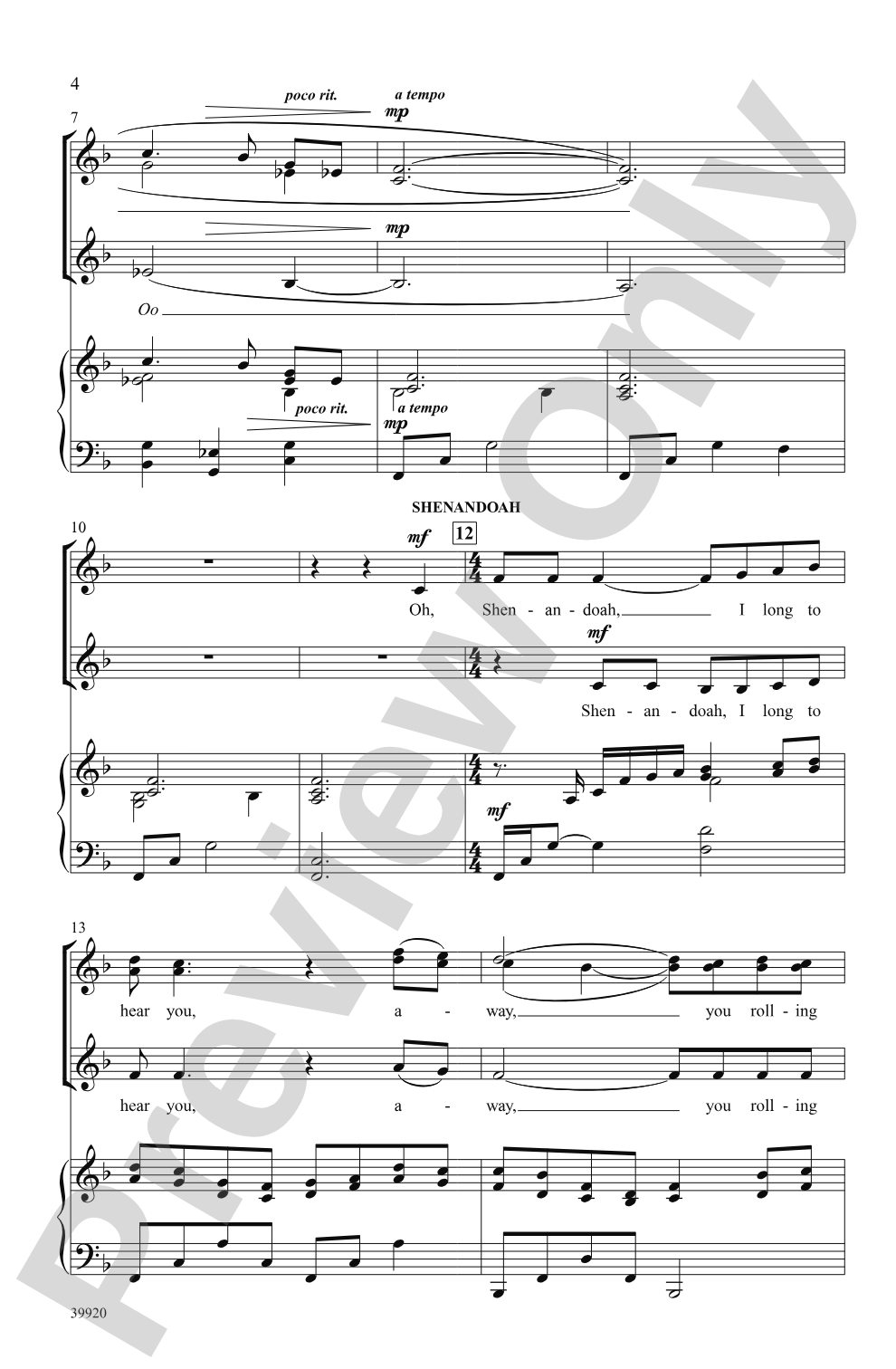
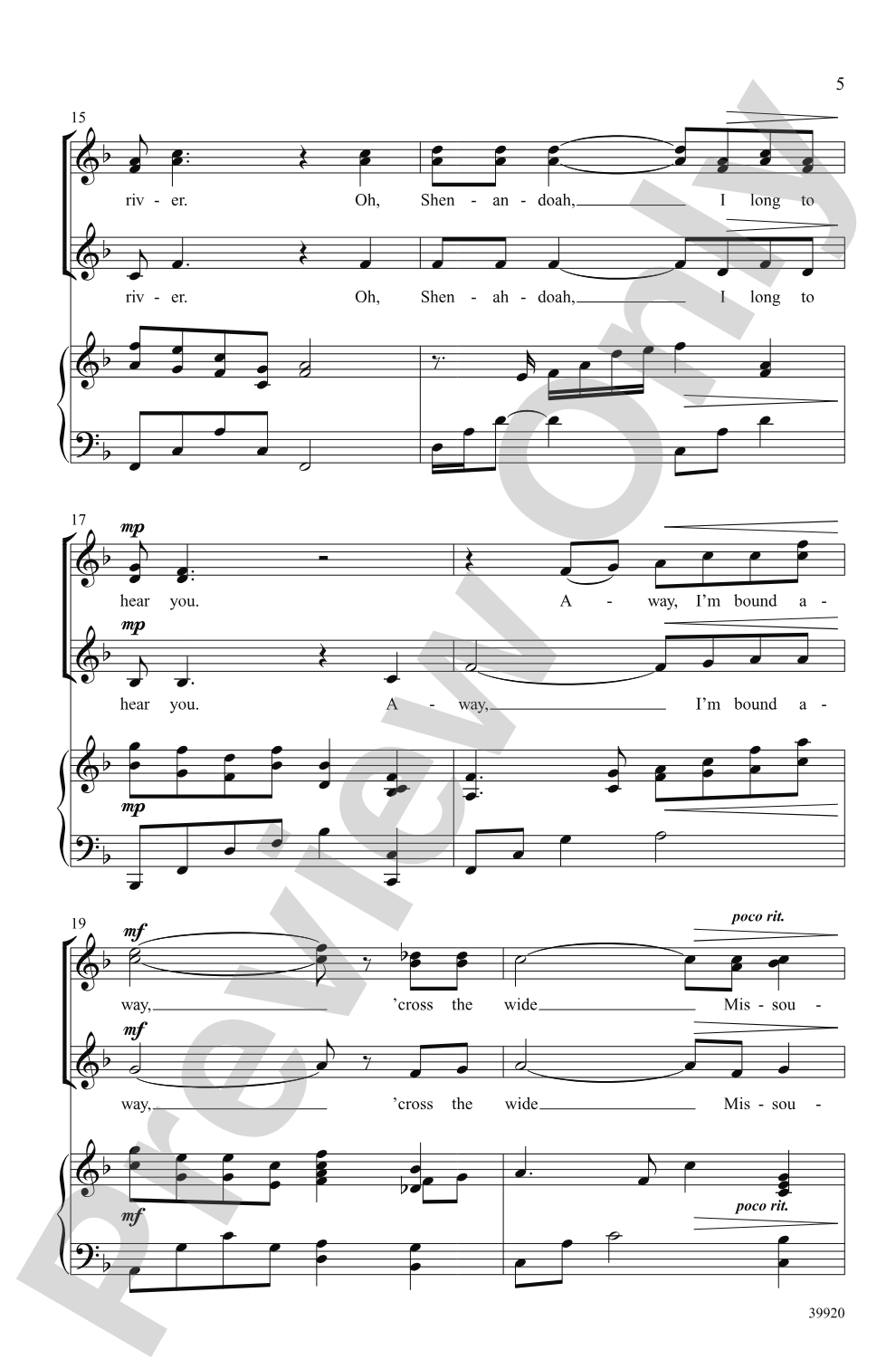

Shenandoah / He's Gone Away: SSA Choral Octavo
Traditional American Folk Songs / arr. Mark Hayes
Item: 00-PO-0001702
$1.95
Minimum order quantity: 20 copies
Pickup currently not available
Related Items
Shenandoah / He's Gone Away: SATB Choral Octavo |
$2.95
|
View | |
Shenandoah / He's Gone Away: SAB Choral Octavo |
$2.95
|
View | |
Shenandoah / He's Gone Away: Choral SoundPax |
$25.00
|
View | |
Shenandoah / He's Gone Away: SAB Choral Octavo |
$2.95
|
View | |
Shenandoah / He's Gone Away: SSA Choral Octavo |
$1.95
|
View | |
Shenandoah / He's Gone Away: Choral Octavo SoundTrax CD |
$27.99
|
View | |
Shenandoah / He's Gone Away: Choral SoundPax |
$25.00
|
View |
Description
A breathtaking combination of two simple folks songs, newly available for SSA. The artistic treatment of these two favorites will raise your choir to a new level of excellence. Opulently expressive.


Shenandoah / He's Gone Away: SSA Choral Octavo isn't in MakeMusic Cloud just yet...but it could be. Let us know you'd like to see it, and you'll help shape what comes next. In the meantime, start a free trial and dive into thousands of interactive titles your students can play along with today.
Request This Title
Tell us you want it.
Start Your Free Trial
Explore everything that's ready to play right now.
Sample Audio
1
Audio File
--:--
0:00
0:00
Sample Video
No sample videos found.
Additional Details
Series:
Alfred Choral Designs
Publisher:
Alfred Music
Page Count:
16
SKU:
00-PO-0001702
More about this title
About the Arranger: Mark Hayes
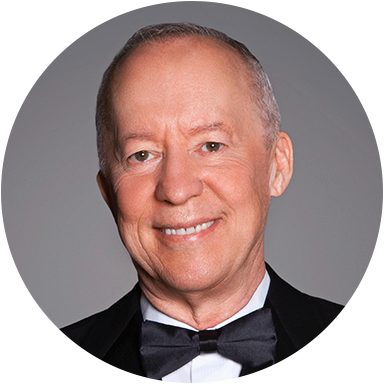
Mark Hayes brings a distinctive voice to choral arranging grounded in decades of experience as a concert pianist, composer, and conductor. His catalog exceeds 1,750 published works across sacred and secular genres, and his compositions have premiered at Lincoln Center, the National Cathedral, and Carnegie Hall. Hayes earned a Bachelor of Music degree summa cum laude in Piano Performance from Baylor University in 1975 and has guest conducted at major venues internationally.
Beyond the concert hall, Hayes has shaped Christian music education through his leadership work and has contributed significantly to musical theater, orchestrating the hit musical Madame Buttermilk and arranging scores for stage productions. Baylor University recognized his impact on Christian music with the Award for Exemplary Leadership in 2010. A passionate advocate for writing that serves singers at all levels, Hayes maintains over 100 piano publications in print and brings that same accessibility and artistry to his choral arrangements.
Why we love this
Hayes's treatment elevates familiar melodies into something genuinely moving without overcomplicating the harmonic language, making this perfect for SSA choirs seeking repertoire with real emotional weight. The pairing of these two folk traditions creates a natural arc that rewards careful phrasing and gives singers satisfying moments of ensemble blend and individual line work. This is the kind of arrangement that sounds effortless to the listener but teaches singers how to shape melody, balance parts, and build dynamic interest across a longer form.
What to expect
These familiar folk melodies unfold with a contemplative beauty that feels both intimate and grand. The harmonic language adds richness and emotional depth while maintaining the pastoral quality inherent in the original songs, creating space for singers to connect emotionally with the text.
Who it's for
SSA choirs ranging from intermediate to advanced levels will find this arrangement accessible yet artistically substantial. Treble choirs preparing for concert or festival performance benefit from repertoire that honors the simplicity of the source material while providing genuine interpretive challenge. Community choirs, school ensembles, and auditioned groups all have space for this work in their programs.
How to get the most out of it
- Shape the opening phrase generously; these folk melodies thrive on breath and flexibility rather than metronomic precision.
- Balance treble and soprano lines carefully, especially where the melody passes between voice parts or where harmony thickens.
- Use the recorded accompaniment to anchor sectional rehearsals, then work toward independence so the choir can breathe as a unified ensemble.
- Pay special attention to vowel consistency in the sustained moments; the opulent harmonic writing asks for a unified resonance across the section.
How to use it
Program this as a contrasting work alongside more structured classical repertoire, or use it as an anchor piece in a folk or Americana themed concert. The 16-page score allows for a graceful pacing within a concert arc, and the two folk traditions work naturally as companion pieces that can each stand alone or be performed together as a set.
Skills your students will build
- Phrase shaping and breath management in lyrical contexts
- Balancing independent melodic lines within SSA voicing
- Sustaining pure vowels in extended harmonic progressions
- Interpreting folk material with artistic maturity rather than overly literal delivery
- Part independence and blend within the middle and lower treble voices