
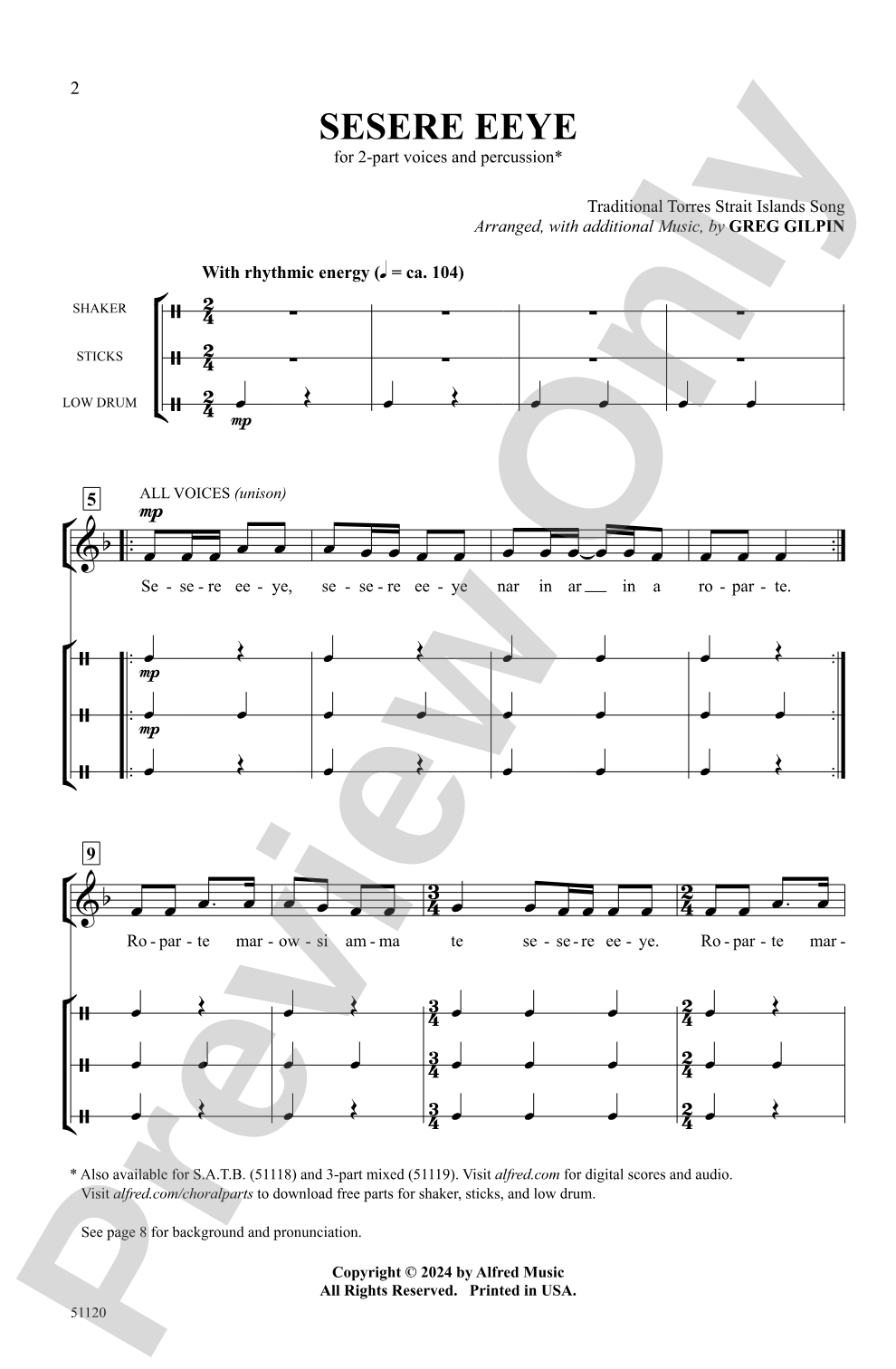

Sesere Eeye: 2-Part Choral Octavo
Traditional Torres Strait Islands Song / arr., with additional music, by Greg Gilpin
Item: 00-PO-0007209
$2.20
Minimum order quantity: 10 copies
Please note: Under U.S. copyright law, you must purchase the exact number of copies needed for your ensemble. Printing, duplicating or sharing additional copies is strictly prohibited.
Pickup currently not available
Description
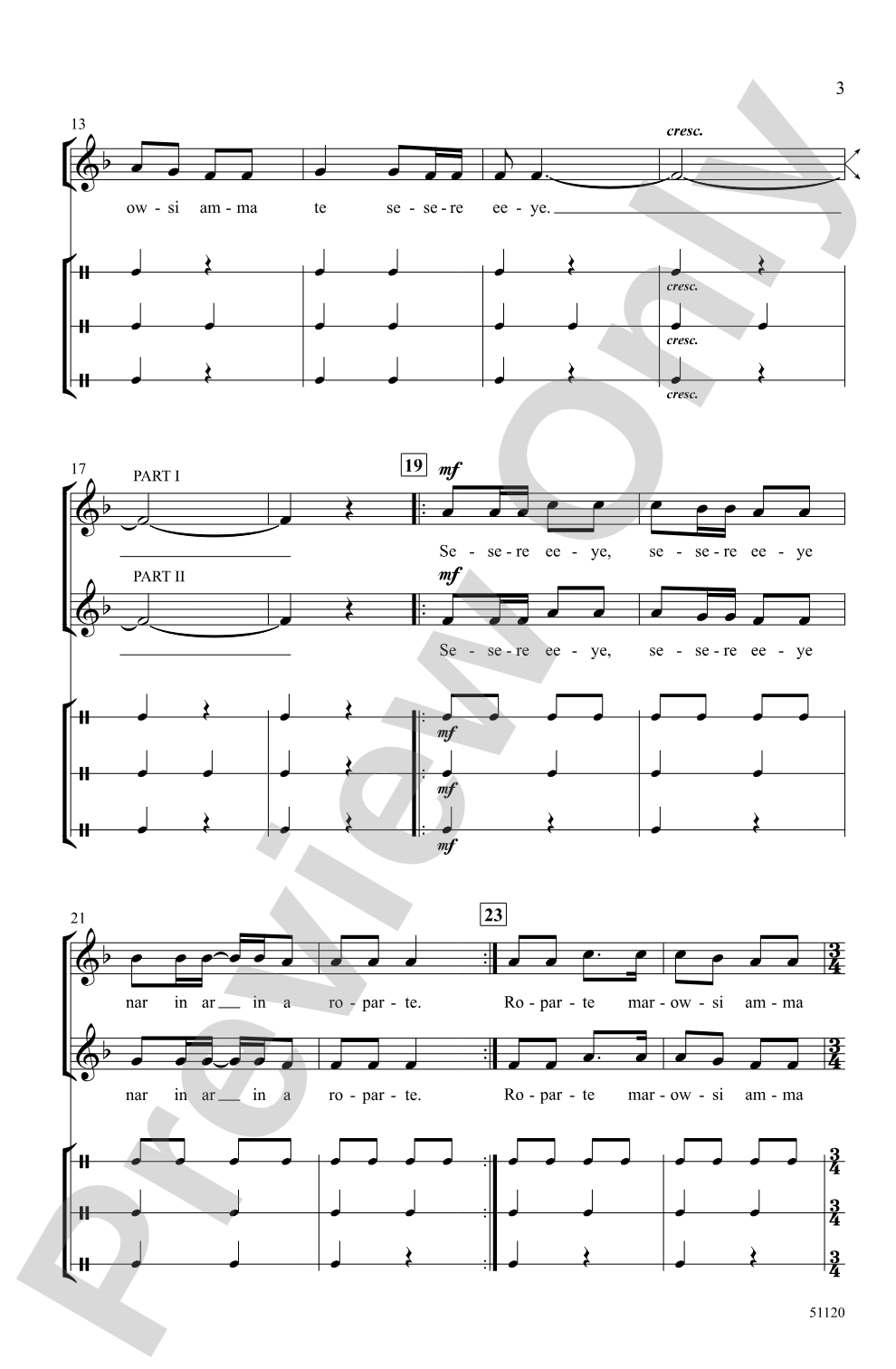
This Torres Strait Islands folk song presents a wonderful opportunity for a cappella choirs to perform with authentic world percussion instruments (common alternates offered). All the voicings are built on a traditional repeat structure that begins in unison and unfolds into more harmony with each verse. A brief bridge of original music punctuates the repeated sections. Choirs around the globe have enjoyed adding movement to this playful nature song.


Discover MakeMusic Cloud: thousands of interactive titles your students can play along with today.
Sample Audio
1
Audio File
--:--
0:00
0:00
Sample Video
Additional Details
Series:
Alfred Choral Designs
Publisher:
Alfred Music
Page Count:
8
SKU:
00-PO-0007209
Instrumentation:
Percussion
More about this title
About the Arranger: Greg Gilpin

Greg Gilpin is an ASCAP award-winning composer and arranger whose choral works have been performed at major concert halls throughout North America, Europe, and Australia, including Carnegie Hall, Lincoln Center, and the Sydney Opera House. His career spans conducting, composing, recording production, and music publishing, where he serves as Director of Educational Choral Publications for Shawnee Press.
Beyond the concert hall, Gilpin has expanded into film scoring and television appearances, including work on the award-winning short film "Rosie's Rescue" and appearances on network television. He holds memberships in ACDA, NAfME, SAG-AFTRA, and maintains Life Loyal membership in Phi Mu Alpha Sinfonia.
Why we love this
Gilpin's arrangement captures the essential character of this Torres Strait Islands folk song while making it genuinely accessible for young or developing two-part choirs. The gradual harmonic unfolding from unison into fuller voicings builds confidence naturally, and the invitation to add movement and world percussion transforms it from a pleasant piece into something your singers will remember years after performing it.
What to expect
Playful and grounded, with a warm, storytelling quality that invites both musical participation and physical response. The gradual harmonic expansion feels like watching something unfold naturally, and the bridge section breaks the hypnotic charm of the repeated structure just long enough to refresh the listener's ear before returning to the familiar pattern.
Who it's for
Two-part choirs seeking authentic world music that engages young singers without condescending to them. It works equally well for community choirs, middle school groups exploring cultural repertoire, and festival-bound ensembles looking for a piece with real personality and ensemble-building potential.
How to get the most out of it
- Secure the unison opening with precision before introducing any harmony; this establishes the foundation and makes the harmonic layers that follow feel intentional rather than cluttered.
- Research traditional Torres Strait Islands percussion instruments and their timbres before rehearsal begins. Even if you use common classroom alternatives, understanding the authentic sound world will inform your ensemble's phrasing and articulation.
- Experiment with a cappella balance first before adding percussion. Once your singers own the piece vocally, the rhythmic accompaniment will enhance rather than overshadow their parts.
- Invite movement workshops during sectional rehearsals. The playful nature of this song responds beautifully to gesture, and early experimentation prevents last-minute choreography from feeling forced.
How to use it
This piece shines in cultural diversity programming or world music-themed concerts, where it anchors a set of global repertoire without requiring major production elements. It also works beautifully as a teaching piece within a concert that otherwise features Western art music, offering students and audiences alike a genuine connection to another musical tradition. The optional percussion parts and movement possibilities make it particularly valuable for family concerts or educational outreach performances.
Skills your students will build
- Reading and sustaining unison melody with confidence
- Blending two-part harmony while maintaining clear voice independence
- Responding to rhythmic ostinato and percussion accompaniment as an ensemble
- Connecting music to cultural context and authentic world music traditions
- Coordinating vocal line with movement and gesture