
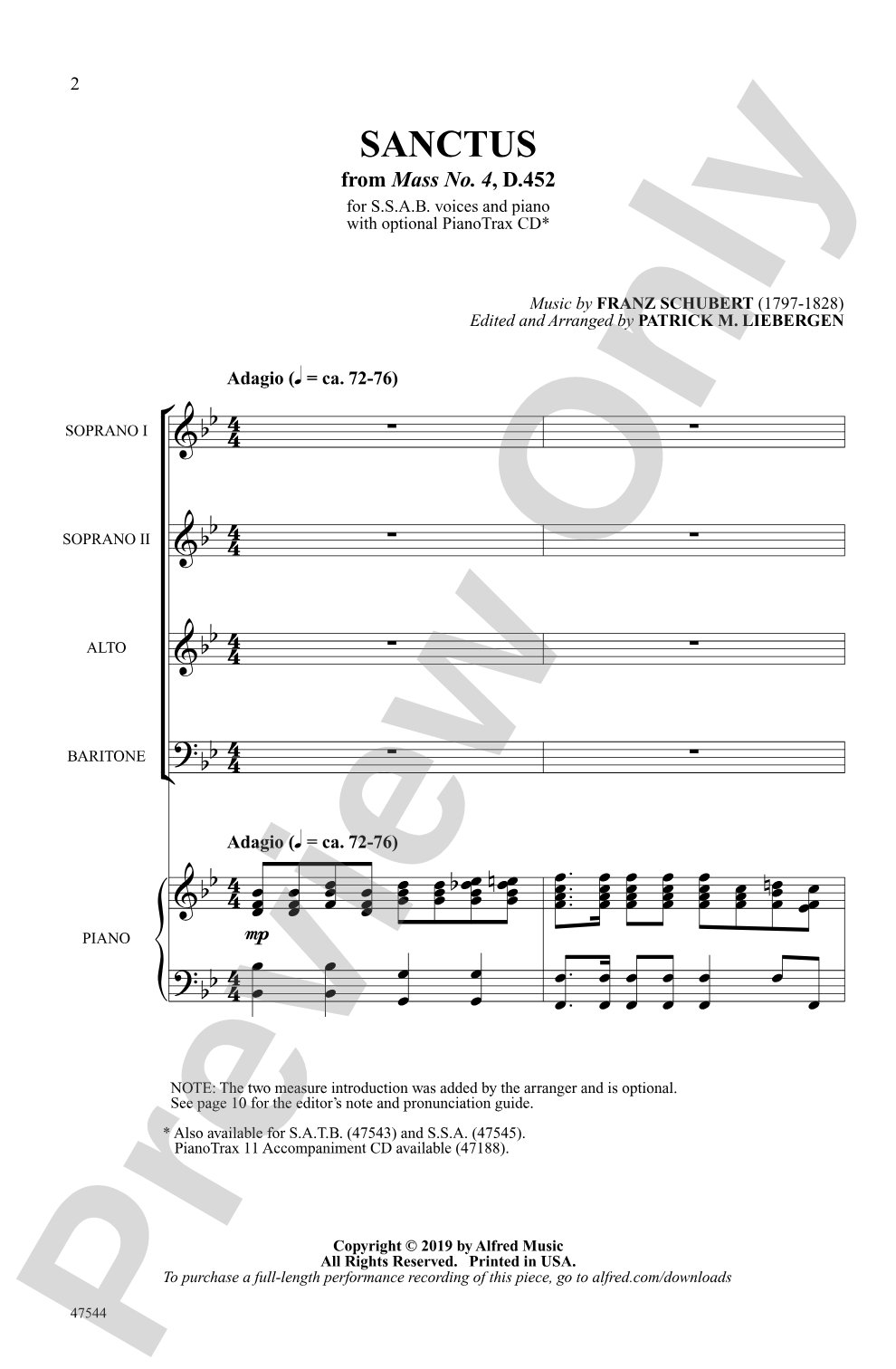

Sanctus: SSAB Choral Octavo
from Mass No. 4, D. 452
Music by Franz Schubert / ed. and arr. Patrick M. Liebergen
Item: 00-PO-0005923
$2.05
Minimum order quantity: 20 copies
Pickup currently not available
Description
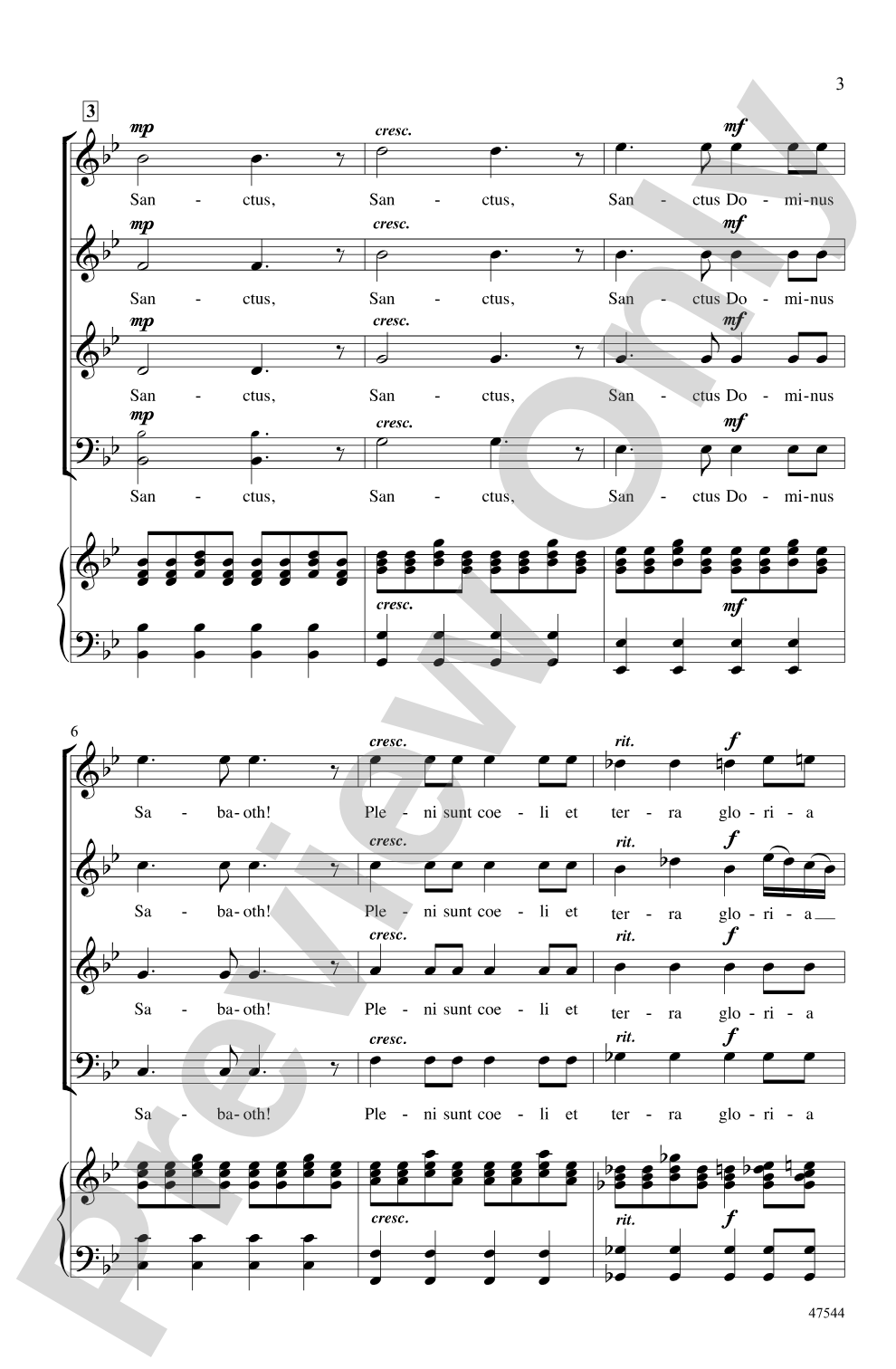
A warm adagio introduction breaks into a joyous “Hosanna” chorus in this 44-measure homophonic masterwork. Taken from Schubert's Mass No. 4, this edition offers sensible vocal ranges, editorial dynamic and metronome markings, plus a complete IPA guide for the brief Latin text. The orchestral parts have been reduced to a playable piano accompaniment while preserving the Classical characteristics of the original work.


Sanctus: SSAB Choral Octavo isn't in MakeMusic Cloud just yet...but it could be. Let us know you'd like to see it, and you'll help shape what comes next. In the meantime, start a free trial and dive into thousands of interactive titles your students can play along with today.
Request This Title
Tell us you want it.
Start Your Free Trial
Explore everything that's ready to play right now.
Sample Audio
1
Audio File
--:--
0:00
0:00
Sample Video
No sample videos found.
Additional Details
Series:
Alfred Choral Designs
Publisher:
Alfred Music
Page Count:
12
SKU:
00-PO-0005923
More about this title
About the Composer: Franz Schubert
Franz Schubert (1797-1828) shaped the Romantic era by expanding the expressive range of instrumental and vocal music. His nine symphonies and more than 600 songs established new emotional depth in European classical tradition, yet his sacred works remain underperformed despite their lyrical generosity and harmonic innovation. Schubert composed six masses across his lifetime, each one deepening his exploration of text setting and ensemble writing.
Why we love this
Liebergen's arrangement preserves the sweeping lyricism that makes Schubert essential listening while making the orchestral texture singable by any intermediate choir. The arc from quiet adagio to exuberant "Hosanna" gives your singers both intimate musical storytelling and moments of pure joy; that emotional range makes this one of the most rewarding pieces to rehearse at this level.
What to expect
The piece opens with contemplative warmth, voices entering gradually in a hush of reverence. Energy builds organically as the "Hosanna" arrives, bringing a rush of light and affirmation; the homophonic texture keeps the effect communal rather than complicated. Throughout, Schubert's gift for melody makes even the simplest passages feel inevitable and beautiful.
Who it's for
Intermediate to advancing mixed choirs (Grades 8-12, college, community) who can manage sustained vocal lines and text clarity in Latin. This arrangement works equally well for groups with limited orchestra access, since the piano reduction captures Schubert's harmonic language and textures without sacrificing musicality. Conductors seeking festival-worthy sacred repertoire that feels substantial without being technically overwhelming will find a strong match here.
How to get the most out of it
- Shape the opening adagio with long vocal lines rather than syllable-by-syllable articulation; Schubert's genius lies in the way melody unfolds across phrases, not in note-by-note clarity.
- Balance the sopranos and altos carefully when they diverge early in the piece; the homophonic texture can blur if upper voices dominate the accompaniment.
- Find the rhythmic lift into "Hosanna" by rehearsing the transition with the pianist; even a small tempo increase here signals the emotional shift without sounding rushed.
- Use the IPA guide systematically in early rehearsals, then drill the Latin syllables with rhythm before adding full text delivery; your diction will clarify dramatically once the notes are secure.
How to use it
Program this during a sacred concert or holiday service where it can anchor a section of Romantic-era liturgical music. Its 44-measure length and moderate difficulty make it ideal as a centerpiece piece (not a warm-up or filler) that still leaves room for an opening piece and closing work on the same program. The emotional progression from introspection to celebration also works beautifully as a concert finale.
Skills your students will build
- Latin diction and text delivery (with integrated IPA pronunciation guide)
- Sustaining long melodic lines without losing breath control
- Balancing upper voice parts in homophonic texture
- Reading editorial dynamic and tempo markings to shape phrase architecture
- Singing Classical harmonic language with understanding of voice leading