
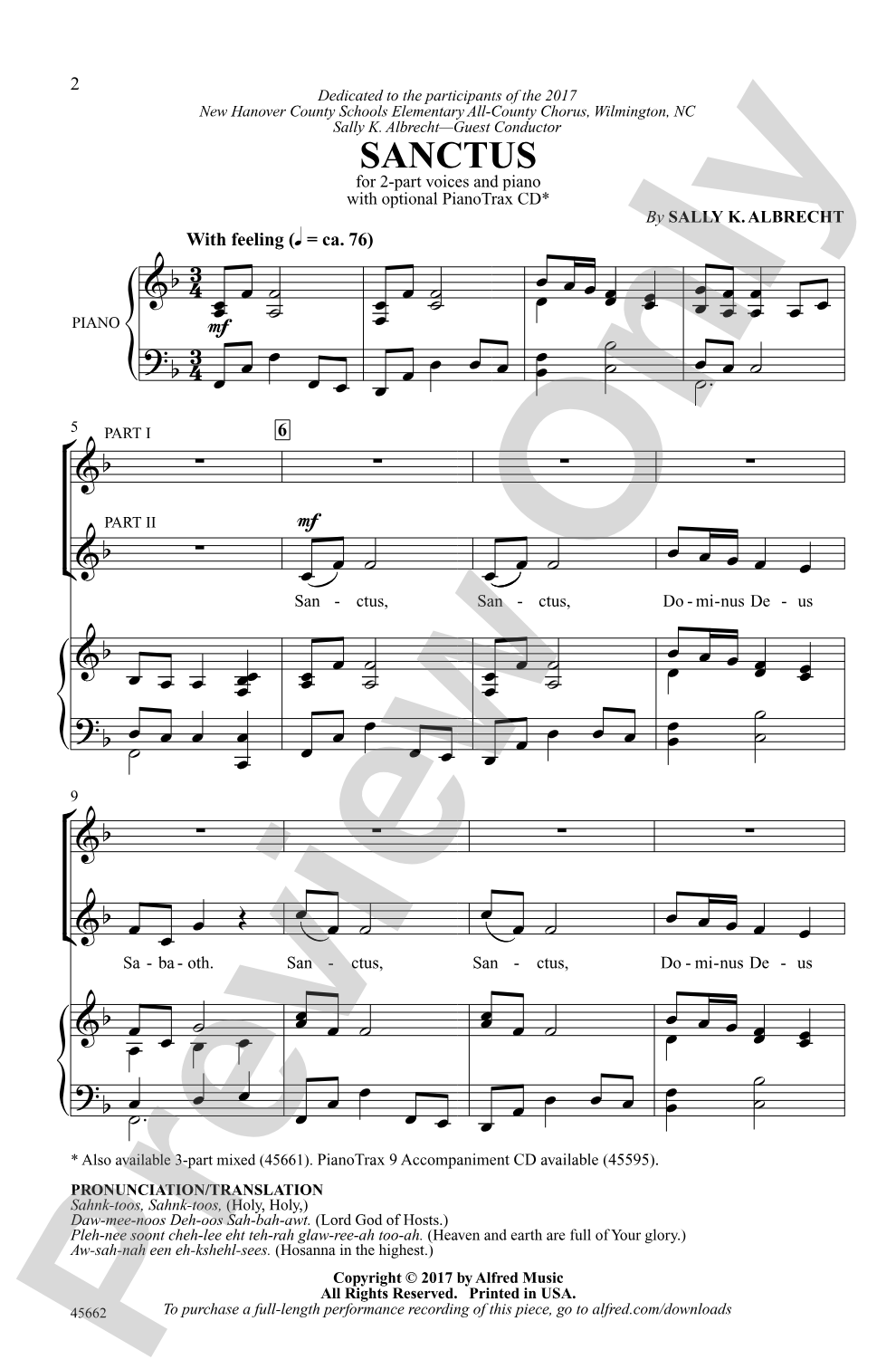
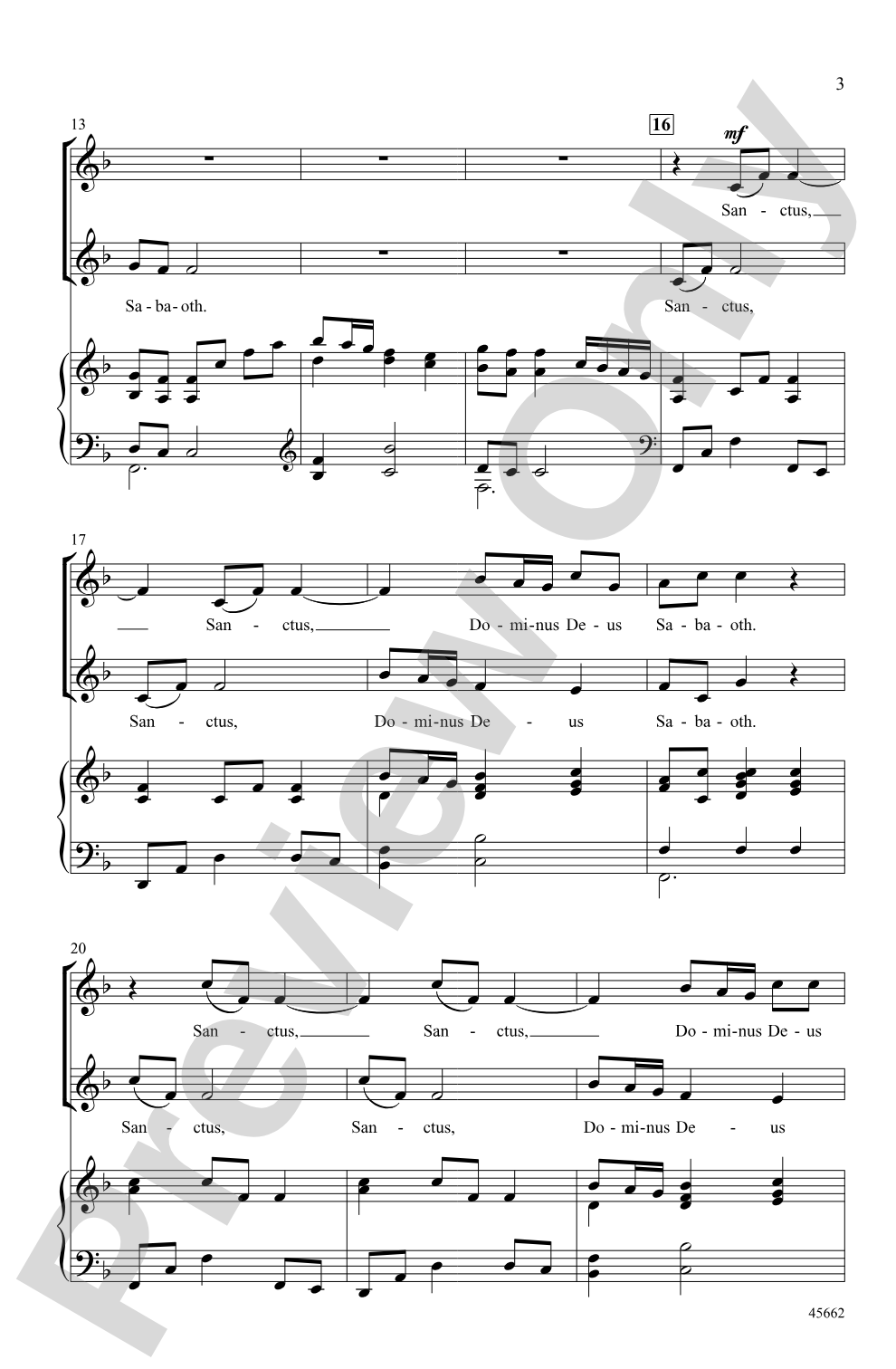

Sanctus: 2-Part Choral Octavo
By Sally K. Albrecht
Item: 00-PO-0005541
$1.90
Minimum order quantity: 20 copies
Pickup currently not available
Description
A one-octave melody, imitative textures, independent vocal parts, and an accessible Latin text make this an ideal selection for developing choirs. Emphasize pure vowels and legato phrasing to highlight the beauty of this gorgeous setting. Simply stunning.


Sanctus: 2-Part Choral Octavo isn't in MakeMusic Cloud just yet...but it could be. Let us know you'd like to see it, and you'll help shape what comes next. In the meantime, start a free trial and dive into thousands of interactive titles your students can play along with today.
Request This Title
Tell us you want it.
Start Your Free Trial
Explore everything that's ready to play right now.
Sample Audio
1
Audio File
--:--
0:00
0:00
Sample Video
No sample videos found.
Additional Details
Series:
Alfred Choral Designs
Publisher:
Alfred Music
Page Count:
8
SKU:
00-PO-0005541
More about this title
About the Composer: Sally K. Albrecht

Sally K. Albrecht has shaped choral music education for over thirty years as a composer, conductor, and clinician with particular expertise in choral movement. Since 1987, she has received annual ASCAP Special Music Awards, and her catalog includes more than 600 published choral works alongside 75 larger songbooks and musicals. She has guest-conducted honor choirs at major venues including Lincoln Center, Carnegie Hall, and The Kennedy Center, while serving as Director of School Choral, Vocal, and Elementary Publications at Alfred Music and other leading educational publishers.
Albrecht holds degrees from Rollins College (B.A. in Music and Theater, 1976) and the University of Miami (M.A. in Drama, 1977; M.M. in Accompanying, 1979). She has taught in music departments at Oakland University, Jersey City State College, and Meredith College, and currently resides in Wake Forest, North Carolina with her husband, composer and arranger Jay Althouse. In 2021, she received the Distinguished Alumna Award from both the University of Miami Frost School of Music and Rollins College, where she serves on the Board of Trustees.
Why we love this
Albrecht writes with a keen ear for what developing choirs can achieve: the imitative textures here give singers genuine contrapuntal experience without overwhelming them, and the Latin text feels dignified rather than intimidating. The one-octave range sits perfectly for mixed-age groups and younger voices, while the independent vocal parts keep both sections engaged throughout.
What to expect
There is an understated elegance here; the imitative writing creates a sense of voices conversing rather than competing. The Latin text and legato phrasing evoke reverence without heaviness, and the one-octave melody feels intimate and human-scaled.
Who it's for
Developing choirs with mixed age and experience levels benefit most from this setting. Directors preparing groups for concert or festival performance will find a piece that builds confidence through its accessible range and clear structure while still offering musical substance.
How to get the most out of it
- Shape phrases through sustained, connected vowels. Latin vowels (especially the pure 'a' in Sanctus) naturally support legato singing, so use this text setting as an opportunity to refine sustained tone.
- Balance the independent lines by rehearsing each voice part separately before combining them, then check that neither part dominates the other during imitative sections.
- Let the text rhythm guide your interpretation rather than imposing an overly rigid tempo. Where the words naturally breathe, give singers space to phrase organically.
How to use it
This works beautifully as a centerpiece in a sacred music program or as part of a concert exploring choral textures and Latin repertoire. Its modest length and melodic clarity also make it an excellent choice for festival performances where you want to showcase the choir's musicality and blend without requiring extended rehearsal time.
Skills your students will build
- Imitative singing and part independence
- Sustained legato phrasing and pure Latin vowel formation
- Reading and performing music in the one-octave range
- Balancing melodic lines while maintaining ensemble cohesion