
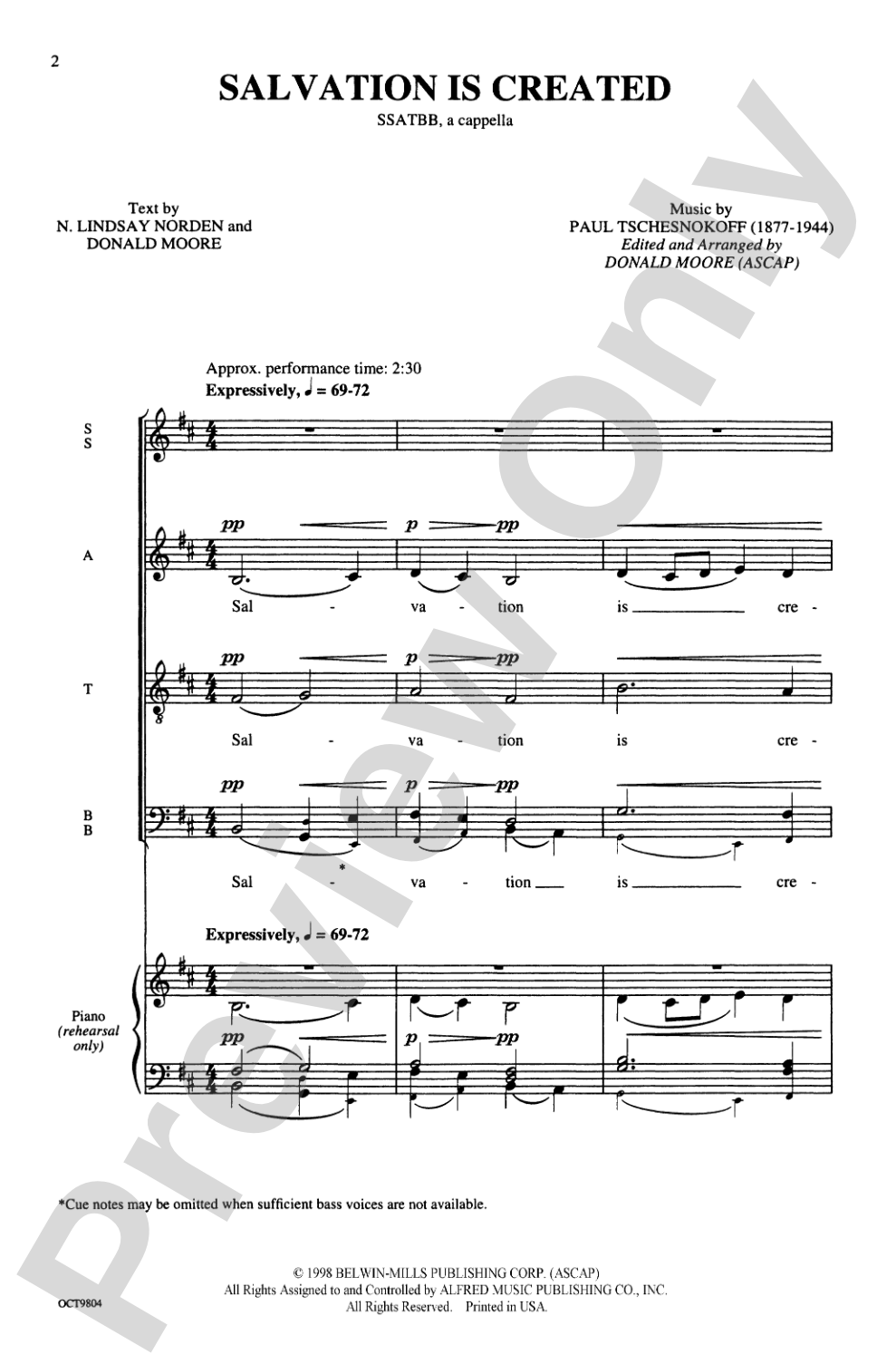
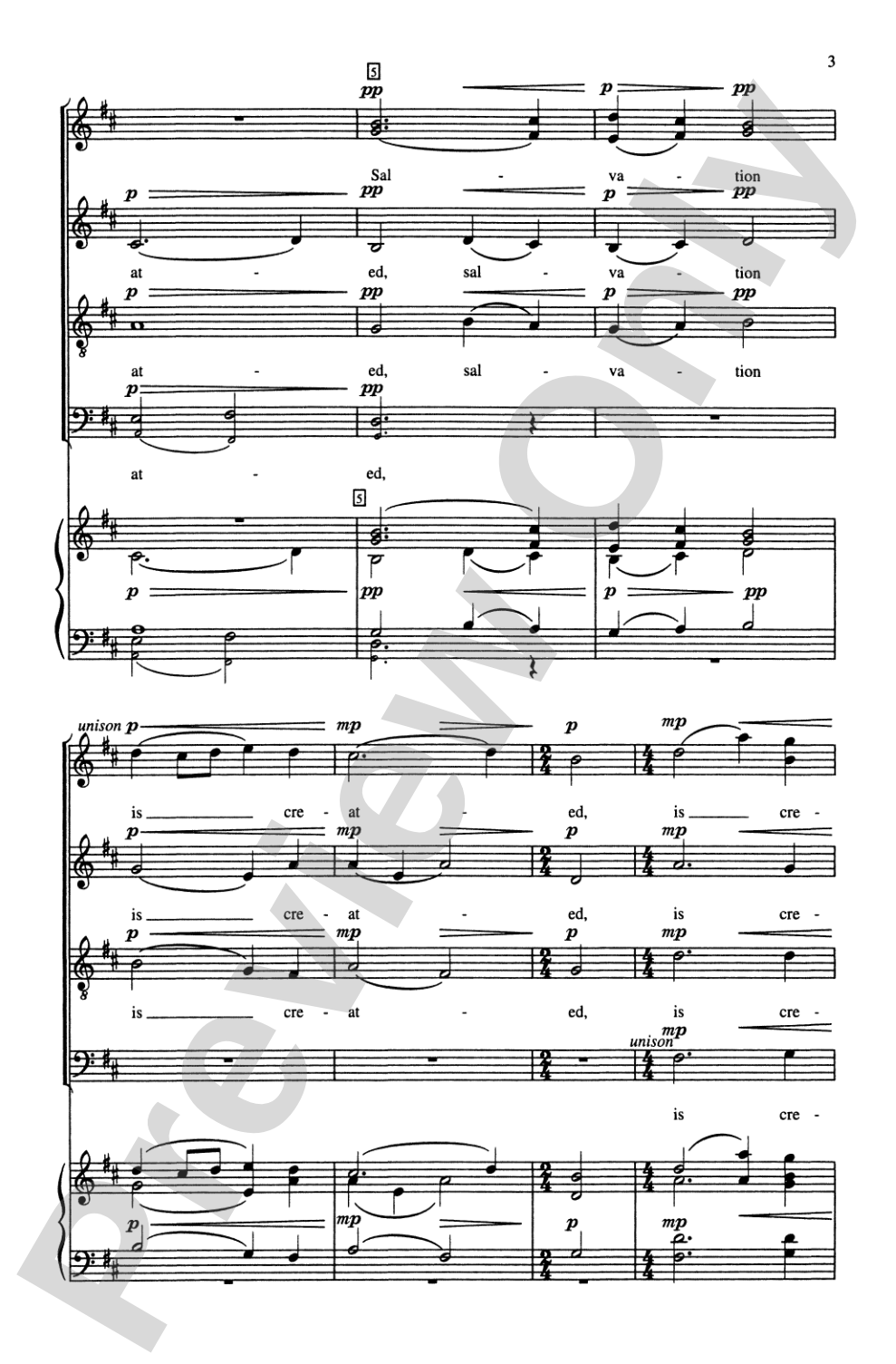

Salvation Is Created: SSATBB, a cappella Choral Octavo
By Paul Tschesnokoff / ed. and arr. Donald Moore
Item: 00-PO-0003044
$2.25
Minimum order quantity: 20 copies
Pickup currently not available
Description
Some choral pieces speak for themselves! 'Salvation Is Created' is just such a work. Don Moore brings this song into the reach of many choirs who may have been unable to perform the original edition. All of the rich sonorities have been captured in this wonderful new edition. Don't miss this one!


Salvation Is Created: SSATBB, a cappella Choral Octavo isn't in MakeMusic Cloud just yet...but it could be. Let us know you'd like to see it, and you'll help shape what comes next. In the meantime, start a free trial and dive into thousands of interactive titles your students can play along with today.
Request This Title
Tell us you want it.
Start Your Free Trial
Explore everything that's ready to play right now.
Sample Audio
No sample audio found.
Sample Video
No sample videos found.
Additional Details
Series:
Alfred Archive Edition: Belwin Festival Series
Publisher:
Alfred Music
Page Count:
8
SKU:
00-PO-0003044
More about this title
About the Composer: Paul Tschesnokoff
Paul Tschesnokoff (1877-1944) was a Russian choral composer and conductor whose sacred works defined the sound of Russian Orthodox liturgical music in the early twentieth century. His compositions are marked by sweeping harmonic progressions, rich sonorities built across multiple voice parts, and a deep understanding of how the human voice can sustain complex vertical structures. Tschesnokoff's choral works remain cornerstones of the a cappella repertoire worldwide, prized for their spiritual depth and architectural ambition.
Why we love this
Donald Moore's arrangement opens this Russian choral masterwork to choirs that lack the resources or experience for the original edition, yet preserves the harmonic architecture and emotional sweep that make Tschesnokoff's writing unforgettable. The SSATBB voicing allows expanding ensembles to experience the weight and resonance of divided voices without requiring an oversized choir. Directors consistently find that singing this piece transforms their section's blend and intonation work in ways that ripple across the rest of their repertoire.
What to expect
The piece unfolds like light gradually filling a cathedral space: voices enter in measured layers, building harmonic density until the full choir speaks with unified conviction. There is both restraint and grandeur in Tschesnokoff's language, an almost elemental quality that makes singers feel they are tapping into something much larger than themselves. The a cappella texture heightens this intimacy, placing the burden of intonation and balance squarely on the ensemble's collective attention.
Who it's for
This arrangement works for choirs with solid sight-reading skills and some experience with extended vocal ranges, including those with growing second soprano or bass sections. It suits sacred concert programming, liturgical settings, and festivals where the piece's spiritual authority and technical challenge will both be valued. College, community, and advanced high school choirs will find the work rewarding and performable without excessive rehearsal time.
How to get the most out of it
- Balance the divided soprano and bass lines by rehearsing each voice part in isolation before bringing sections together; these outer voices carry the harmonic foundation and must speak with clarity even when the middle voices are full.
- Approach the piece as a long harmonic journey rather than a collection of moments; mark your conductor's score with phrase arrival points and allow singers to understand how each cadence prepares the next section.
- Tune the vertical sonorities by ear in rehearsal, paying particular attention to the spaces where voices hold the same note across different voice parts, which will expose intonation issues immediately.
- Shape the dynamic arc gradually; resist the urge to jump to full volume early, letting the piece build its own momentum through the layering of voices and the harmonic language itself.
How to use it
Program this as an anchor piece for a sacred or spiritual concert theme, where its liturgical roots and reverent character can be the emotional center around which lighter or more contemporary works orbit. It pairs naturally with other Russian or Eastern European choral works, creating a cohesive concert block that demonstrates the breadth of the a cappella tradition. Schedule rehearsals strategically in the final weeks leading to performance, since the harmonic density means that singers will refine their approach significantly with each run-through.
Skills your students will build
- Sustaining blend and intonation across divided voice parts
- Reading and singing extended vocal ranges with accuracy
- Understanding harmonic function through careful listening and balance
- Interpreting sacred choral music with appropriate restraint and reverence
- Building stamina for longer a cappella passages without instrumental support