
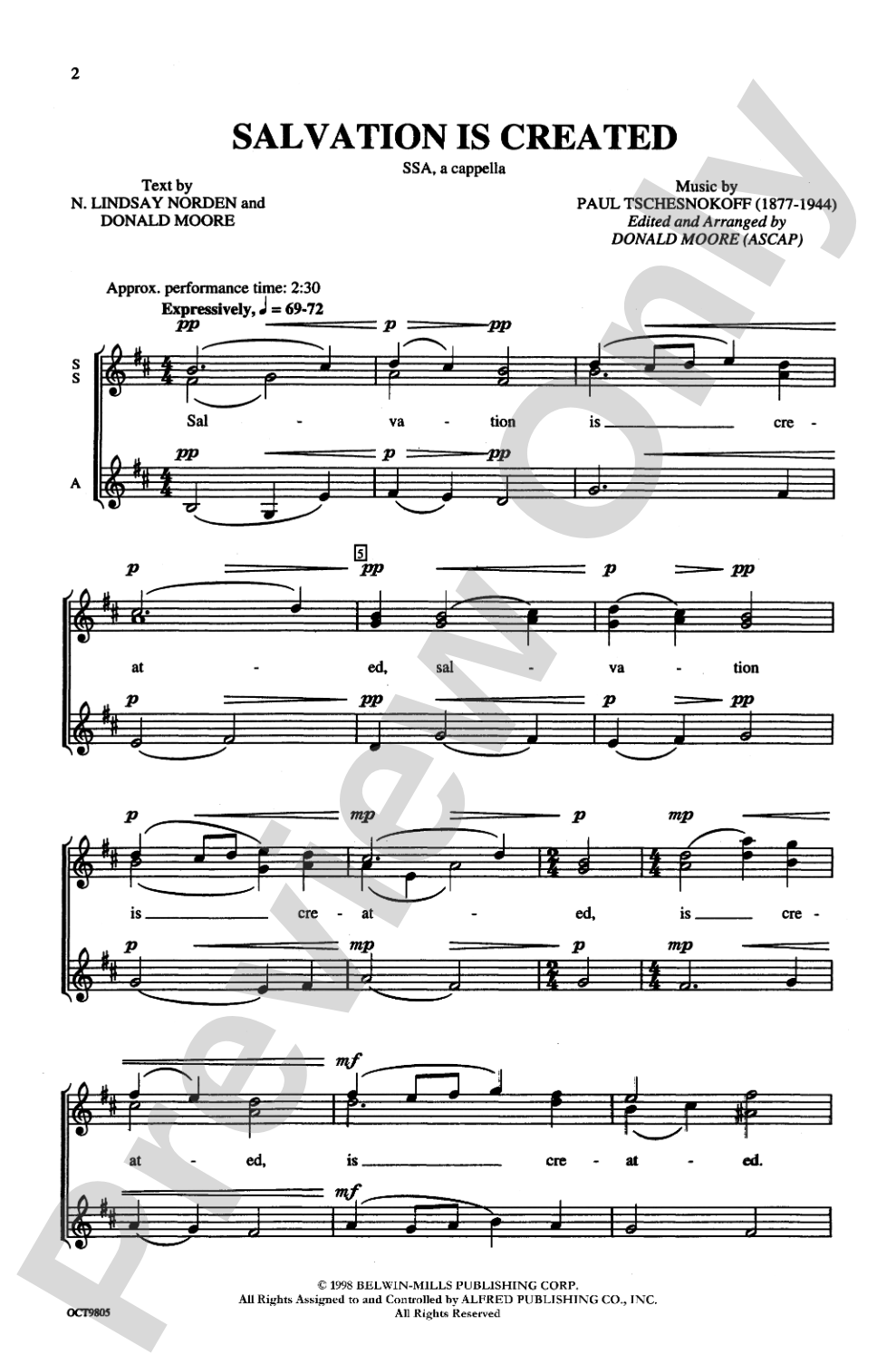

Salvation Is Created: SSA, a cappella Choral Octavo
By Paul Tschesnokoff / ed. and arr. Donald Moore
Item: 00-PO-0005152

$2.25
Minimum order quantity: 20 copies
Pickup currently not available
Description
Some choral pieces speak for themselves! 'Salvation Is Created' is just such a work. Don Moore brings this song into the reach of many choirs who may have been unable to perform the original edition. All of the rich sonorities have been captured in this wonderful new edition. Don't miss this one!


Don't just read it, hear it, play along with it, and watch your students grow with it. In MakeMusic Cloud, Salvation Is Created: SSA, a cappella Choral Octavo comes alive with professional accompaniment, adjustable tempo, and built-in practice tools that turn solo practice into real progress.
Open in the Player
Jump straight in and assign it today.
Start Your Free Trial
Open this title and explore the full library in minutes.
Sample Audio
No sample audio found.
Sample Video
No sample videos found.
Additional Details
Series:
Alfred Archive Edition: Belwin Festival Series
Publisher:
Alfred Music
Page Count:
4
SKU:
00-PO-0005152
More about this title
About the Composer: Paul Tschesnokoff
Paul Tschesnokoff (1877–1944) was a Russian choral composer whose sacred works became cornerstones of the Eastern Orthodox choral tradition. He studied at the St. Petersburg Conservatory and later directed the Court Chapel Choir, positions that shaped his deep understanding of choral sonority and liturgical music.
Tschesnokoff's compositions, particularly his sacred motets, are prized for their rich harmonic language and spiritual depth. 'Salvation Is Created' stands as one of his most performed works, celebrated in choirs worldwide for its accessible yet profound musical expression. His writing continues to challenge and inspire choral musicians across skill levels.
Why we love this
Donald Moore's SSA arrangement opens this Russian sacred masterpiece to choirs without the vocal range or experience needed for the original. The reduction preserves every harmonic color that makes Tschesnokoff's writing distinctive, meaning your singers aren't performing a simplified version but a thoughtfully adapted one. This is the piece many directors want to program but haven't found the right voicing for until now.
What to expect
Luminous and contemplative, with the harmonic richness you'd expect from Russian sacred music compressed into an intimate a cappella texture. Each chord hangs in the air with weight and clarity, creating moments of genuine spiritual presence. The piece builds gradually from restraint to a powerful affirmation, leaving singers and listeners moved by simplicity and depth working in concert.
Who it's for
Directors seeking a major sacred work that sits comfortably in the alto and soprano range without sacrificing musical substance. Festival, concert, and sacred music programs looking for a piece that will impress audiences while remaining achievable for intermediate to advanced choirs.
How to get the most out of it
- Shape phrases through vowel resonance rather than dramatic dynamic shifts. The a cappella texture rewards sustained, pure tone and careful attention to how vowel choices affect blend.
- Work the inner voice movement in rehearsal separately. In an SSA voicing, the alto line carries harmonic weight that can easily disappear if second sopranos aren't singing with confidence and projection.
- Balance the vertical sonorities by testing chords in four-part harmony before adding the full texture. This helps singers hear their role within the harmonic architecture.
- Take time with the piece's cadential moments. These passages reward careful attention to ritard and the shape of the final phrase, which should feel inevitable rather than rushed.
How to use it
This works beautifully on a concert or festival program that pairs sacred music across traditions or time periods. It also serves as an excellent closer for a concert program, offering a contemplative finish that gives an audience time to absorb what they've heard. Consider pairing it with other works in minor keys or pieces that share its meditative quality.
Skills your students will build
- Sustaining pure vowel tone in a cappella singing across extended passages
- Balancing three-part harmony with attention to inner voice independence
- Shaping long phrases through breath placement rather than dynamic swelling
- Understanding Russian choral harmonic language and its distinct color palette
- Achieving blend while maintaining individual line clarity in close voicing