

Rockin' the Baby: 2-Part/SSA Choral Octavo
Music by Sally K. Albrecht
Item: 00-PO-0004492
$2.25
Minimum order quantity: 20 copies
Pickup currently not available
Description
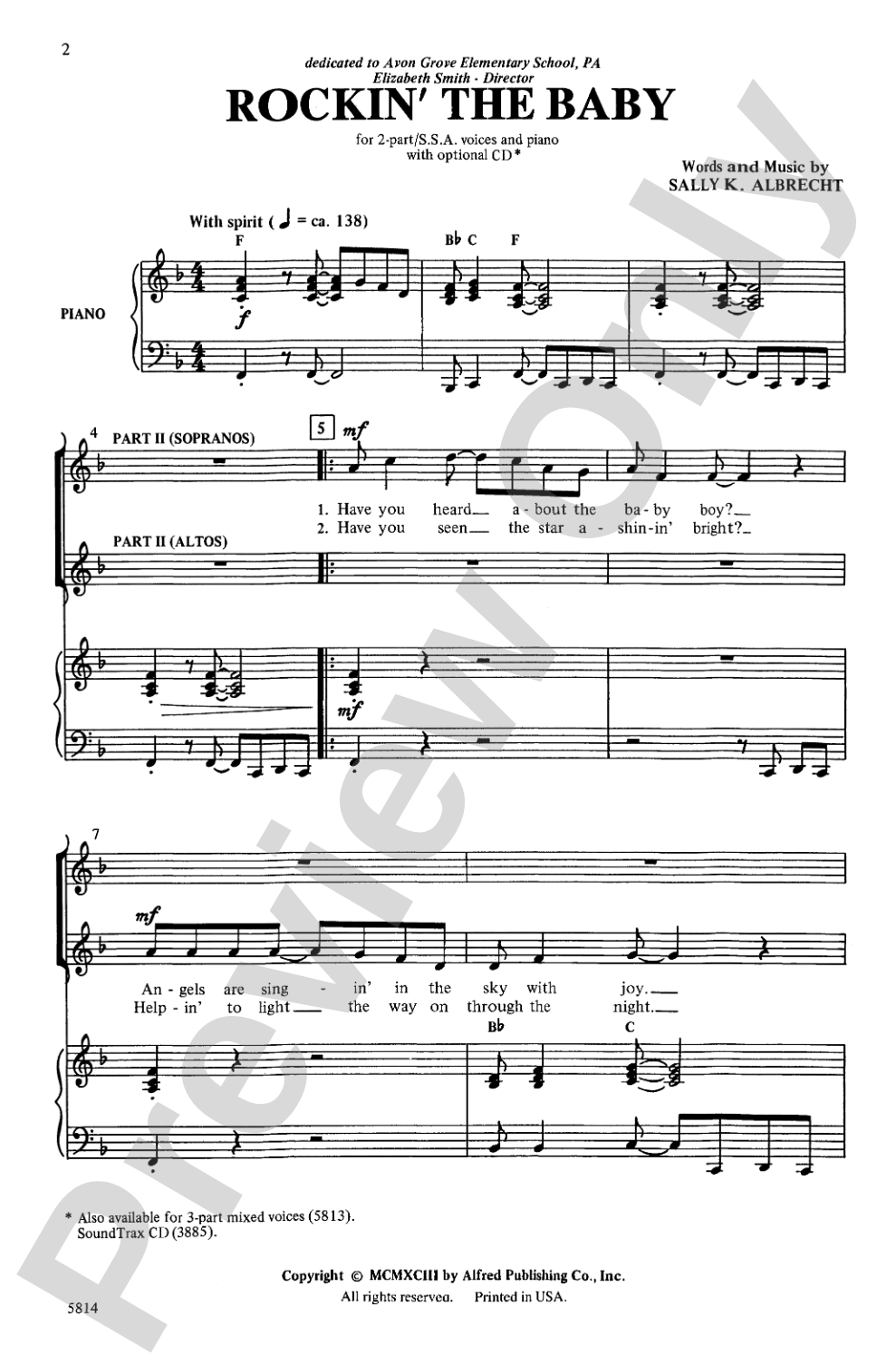
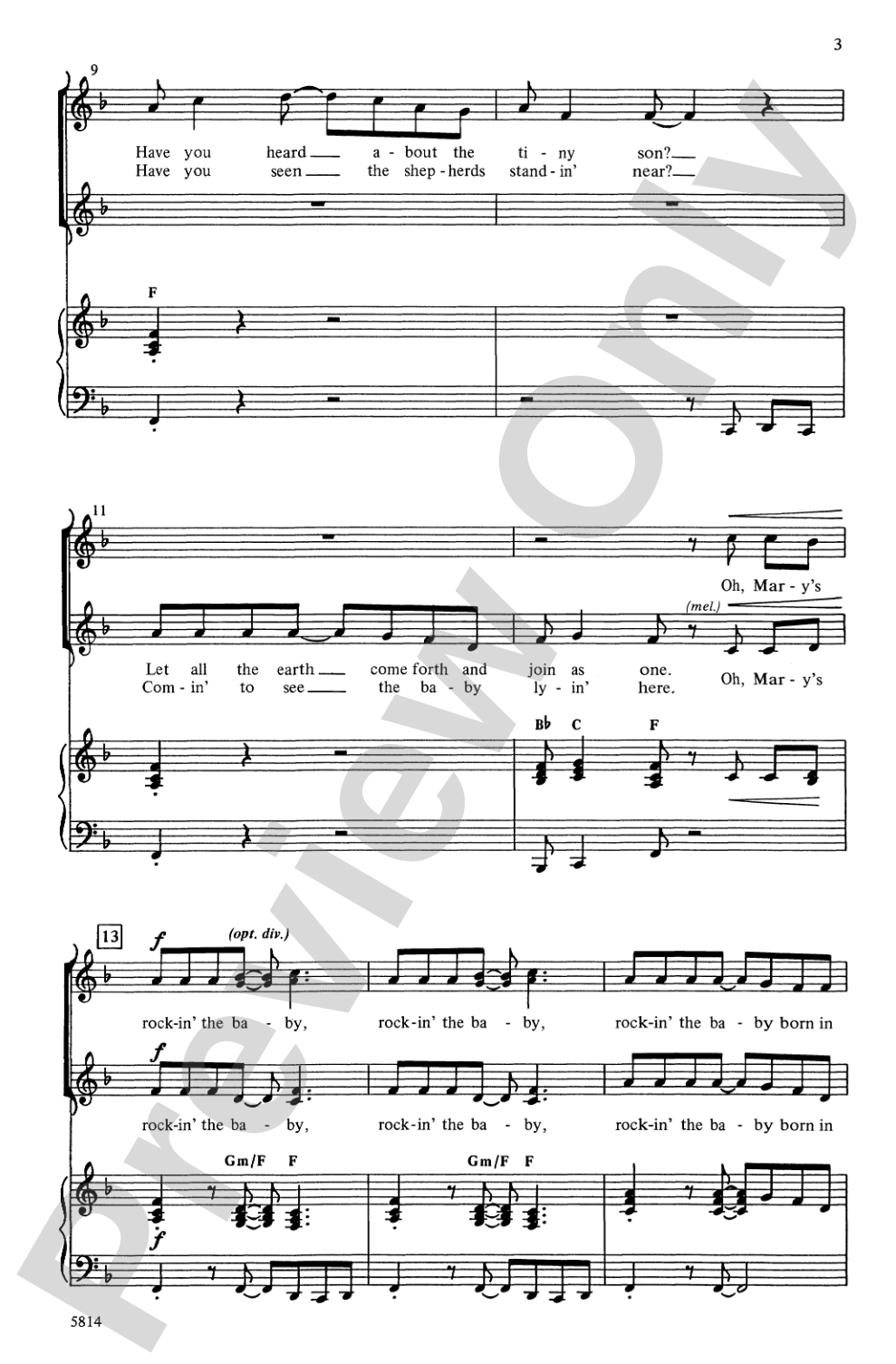
Sally Albrecht has done it again with this catchy, rhythmically rocking (and we don't mean "rock n' roll") Christmas spiritual. The question/answer aspect of the text makes it easy to learn: one part asks a question and the other answers. The parallel chord movement in the chorus is full-sounding and fun to sing. Optional descant.


Rockin' the Baby: 2-Part/SSA Choral Octavo isn't in MakeMusic Cloud just yet...but it could be. Let us know you'd like to see it, and you'll help shape what comes next. In the meantime, start a free trial and dive into thousands of interactive titles your students can play along with today.
Request This Title
Tell us you want it.
Start Your Free Trial
Explore everything that's ready to play right now.
Sample Audio
No sample audio found.
Sample Video
No sample videos found.
Additional Details
Series:
Alfred Archive Edition: Alfred Choral Designs
Publisher:
Alfred Music
Page Count:
8
SKU:
00-PO-0004492
More about this title
About the Composer: Sally K. Albrecht

Sally K. Albrecht has shaped American choral music for over three decades as a composer, conductor, clinician, and publisher. Her catalog exceeds 600 choral works alongside 75 songbooks and musicals, and she has received the ASCAP Special Music Award annually since 1987. She spent more than thirty years leading choral and vocal publications at major educational publishers, most notably as Director of School Choral, Vocal, and Elementary Publications for Alfred Music. Her work as a clinician has taken her to honor choirs and festivals at Lincoln Center, Carnegie Hall, and The Kennedy Center.
Albrecht's background in both music and theater informs her distinctive approach to choral writing, particularly her signature integration of movement with sound. She earned a B.A. in Music and Theater from Rollins College (1976), then continued at the University of Miami, receiving an M.A. in Drama (1977) and an M.M. in Accompanying (1979). She was honored with the Distinguished Alumna Award from both institutions in 2021 and currently serves on Rollins College's Board of Trustees. She lives in Wake Forest, North Carolina, with her husband, composer and arranger Jay Althouse.
Why we love this
Albrecht's clever use of call and response makes this a natural teaching piece; singers internalize the melody and text effortlessly when one section asks and another answers. The rhythmic energy is infectious without veering into secular territory, and the full-sounding parallel harmony in the chorus feels rewarding to perform even with smaller choirs. The optional descant adds flexibility for programs ranging from intimate chapel settings to festive Christmas concerts.
What to expect
The piece rocks with a spiritual authenticity rooted in African American musical tradition while remaining fresh and contemporary. The parallel harmonies in the chorus create a joyful, almost dance-like quality, and the call-and-response structure brings natural warmth and conversation to the ensemble.
Who it's for
This works beautifully for middle school, high school, or community choirs looking for accessible yet musically satisfying Christmas repertoire. The 2-Part/SSA voicing makes it ideal for developing singers, while the optional descant and movement suggestions appeal to more experienced choirs seeking added dimension.
How to get the most out of it
- Emphasize the rhythmic precision in the call and response sections; let the questions land cleanly before answers follow, creating conversation rather than overlap.
- Experiment with adding the suggested movement during rehearsals early on; it reinforces the phrasing and gives singers a physical anchor for the text.
- Balance the descant carefully if your group includes confident higher voices; it should enhance rather than overshadow the main voicing.
- Use the recorded accompaniment to establish the groove and keep the energy consistent across performances, especially if conducting without instrumental musicians.
How to use it
Program this in the heart of a Christmas concert where you want energy and audience engagement; the movement element and rhythmic drive make it a crowd-pleaser between slower, contemplative pieces. It also serves well as a processional or recessional if your staging incorporates movement through the performance space.
Skills your students will build
- Call-and-response singing with clear entrances and releases
- Parallel harmony singing in major chord progressions
- Integration of movement with musical phrasing and rhythm
- Intonation in parts-singing contexts
- Rhythmic independence while maintaining ensemble cohesion