
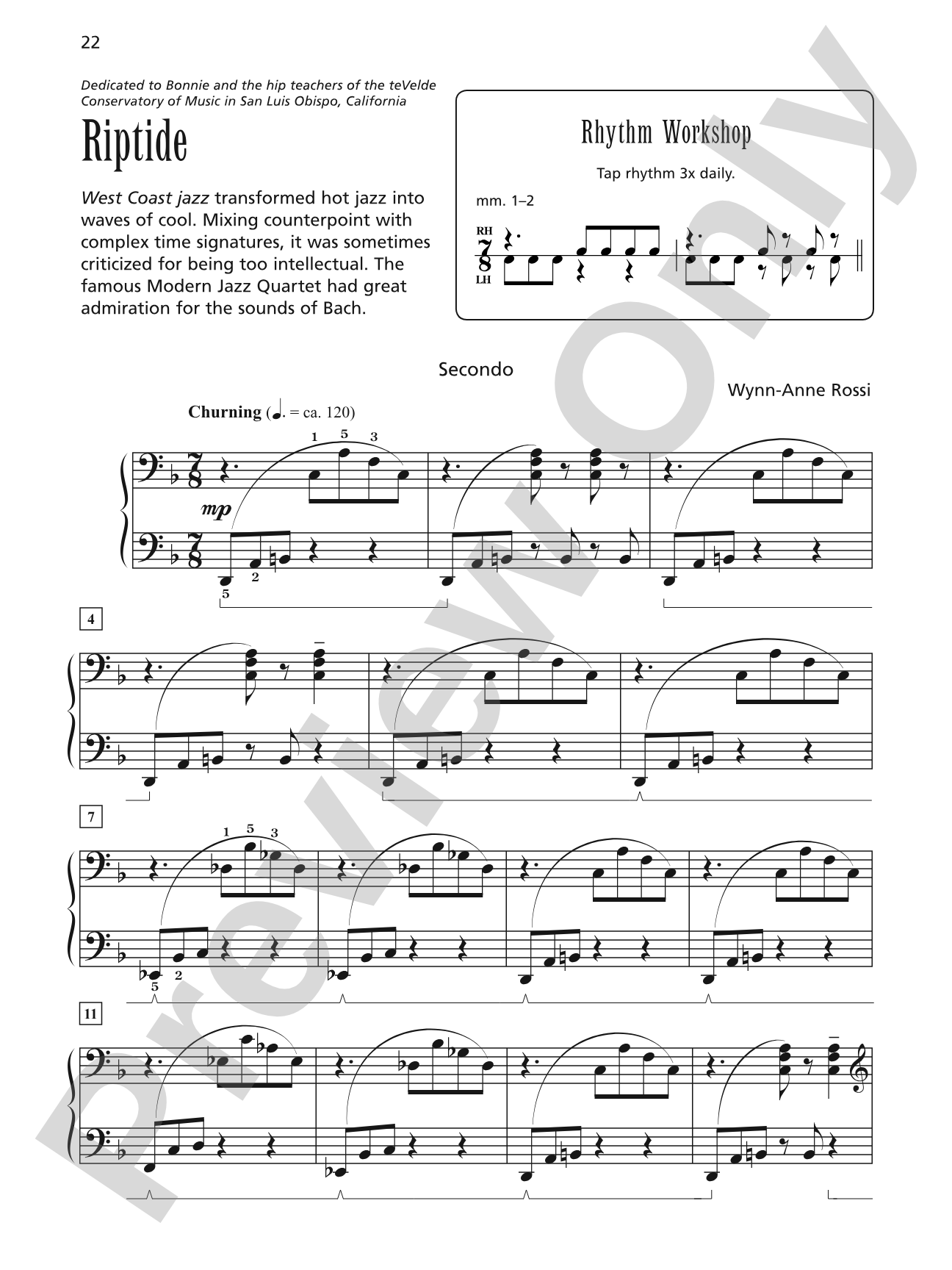
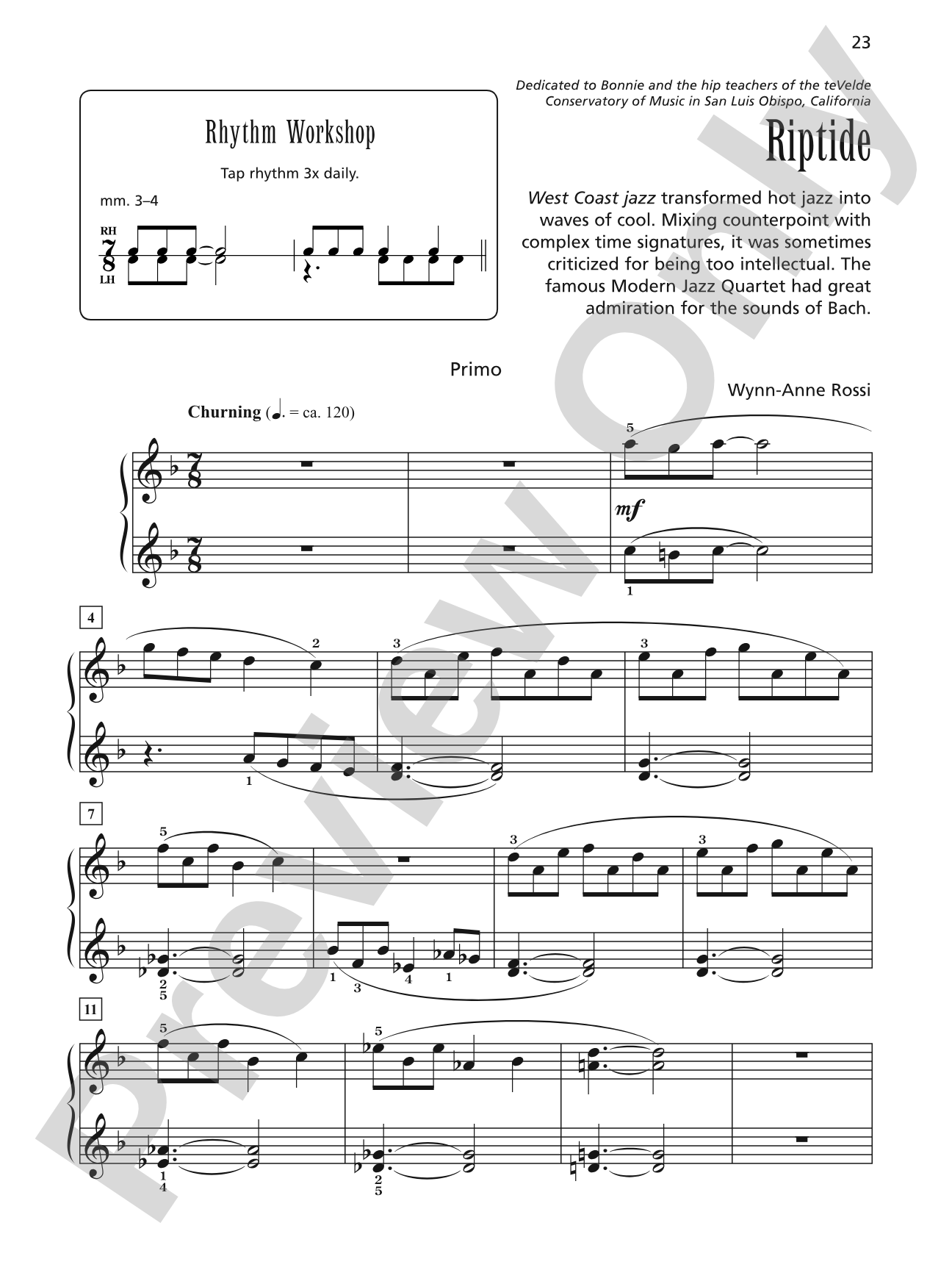

Riptide - Piano Duet (1 Piano, 4 Hands): Piano Duet (1 Piano, 4 Hands)
5 Intermediate to Late Intermediate Piano Duets That Celebrate American Jazz
By Wynn-Anne Rossi
Level: Intermediate / Late Intermediate
Item: 00-PS-0017601
$5.99
Pickup currently not available
Related Items
Mobster Birthday in Stride - Piano Duet (1 Piano, 4 Hands): Piano Duet (1 Piano, 4 Hands) |
$4.99
|
View | |
Trailblazer - Piano Duet (1 Piano, 4 Hands): Piano Duet (1 Piano, 4 Hands) |
$5.99
|
View | |
Wailin' in the Doghouse - Piano Duet (1 Piano, 4 Hands): Piano Duet (1 Piano, 4 Hands) |
$5.99
|
View | |
Waltzing Impressions - Piano Duet (1 Piano, 4 Hands): Piano Duet (1 Piano, 4 Hands) |
$7.99
|
View | |
Jazzin' Americana for Two, Book 3: Piano Duet (1 Piano, 4 Hands) Book |
$7.99
|
View |
Description
Wynn-Anne Rossi's Jazzin' Americana for Two series is a journey through the jazz genre, honoring the history, the diverse styles, and the fabulous musicians who made this music great. Students will become familiar with the names of famous musicians such as Fats Waller, Melba Liston, and Bill Evans while learning different jazz styles, from blues and bebop to boogie and rock. Each duet (for one piano, four hands) is enhanced with interesting facts that will awaken curiosity and enhance the musical experience. Titles: Mobster Birthday in Stride * Riptide * Trailblazer * Wailin' in the Doghouse * Waltzing Impressions. A Federation Festivals 2024-2028 selection.


Discover MakeMusic Cloud: thousands of interactive titles your students can play along with today.
Sample Audio
No sample audio found.
Sample Video
Additional Details
Series:
Jazzin' Americana
Publisher:
Alfred Music
Page Count:
28
SKU:
00-PS-0017601
More about this title
About the Composer: Wynn-Anne Rossi
Wynn-Anne Rossi has built a reputation for creating jazz education materials that honor the genre's rich history while remaining deeply accessible to young musicians. Her approach combines rigorous musical writing with contextual learning, students don't just play the notes; they encounter the stories and figures that shaped American jazz.
Rossi's Jazzin' Americana series reflects her conviction that jazz study belongs in every music classroom. By pairing substantial arrangements with historical annotation, she's created a resource that serves both the ear and the mind, making jazz feel less like a specialized elective and more like a natural evolution of musical literacy.
Why we love this
Four-hand duets solve the ensemble problem in piano studios where sight-reading groups aren't always available. Rossi writes with clear voice independence and genuine jazz vocabulary, no diluted approximations, so students gain authentic musical experience alongside historical knowledge. The Federation selection confirms this isn't supplementary material; it's core repertoire.
What to expect
Riptide carries the restless energy of blues and boogie, there's swagger in the harmony and forward momentum in the rhythmic figures. Playing it feels less like executing notation and more like stepping into a living tradition; you're not just reading a page, you're inhabiting a voice that mattered to real musicians.
Who it's for
Intermediate to late intermediate pianists studying jazz idioms for the first time, or duet partners looking to expand beyond classical arrangements. Teachers programming for festivals, school concerts, or jazz curriculum will find this series particularly valuable because it moves students from listening to jazz to actively performing it.
How to get the most out of it
- Balance the parts dynamically from the start of rehearsal. Four hands often gravitate toward the primo voice; mark clear dynamic layers so the secondo part drives the harmonic foundation without disappearing.
- Anchor tempo through the rhythm section elements first. If this arrangement has walking bass or swing figures, lock those patterns between the two players before layering melody.
- Use the historical context provided in the score as a reference point during performance. When students understand the musician or style they're emulating, the phrasing becomes more intentional.
How to use it
Place this as a bridge between classical piano study and jazz electives. It works equally well as a spring concert feature, a festival entry, or a rehearsal project during a unit on American music. The five titles in the series allow you to program multiple pieces across an academic year without repetition.
Skills your students will build
- Jazz comping and voicing conventions (7th chords, extended harmonies)
- Swing articulation and rhythmic independence between hands
- Blues and boogie bass patterns
- Reading slash chords and jazz lead-sheet notation
- Ensemble listening and balancing within a duet texture
- Historical context connecting musical style to named jazz figures