

Revelation: SATB Choral Octavo
Words by Robert Frost, music by Greg Gilpin
Item: 00-PO-0006960
$2.05
Minimum order quantity: 20 copies
Pickup currently not available
Description
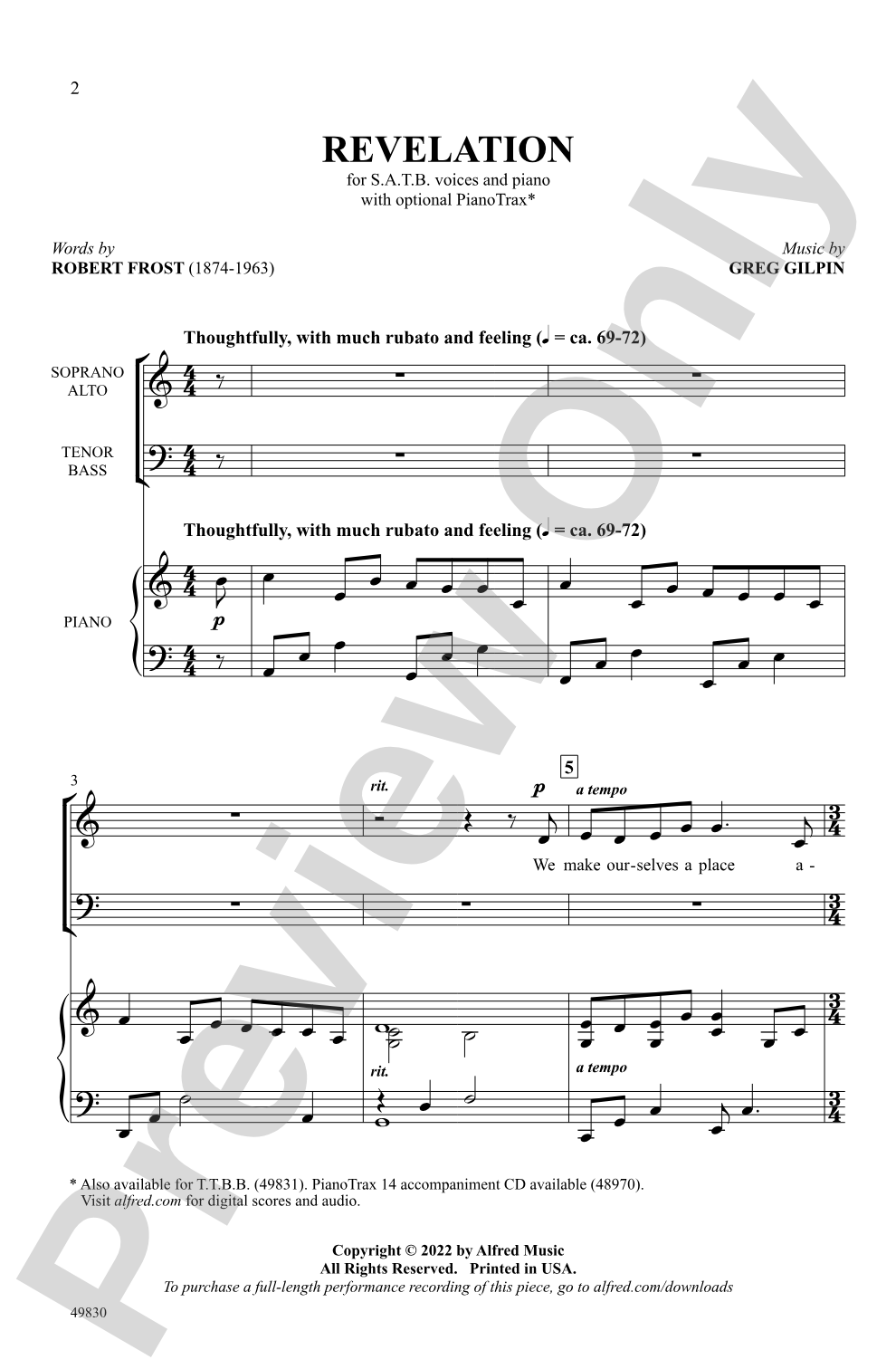
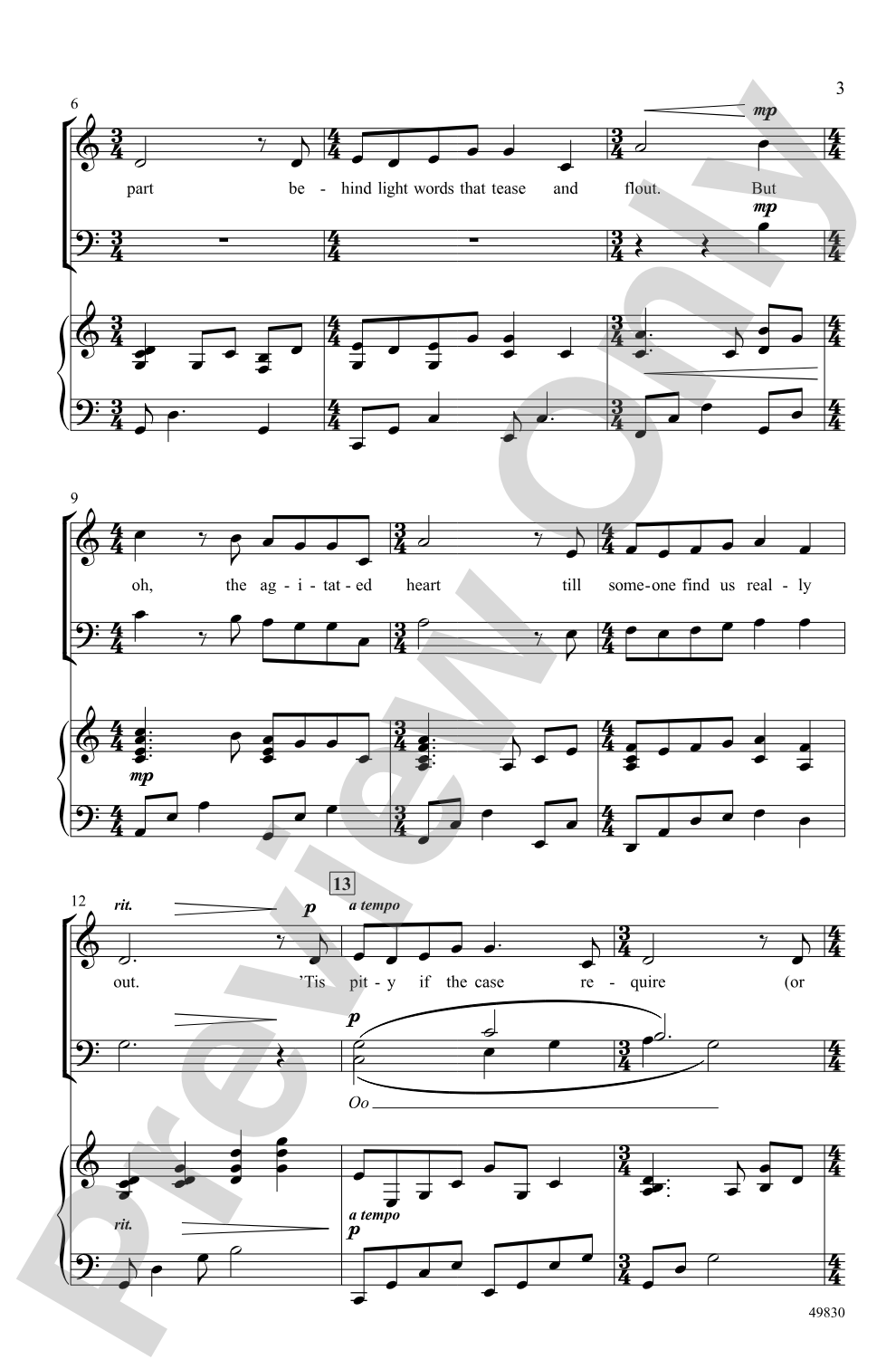
A lesser known yet deeply poignant Robert Frost poem. Greg's emotional choral setting is full of expressive rubato that invites time to thoughtfully process the meaningful words. Changing time signatures make space for effortless phrasing and sensitive syllabic stress. A consistently warm harmonic palette and several fully realized suspensions leave us with a feeling of resolution. An exquisite selection for SATB or TTBB choirs and their responsive accompanists.


Revelation: SATB Choral Octavo isn't in MakeMusic Cloud just yet...but it could be. Let us know you'd like to see it, and you'll help shape what comes next. In the meantime, start a free trial and dive into thousands of interactive titles your students can play along with today.
Request This Title
Tell us you want it.
Start Your Free Trial
Explore everything that's ready to play right now.
Sample Audio
1
Audio File
--:--
0:00
0:00
Sample Video
Additional Details
Series:
Alfred Choral Designs
Publisher:
Alfred Music
Page Count:
8
SKU:
00-PO-0006960
More about this title
About the Composer: Greg Gilpin

Greg Gilpin has established himself as a prolific composer and conductor whose work appears on concert stages across the country. He has led performances at Carnegie Hall, Lincoln Center, and Ryman Auditorium, and his conducting has taken him to renowned venues including the Sydney Opera House, Royal Festival Hall in London, and Harpa Concert Hall in Reykjavik. His contributions to choral music have earned him recognition from ASCAP, and he serves as Director of Educational Choral Publications for Shawnee Press.
Beyond his work in music, Gilpin has pursued ventures in recording production and professional organizing, founded his own organizing business, and scored the award-winning short film "Rosie's Rescue." He remains active as a composer, conductor, and educator, holding memberships in ACDA, NAfME, SAG-AFTRA, and Phi Mu Alpha Sinfonia.
Why we love this
Gilpin's setting elevates a lesser-known Frost poem into something luminous and concert-worthy, with a harmonic language that feels both sophisticated and immediately accessible to singers. The changing meters serve the natural phrasing of the text rather than complicating it, creating moments that feel generous and unrushed. This is the kind of piece that singers will want to perform again, and audiences will remember.
What to expect
Introspective and considered, like sitting with a poem that reveals something new with each reading. The harmonic language is warm and generous, with suspended chords creating moments of gentle tension that resolve into calm acceptance. Time feels spacious here, and each word lands with intention.
Who it's for
SATB and TTBB choirs seeking a sophisticated secular work that speaks to contemplative texts and honors poetic nuance. This piece works equally well in concert and festival settings for choirs with strong sight-reading skills and responsive accompanists who can follow the expressive rubato.
How to get the most out of it
- Honor the expressive rubato notated throughout; resist locking into a rigid pulse, especially where suspensions resolve. Let the harmonic movement breathe and guide your tempo choices.
- Shape each phrase syllabically, allowing the text stress to fall naturally. Gilpin's meter changes are there to support this phrasing, not to fight it.
- Balance the warm harmonic palette by keeping vowel sounds consistent across voice parts. Blend is essential; a soloist's approach here will cloud the suspended chord resolutions.
How to use it
Program this alongside other Gilpin works or other poetic settings that share a contemplative mood; it pairs well with pieces that value text clarity and harmonic sophistication. It makes an excellent centerpiece for a concert themed around American poetry or a festival program that celebrates literary art song in choral form.
Skills your students will build
- Reading and singing through changing time signatures (including 3/4 and 4/4) without losing harmonic awareness
- Voicing and balancing suspended chords and extended harmonies
- Responding to expressive rubato and following a conductor's interpretation of tempo flexibility
- Projecting meaning through syllabic stress and natural phrase shapes
- Part independence while maintaining blend across the harmonic spectrum