
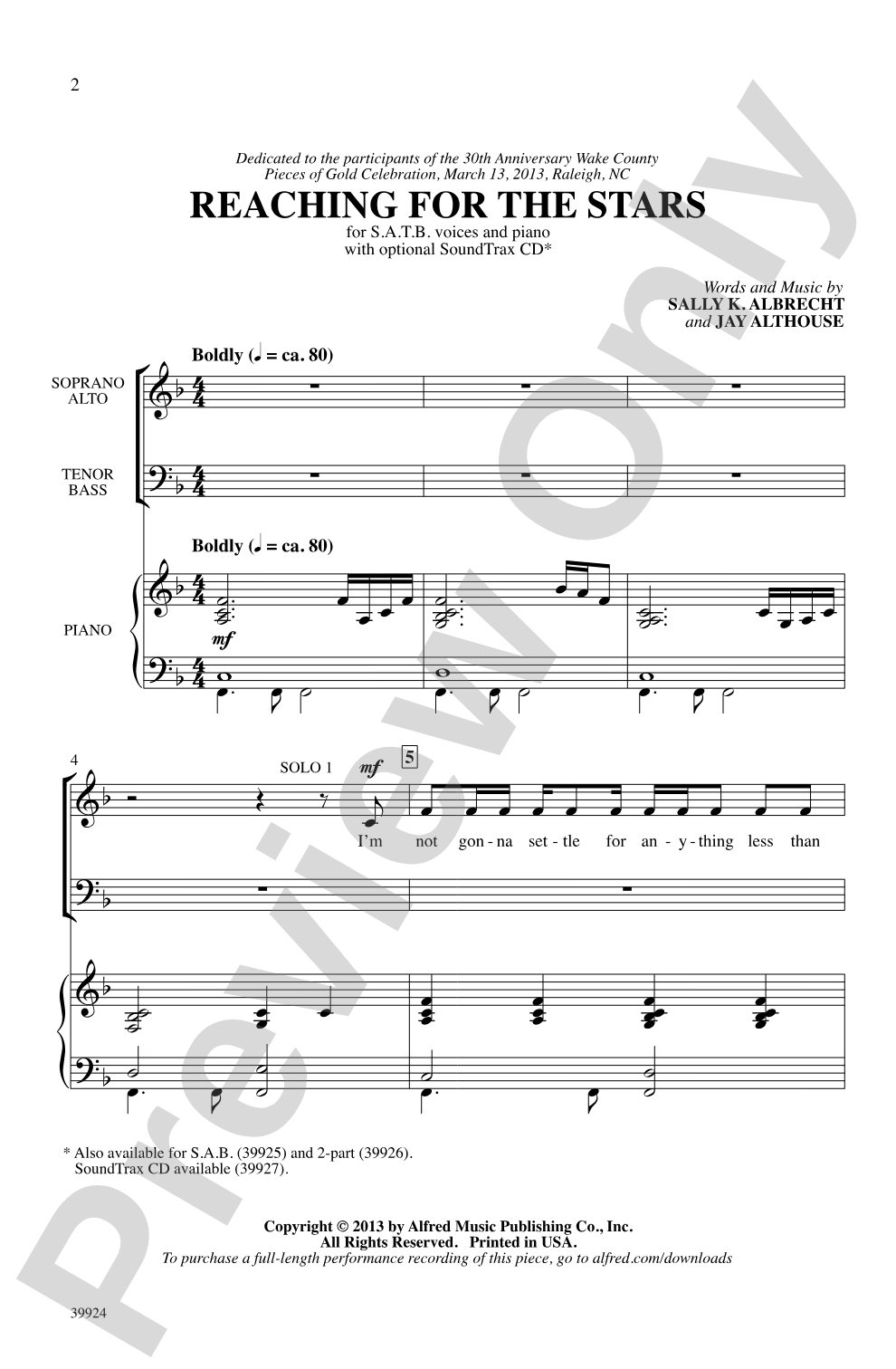
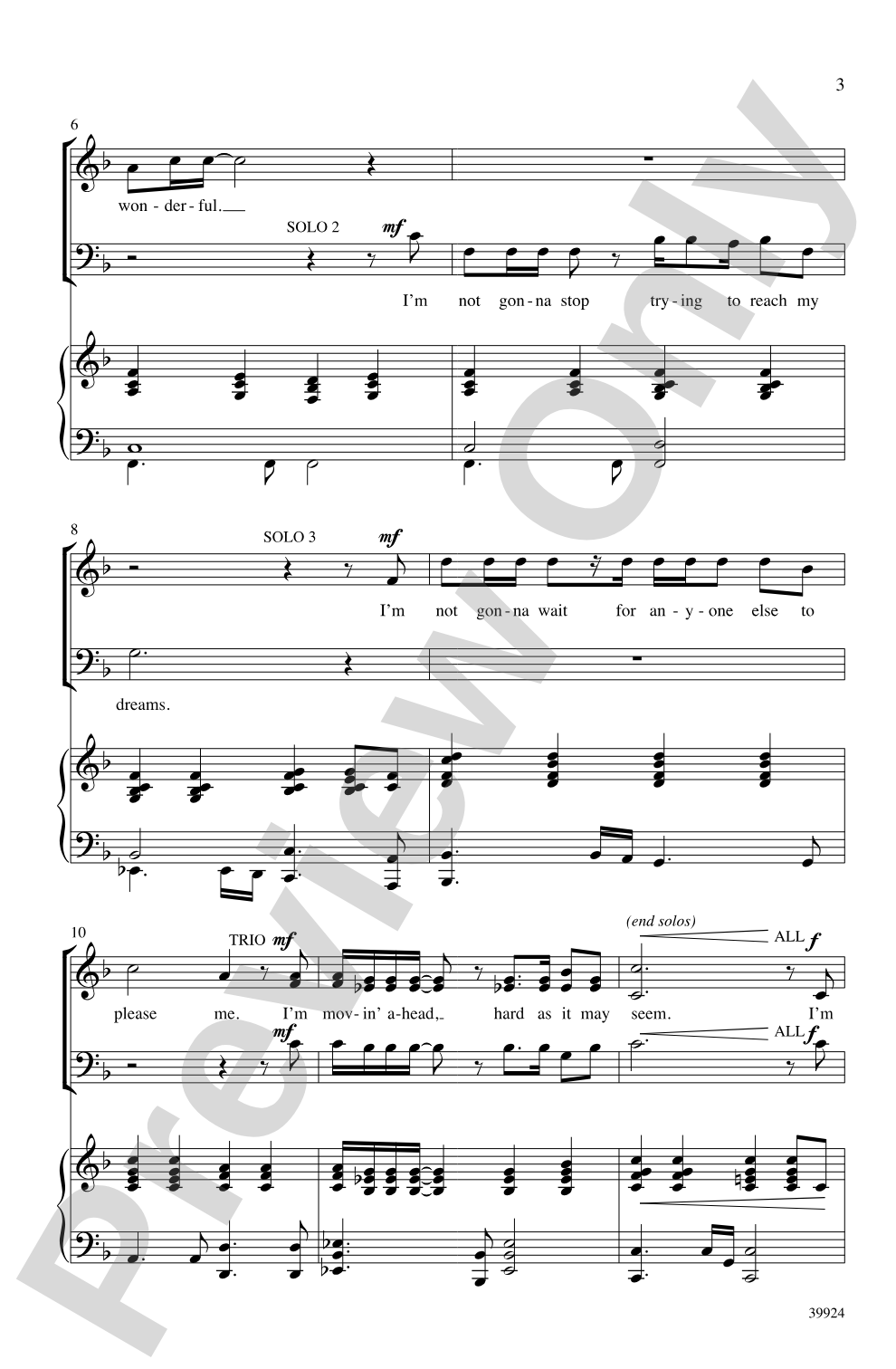

Reaching for the Stars: SATB Choral Octavo
Words and music by Sally K. Albrecht and Jay Althouse
Item: 00-PO-0001705
$1.85
Minimum order quantity: 20 copies
Pickup currently not available
Related Items
Reaching for the Stars: SoundTrax Digital Audio Download |
$27.99
|
View | |
Reaching for the Stars: SAB Choral Octavo |
$1.85
|
View | |
Reaching for the Stars: 2-Part Choral Octavo |
$1.85
|
View | |
Reaching for the Stars: 2-Part Choral Octavo |
$1.85
|
View | |
Reaching for the Stars: Choral Octavo SoundTrax CD |
$27.99
|
View |
Description
Here's the ultimate motivational choral, perfect as a closer, especially for year-end concerts and graduation events. "I'm not gonna stop trying to reach my dreams." Featured on "Reaching for the Stars" choral movement DVD 00-39928. Check this out! https://leapingbrain.com/modshop/product/?shop=9&product=5690


Reaching for the Stars: SATB Choral Octavo isn't in MakeMusic Cloud just yet...but it could be. Let us know you'd like to see it, and you'll help shape what comes next. In the meantime, start a free trial and dive into thousands of interactive titles your students can play along with today.
Request This Title
Tell us you want it.
Start Your Free Trial
Explore everything that's ready to play right now.
Sample Audio
1
Audio File
--:--
0:00
0:00
Sample Video
No sample videos found.
Additional Details
Series:
Alfred Choral Designs
Publisher:
Alfred Music
Page Count:
12
SKU:
00-PO-0001705
More about this title
About the Composer: Sally K. Albrecht
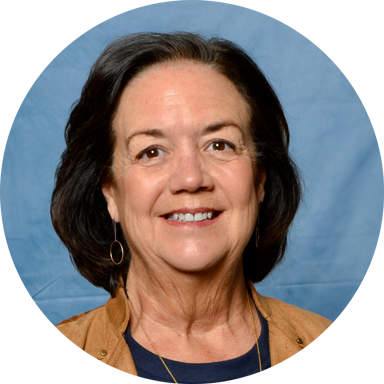
Sally K. Albrecht has shaped American choral music through three decades of publication work at major educational publishers, most recently as Director of School Choral, Vocal, and Elementary Publications at Alfred Music. A conductor, clinician, and prolific composer, she has received the ASCAP Special Music Award annually since 1987 and maintains over 600 published choral works in print. Her expertise extends to choral movement and staging; she has conducted honor choirs at Lincoln Center, Carnegie Hall, and The Kennedy Center.
Albrecht holds degrees from Rollins College (B.A. in Music and Theater, 1976), the University of Miami (M.A. in Drama and M.M. in Accompanying), and has taught at Oakland University, Jersey City State College, and Meredith College. In 2021, she received the Distinguished Alumna Award from both the University of Miami Frost School of Music and Rollins College, where she serves on the Board of Trustees.
Why we love this
Albrecht and Althouse craft a piece that lands exactly where graduation programs need it: emotionally resonant without overwrought, singable throughout all four parts, and built for movement without requiring elaborate staging. The message of persistence feels earned rather than preachy, and the 12-page octavo fits naturally into year-end concerts alongside more traditional repertoire.
What to expect
Hopeful and determined, with a pulse that feels like forward momentum. The piece sits in that sweet spot between inspirational anthem and honest reflection on the effort required to pursue dreams. It builds energy without aggression and lands with genuine uplift rather than false cheeriness.
Who it's for
Directors programming year-end concerts, graduation ceremonies, or spring celebration concerts who need a contemporary secular piece with genuine emotional impact. This works for developing choirs through advanced ensembles; the message and melody are accessible, but the four-part writing and ensemble coordination demand solid fundamentals.
How to get the most out of it
- Use the movement suggestions in the octavo to add visual dimension; even simple, synchronized gestures during the refrain strengthen the piece's motivational message without demanding choreography expertise.
- Balance the melody with supporting voices, particularly in SATB passages where tenors and altos might sit back. The strength of the piece depends on all four parts equally present.
- Lock the climactic sections (refrain repeats) with strong diction on consonants like the opening of 'reach' and 'trying,' which drive the song's energy forward.
How to use it
Close a concert with this as your final number after lighter or more classical repertoire; the contemporary idiom and aspirational text provide natural closure for graduation or year-end events. It also pairs well in a finale sequence where you're layering contemporary and traditional pieces around a thematic arc.
Skills your students will build
- Four-part SATB balance and blend across mixed voicing
- Singing rhythmically independent lines while maintaining harmonic cohesion
- Coordinating movement with ensemble singing and ensemble timing
- Interpreting and expressing contemporary secular text with emotional authenticity
- Building and sustaining energy through climactic sections and final statements