

Psallite (Sing): 3-Part Mixed Choral Octavo
By Michael Praetorius / arr. John Leavitt
Level: Moderately Easy
Item: 00-PO-0005232
$2.25
Minimum order quantity: 20 copies
Pickup currently not available
Description
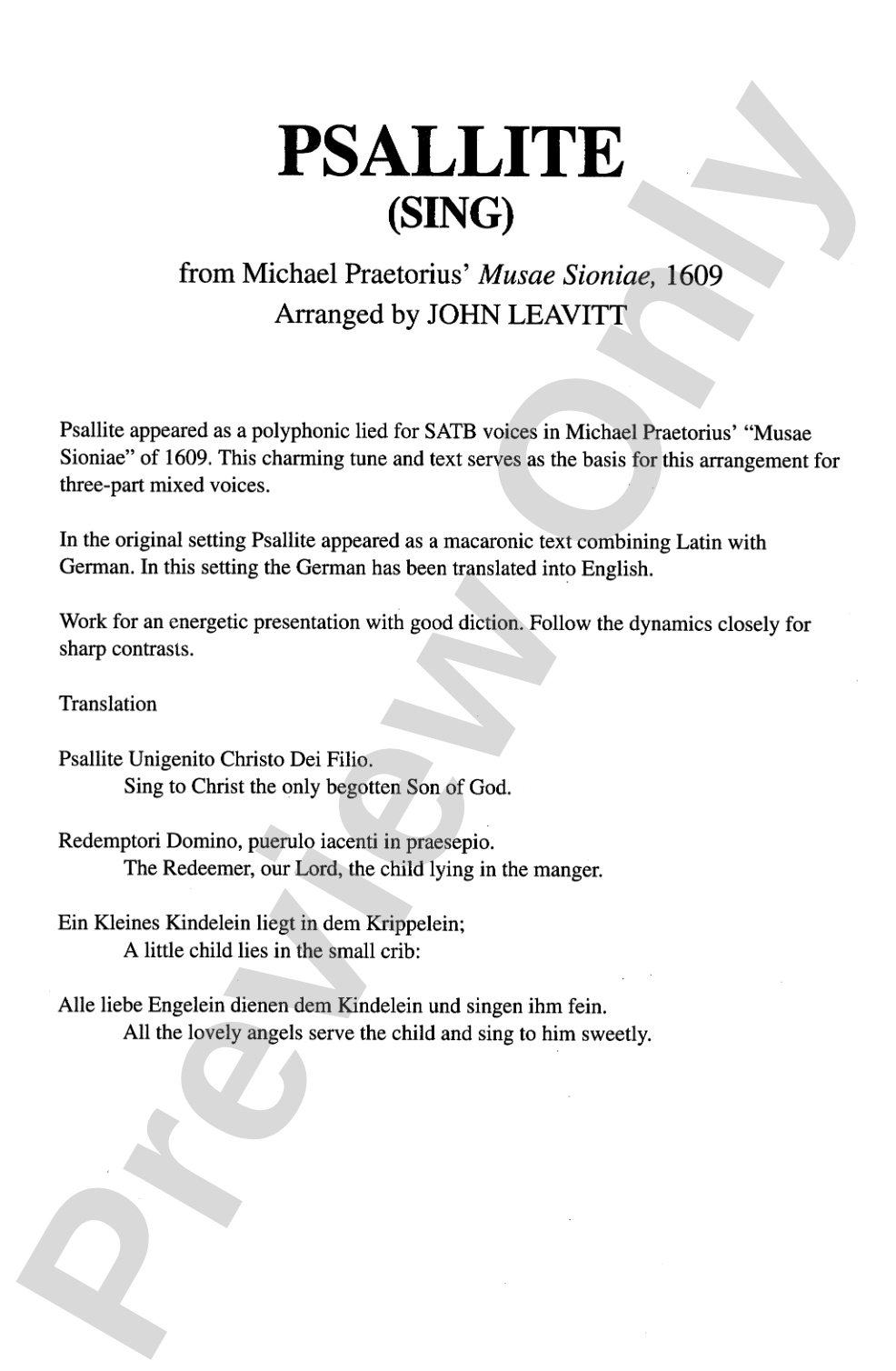
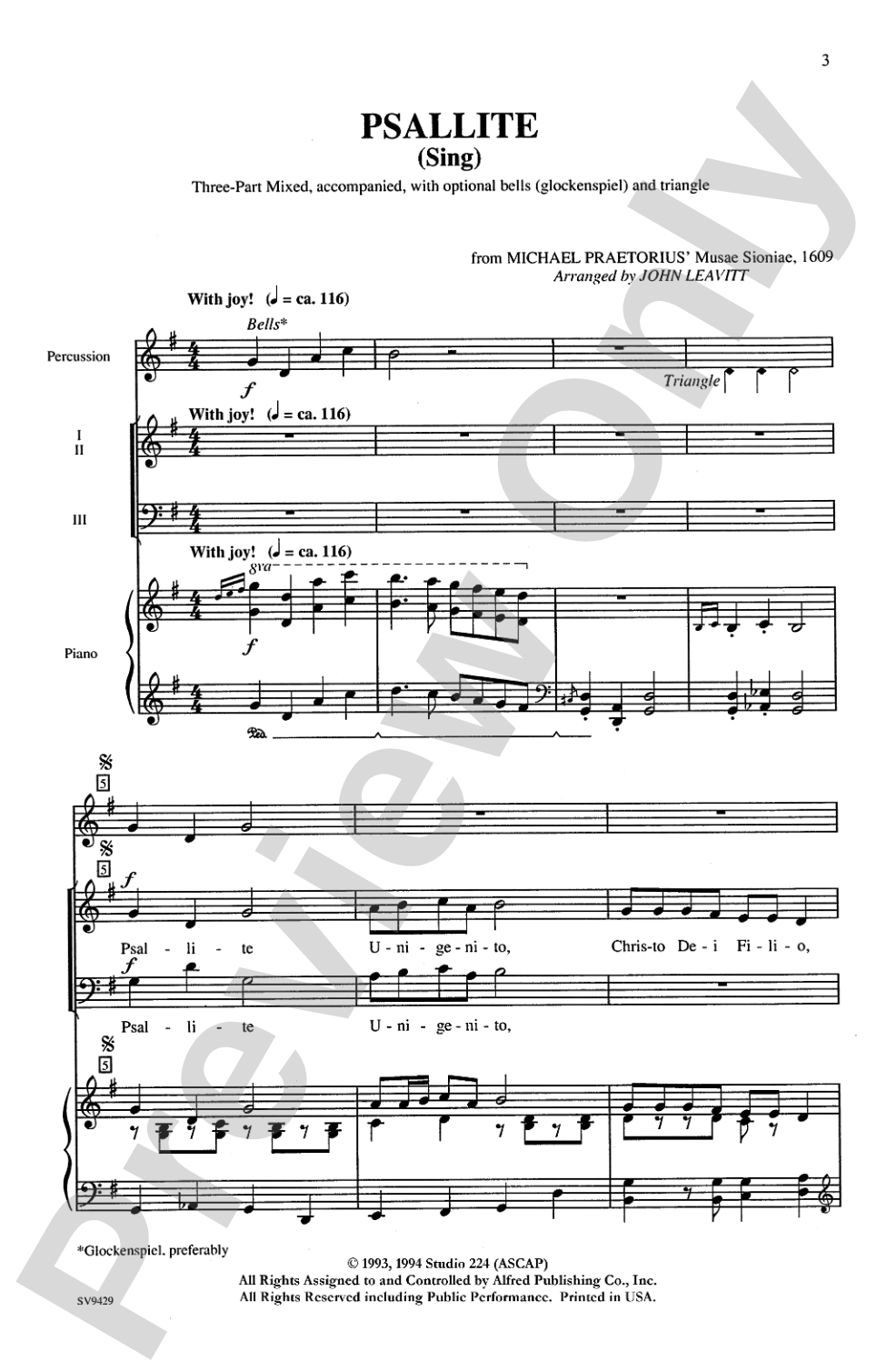
John's inventive two-part setting was so successful in 1993, he has added a three-part mixed setting. Latin and English text. A fun work with an exciting accompaniment.


Psallite (Sing): 3-Part Mixed Choral Octavo isn't in MakeMusic Cloud just yet...but it could be. Let us know you'd like to see it, and you'll help shape what comes next. In the meantime, start a free trial and dive into thousands of interactive titles your students can play along with today.
Request This Title
Tell us you want it.
Start Your Free Trial
Explore everything that's ready to play right now.
Sample Audio
No sample audio found.
Sample Video
No sample videos found.
Additional Details
Series:
Alfred Archive Edition: Studio PR Catalog
Publisher:
Alfred Music
Page Count:
12
SKU:
00-PO-0005232
More about this title
About the Composer: Michael Praetorius
Michael Praetorius (1571-1621) was a prolific German composer whose vast output spanned sacred and secular music across the Renaissance and early Baroque periods. His works, particularly his chorale settings and motets, became foundational to Protestant church music and remain central to choral repertoires today.
Preaetorius documented his compositional practices and music theory in extensive writings, making him not only a master craftsman but also a crucial historical voice on Renaissance performance practice. His melodies are direct, memorable, and deeply singable—qualities that have ensured his choral works endure in classrooms and concert halls for over four centuries.
Why we love this
John Leavitt's three-part arrangement captures everything that makes Praetorius essential repertoire: a melody that sits beautifully in the SAB range, text that alternates between Latin and English, and an accompaniment that drives the piece forward without overwhelming young singers. This is the kind of repertoire that teaches singers how to balance simplicity with authentic early music style.
What to expect
Psallite radiates joy and invitation. The melody feels almost like a call and response between singers and accompaniment, with enough rhythmic vitality to keep energy alive across all three parts. There's a directness here, a quality of honest expression, that makes the piece feel both ancient and immediate.
Who it's for
This octavo works well for middle school and high school choirs seeking accessible Renaissance repertoire with genuine pedagogical depth. It's equally valuable for community choirs and church ensembles looking to expand their early music offerings without sacrificing singability.
How to get the most out of it
- Keep the articulation crisp and even across all three parts, especially where the parts move together. The excitement comes from rhythmic precision and clarity, not from pushing tempo.
- Let the accompaniment establish the harmonic foundation and rhythmic pulse; singers should listen to it as an equal partner rather than competing for attention.
- Shape each phrase with gentle dynamic arcs rather than singing at one volume throughout. The text naturally suggests where breath and musical breathing should occur.
How to use it
Use this as a bridge between holiday programming and year-round early music study. Its Christmas connection gives it seasonal relevance, but the arrangement's moderate difficulty and mixed voicing make it flexible enough to program alongside other masterwork arrangements in spring concerts or choral festivals.
Skills your students will build
- Reading three independent vocal lines in SAB voicing
- Balancing part independence with harmonic blend
- Handling text in two languages (Latin and English)
- Listening to keyboard accompaniment as structural support while maintaining vocal independence
- Understanding Renaissance text declamation and phrasing