
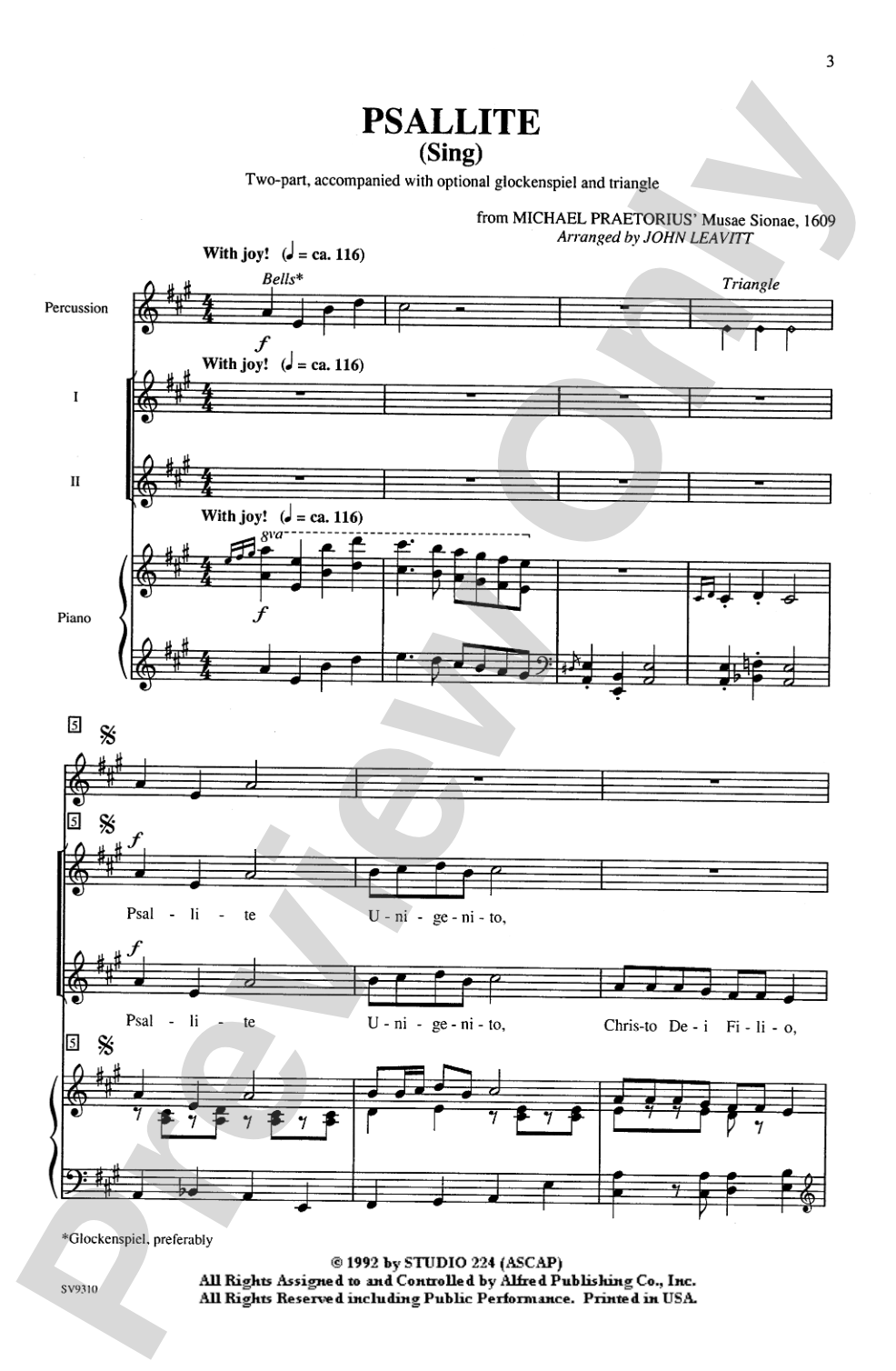
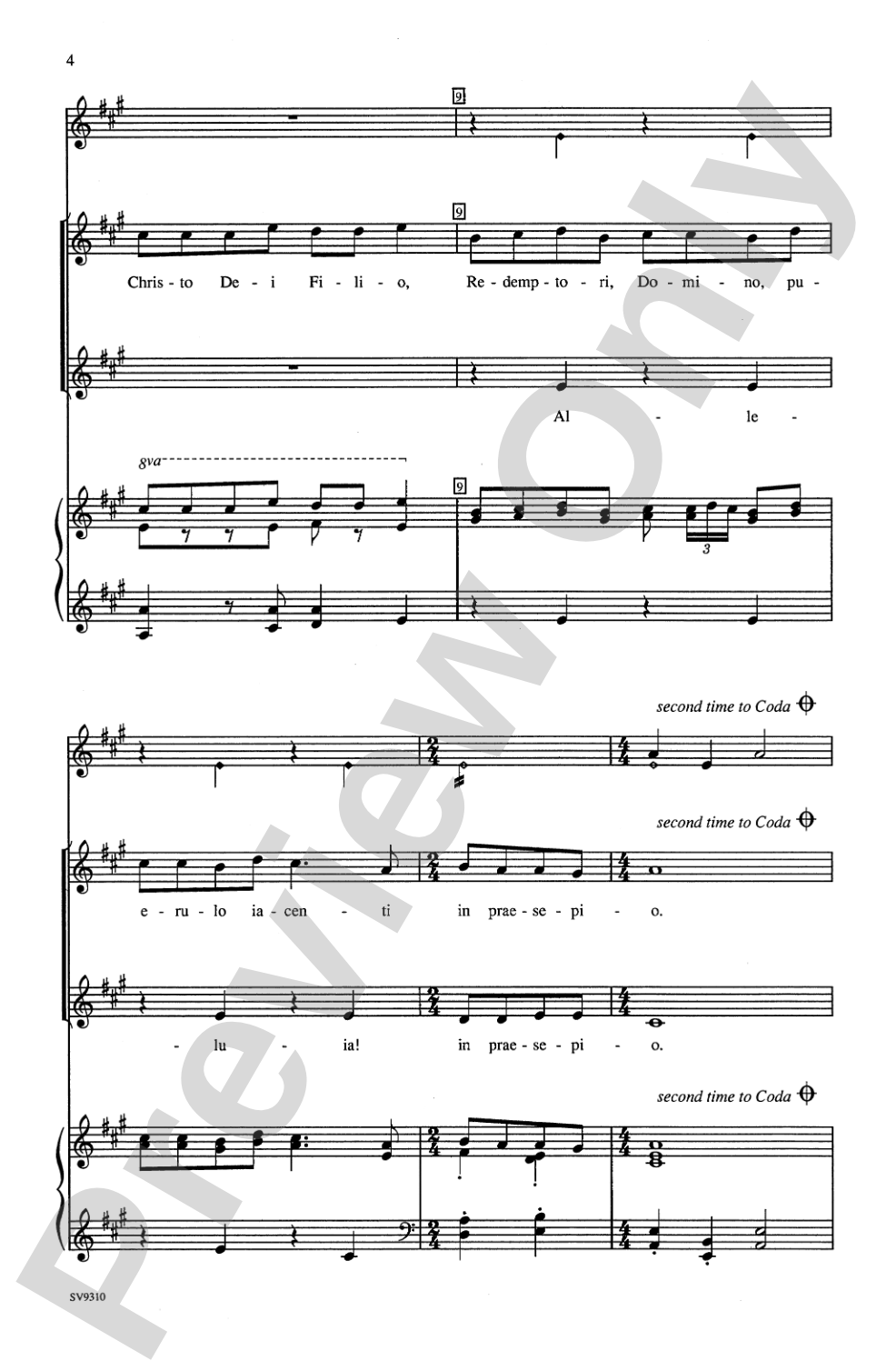

Psallite (Sing): 2-Part Choral Octavo
By Michael Praetorius / arr. John Leavitt
Level: Moderately Easy
Item: 00-PO-0005226
$2.25
Minimum order quantity: 20 copies
Pickup currently not available
Description
John's inventive two-part setting was so successful in 1993, he has added a three-part mixed setting. Latin and English text. A fun work with an exciting accompaniment.


Psallite (Sing): 2-Part Choral Octavo isn't in MakeMusic Cloud just yet...but it could be. Let us know you'd like to see it, and you'll help shape what comes next. In the meantime, start a free trial and dive into thousands of interactive titles your students can play along with today.
Request This Title
Tell us you want it.
Start Your Free Trial
Explore everything that's ready to play right now.
Sample Audio
No sample audio found.
Sample Video
No sample videos found.
Additional Details
Series:
Alfred Archive Edition: Studio PR Catalog
Publisher:
Alfred Music
Page Count:
12
SKU:
00-PO-0005226
More about this title
About the Composer: Michael Praetorius
Michael Praetorius (1571-1621) was a German composer, theorist, and music director whose output spanned the late Renaissance and early Baroque periods. His vast catalog includes sacred vocal music, instrumental works, and theoretical writings that shaped music pedagogy for centuries. Praetorius had a gift for crafting accessible yet musically sophisticated settings that could serve both liturgical and devotional purposes, making his work enduringly popular in choral curricula.
His most famous collection, Terpsichore, compiled hundreds of instrumental dances and songs that demonstrated his command of melody and rhythmic vitality. Praetorius's approach to composition valued singability and clear harmonic structure, qualities that have allowed his music to remain relevant for student choirs and church ensembles worldwide.
Why we love this
John Leavitt's two-part arrangement captures the jubilant spirit of Praetorius's original while making it genuinely accessible for younger or less experienced choirs. The Latin and English text creates a bridge between sacred tradition and contemporary classroom engagement, and the accompaniment is energetic without overwhelming singers still building ensemble confidence.
What to expect
Psallite sparkles with Renaissance joy and baroque momentum. The simple two-part texture and bilingual text create an immediate sense of celebration, while the rhythmic drive of the accompaniment propels singers forward with infectious energy.
Who it's for
This arrangement suits developing choirs in grades 4 and up, including church choirs, school ensembles, and community groups with mixed ages or abilities. Singers benefit from straightforward part-writing and an energizing accompaniment that sustains their interest without requiring sophisticated reading skills.
How to get the most out of it
- Balance the parts by encouraging the lower voices to sing with full support; the second part can disappear too easily if it lacks projection.
- Use the rhythmic drive of the accompaniment as your rehearsal anchor, drilling the piece with piano or accompaniment track to lock the ensemble into the pulse.
- Shape phrases within the text rather than allowing the repeating musical material to flatten; even a simple two-part texture benefits from breath and arrival points.
- Blend articulation choices between parts so diction lands together on shared consonants, especially during the faster sections of the accompaniment.
How to use it
This works beautifully in December concert programming alongside other sacred and secular seasonal work, or in spring festivals celebrating masterworks and arrangements. Its moderate difficulty and festive character make it an excellent closer for a program segment, leaving the audience energized.
Skills your students will build
- Reading two-part writing with divided soprano and alto or soprano and tenor voicings
- Singing Latin pronunciation and English text alignment
- Maintaining rhythmic independence while following accompaniment
- Building ensemble blend and balance across parts